
Flashcards
Aqueous Systems 3.6
Flashcards do conjunto (65)
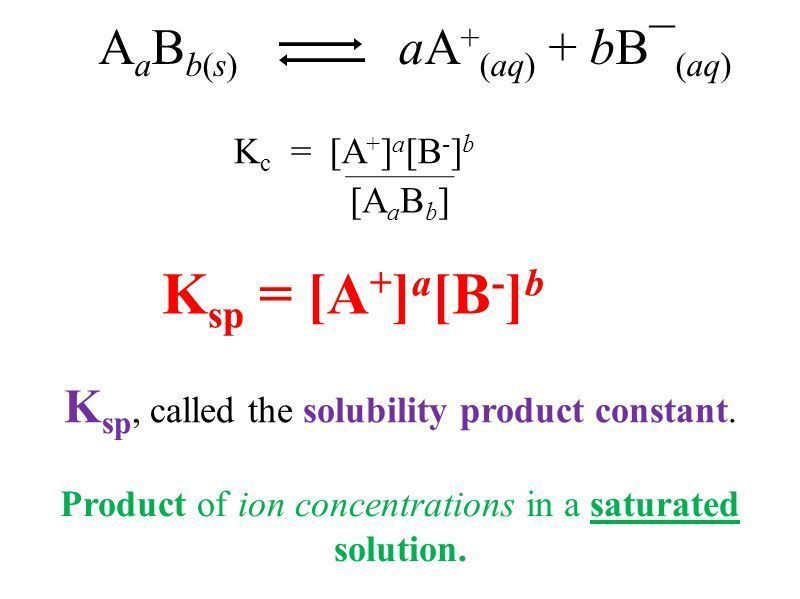
- 1Solubilityhow much of an ionic compound will dissolve in a solution
e.g salt dissolving in water - 2Solubility is measured inunits: g L-1 or mol L-1
(grams per litre or mols per litre) - 3Ks the constant of the equilibrium of a saturated solution of sparingly soluble compounds has no units
- 4Saturated solutionmaximum amount of solid dissolved particles
- 5Dis the dissolving of a solid (solute e.g salt) in a solution (solvent e.g water)
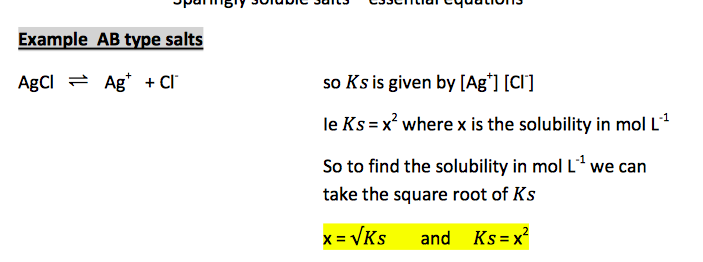
- 6Calculating Ks, given solubility of a 1:1 Of 1 mol of A+ and 1 mol of B-Ks= [A+]x[B-]
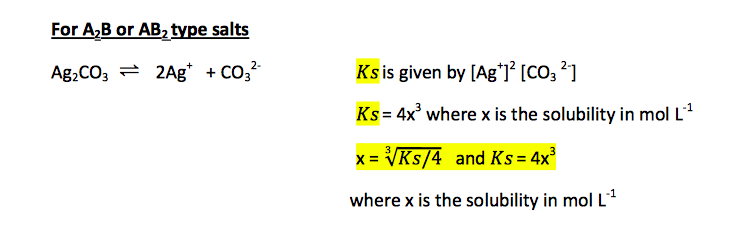
- 7Calculating Ks, given solubility of a 2:1 Of 1 mol of A+ and 2 mol of B- or vice versaKs= [A+]x[B-]^2 (B- is squared)
expression used: 4s^3 - 8Calculating s, given Ks of a 2:1 Of 1 mol of A+ and 2 mol of B- or vice versause rearranging to find s
- 9Calculating s, given Ks of a 1:1 Of 1 mol of A+ and 1 mol of B- or vice versause rearranging to find s
- 10Calculating ion conc given Ks steps1: write equilibrium equation
2: write Ks expression
3: calculate s
4:relate ion conc to s - 11Calculating Ks from solubility given in gL-1 (grams per litre) steps1: convert s to molL-1 (mol per litre)
2: write equilibrium equation
3: write equilibrium expression
4: substitute s for Ks by using expression Ks=s^2
5:find the answer - 12gL-1 convert to mol L-1s conc in gL-1
___________________
g molL-1 (molar mass) - 13Calculating molesnumber of moles (mol) = g
---------------
g mol -1 - 14calculating concentrationconcentration (C) = mol
-----------
V
note: volume is always measured in L (conversion may be needed, divide mL by 1000) - 15calculating Ks given mass and volume steps1: calculate moles
2:calculate conc
3:calcuate ion conc
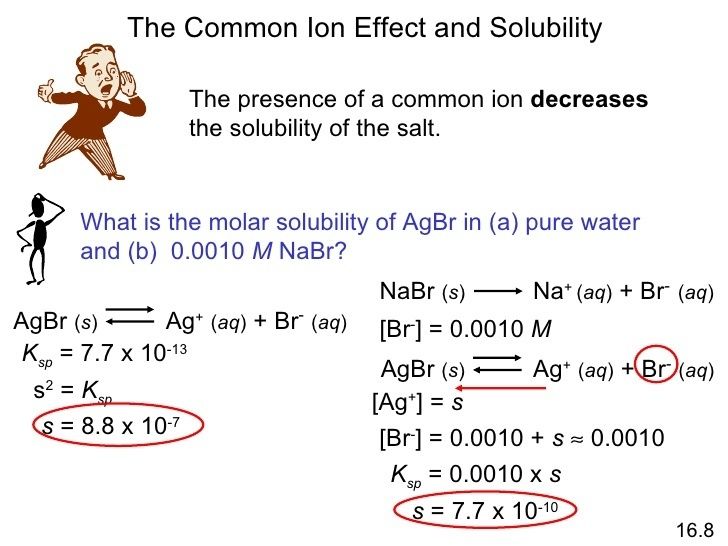
4: write expression for Ks - 16Common ion effectionic compound added to a solution that already contains the same compound (common ion effect) reduces solubility
- 17Reduced solubilitymeans that the solid won't fully dissolve in a solution
- 18Increased solubilitymeans that the solid will dissolve in a solution
- 19Calculating solubility in solutions with common ion
- 20Common ion calculations when solutions are mixed steps1: calculate the new conc
og conc x initial volume
--------------------
total volume
2: write ks expression
3: rearrange to solve for non- common ion conc - 21Ionic product apples to solution of any solute concentrationIP is calculated the same as Ks
- 22Predicting Precipitationprecipitate (ppt) forms when solutions of ionic compounds are mixed or when a solid ionic compound is added to an exisiting solution of ions
- 23Determining whether a ppt will form or not steps1: calculate the IP
2: compare if it is greater than the value of Ks or less than
IP > Ks than a ppt will form
IP < Ks a ppt will not form - 24calculating ion conc to form a ppt steps1: Ppt forms when IP > Ks
2: concentrations of ions > Ks
3: choose on ion conc and rearrange so the expression becomes [B-] > Ks
-----------
[A+]
4: solve for [B-] - 25Predicting ppt the solutions are mixed when two solutions are mixed the ion conc is diluted steps1: used expression:
og conc x initial volume
--------------------
total volume
2:calculate the conc of each ion present in the solution, separately
3: calculate IP
4: compare IP and Ks to see if a ppt forms or not - 26Predicting ppt when grams of solute (solid) are added steps1: find moles
2: find conc
3: find IP
4: compare IP and Ks - 27Calculating minimum quantity required for a ppt to form steps given the question "What is the minimum mass?"1:calculate conc of specific ion (mass wants to be found) rearrange Ks= [A+] [B-] equation to get this
2:calculate moles
3: calculate mass by rearranging moles equation - 28Factors affecting solubilityTemperature
Common ions
pH
Complex ions - 29increased temperature, increases solubilityIncreased temperature means increased solubility
-more energy is available for dissolving
-equilibrium shifts right to use up this energy (endothermic reaction)
--------->
products are favoured - 30decreased temperature, decreases solubilitydecreased temperature means decreased solubility
-little energy is available for dissolving
-equilibrium hardly shifts as there is not much energy - 31Common ions present, reduces solubilityEquilibrium will shift to the side where there is the most conc of ions to oppose the change (solid)
hence it uses up the common ion (solid) to make more of the non-common ion (ions) making more products rather than dissolving the solid - 32added complex ions to metal cation, solubility increasescomplex ion forms the solubility equilibrium shifts to dissolve the solid and replace the ions that were used to make the complex ion
- 33important complex ions
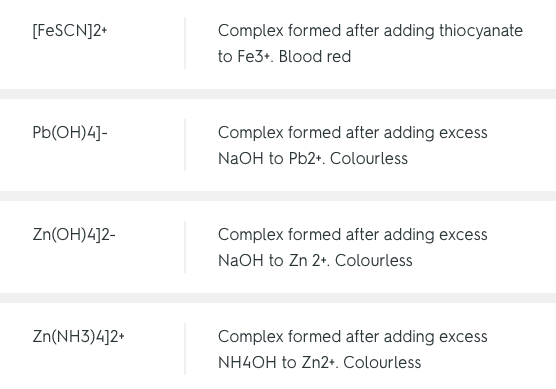
- 34important complex ions
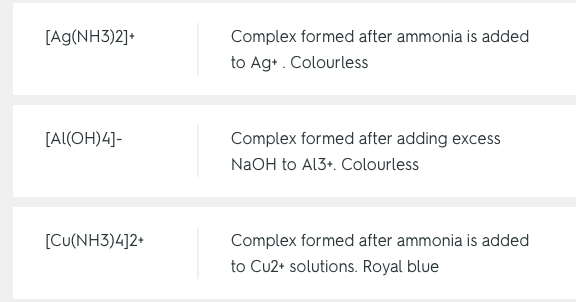
- 35low pH with high conc of H3O+ ions, increases solubiltyStrong acids completely dissociate sparingly soluble compound has an ion that will react with H3O+ ions , the equilibrium will shift to dissolve the solid to make more of the H3O+ ions.
- 36high pH with high conc of OH- ions, increases solubiltyStrong bases completely dissociate sparingly soluble compound has an ion that will react with OH- ions , the equilibrium will shift to dissolve the solid to make more of the OH- ions.
- 37Comparing the solubility of acidic and alkaline conditions (acid and base) explaining why something dissolves better in a solution with a very low pH and a very high pHthis is because particles of the solid fully dissociate hence the solid becomes very soluble
- 38Strong Acids-low pH
-donates all protons
-has a positive charge
-it forms its conjugate base
-completely dissociate, high conc of H3O+ ions
-small pKa
-large Ka - 39Weak acids-higher pH of a strong acid
-donates some protons
-has a slightly positive charge
-it forms its conjugate base
-partially dissociates, low conc of H3O+ ions
-large pKa
-small Ka - 40Strong bases-high pH
-accepts all protons
-has a negative charge
-it forms its conjugate acid
-completely dissociates, high conc of OH- ions
-small pKb
-Large Kb - 41Weak bases-lower pH than strong base
-accepts some protons
-has a slightly negative charge
-it forms its conjugate acid
-partially dissociates, low conc of OH- ions
-large pKb
-small Kb - 42Acidic saltssome salts form weak acids when they dissolve in a solution thus making small amount of H3O+ ions and other ions that only partially dissociate
- 43Basic saltssome salts form weak bases when they dissolve in a solution thus making small amount of OH- ions and other ions that only partially dissociate
- 44Calculating pH of a acidic salt in solution1:write Ka Expression (products/ reactants)
2: Make two assumptions
e.g Ka = [H3O+]^2 (conjugate base = H3O+)
--------------------------------------
[weak acid]
3: substitute number values
4: rearrange to find [H3O+]
5: calculate pH - 45Finding Ka (acid dissociation constant )weak acid + H20 --> conjugate base + H3O+
Ka = [conjugate base][H3O+]
-------------------------------------
[weak acid]
Ka values are small for weak acids - 46Conjugate acid/base pair examplesConjugate acid Conjugate base
NH4+ <------> NH3
H3O+ <------> H2O - 47pKa and its formulars

- 48pKa is used to give the measure of the strength of an acidlarger pKa compared to Ka the less the solid dissociates in water thus it is a weak acid (KapKa)
- 49Calculations of Weak Acids making assumptionsmake 2 assumptions
1: no H3O+ ions comes from water so [conjugate base] and [H3O+] are equal
2: [weak acid] is unchanged as the acid only partially dissociates - 50pH of a weak acid given Ka steps1:write Ka Expression (products/ reactants)
2: Make two assumptions
e.g Ka = [H3O+]^2 (conjugate base = H3O+)
--------------------------------------
[weak acid]
3: substitute number values
4: rearrange to find [H3O+]
5: calculate pH - 51Finding pH given [H3O+]pH= -log [H3O+]
- 52finding [H3O+] given pH[H3O+] =10^-pH
- 53Concentration of a weak acid given pH steps1:write the Ka expression
2: make assumptions
3: rearrange formulas for to equal [weak acid]
e.g [weak acid]= [H3O+]^2
------------
Ka
4: calculate the [H3O+]
5: substitue values - 54Amphiprotic substancescan act as either a base or acid by alernating donating and accepting protons
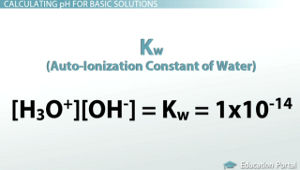
- 55Ionic product of water Kwequilibrium constant for the dissociation of water. H2O is not included in Kw as the concentration of H20 is too high that only a small amount dissociates
- 56Kw formularsKw= 1 x 10^-10
- 57Finding Kb (base dissociation constant)weak base + H20 --> conjugate acid + OH-
Kb = [conjugate acid ][OH-]
-------------------------------------
[weak base]
Kb values are small for weak bases - 58Calculating Kb given KaKb= Kw(1 x 10^-10)
-----------------------
Ka - 59Calculating Kb given pKaKb= 10^-pKa
- 60Calculations of Weak Bases making assumptionsmake 2 assumptions
1: no OH- ions comes from water so [conjugate acid] and [OH-] are equal
2: [weak base] is unchanged as the base only partially dissociates - 61pH of a weak base given Ka steps1:write Kb Expression (products/ reactants)
2: Make two assumptions
e.g Kb = [OH-]^2 (conjugate acid = OH-)
--------------------------------------
[weak base]
3:calculate Kb from Ka
4: substitute number values
5: rearrange to find [OH-]
6:Use Kw to find [H3O+]
5: calculate pH - 62calculating concentration of a weak base given pH1:write the Ka expression
2: make assumptions
3: rearrange formulas for to equal [weak base]
e.g [weak base]= [OH-]^2
------------
Kb
4:Calculate Kb from Ka
5: calculate the [H3O+] from pH
6:use Kw to calculate [OH-]
7: substitue values - 63Calculating pH of a basic salt in solution1:write Kb Expression (products/ reactants)
2: Make two assumptions
e.g Kb = [OH-]^2 (conjugate acid = OH-)
--------------------------------------
[weak base]
3:calculate Kb from Ka
4: substitute number values
5: rearrange to find [OH-]
6:Use Kw to find [H3O+]
5: calculate pH - 64Relative concentration of species
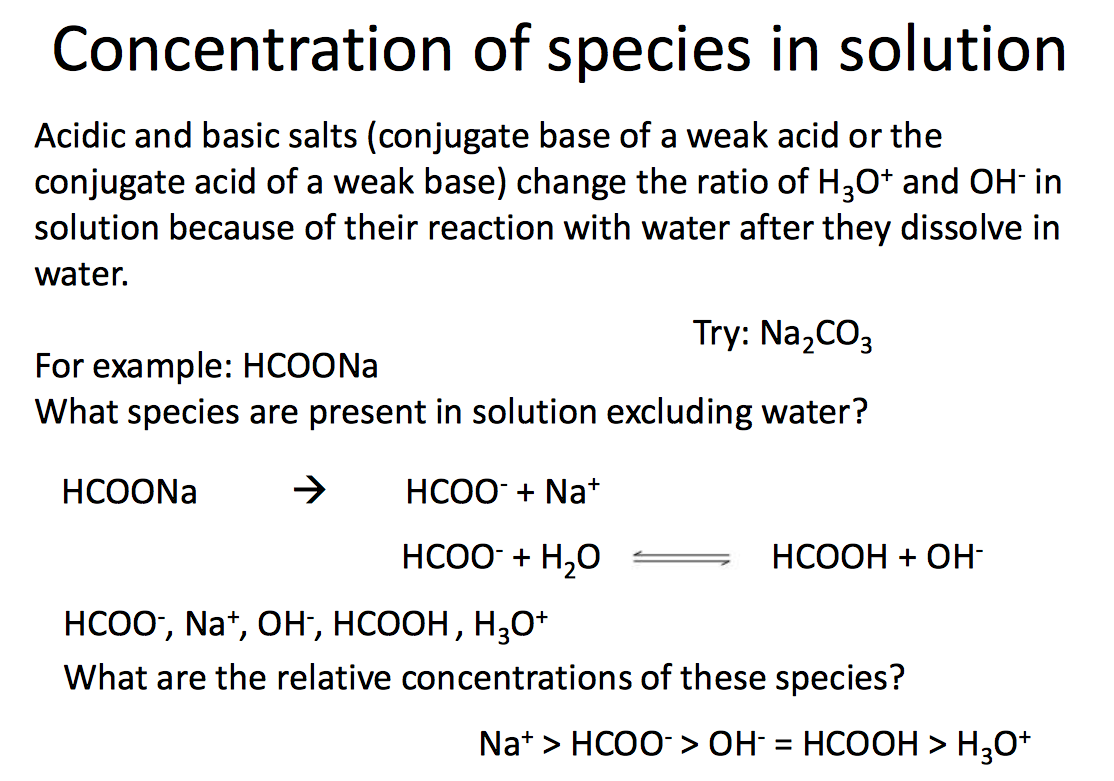
- 65Conductivity of soultionsstrong bases/ strong acids have good electrical conductivity as they fully dissociate thus they have a high
conc of freely moving charged particles/ ions.
Whereas weak acids/weak bases have bad electrical conductivity because they partially dissociate thus they have a low conc of freely moving charged particles/ions.
Informações
- Descrição
- Chemistry revision cue cards on equilibrium and Aqueous systems
- Criado por
- Toby Meredith
- Visualizações
- 65
- Avaliação