
Flashcards
WHMIS and The Structure of Matter
Flashcards do conjunto (26)
- 1John DaltonAll atoms were like spheres. They varied in size, mass or colour.
- All matter is made of small indivisible particles called atoms.
- All the atoms of an element are a like in properties like size and mass.
- Atoms of different elements have different properties
- Atoms of different elements can combine in specific fixed ratios to form new substances. - 2ThomsonAn atom was a sphere of positive charge imbedded with negative particles. The negatively charged particles were called electrons.
- 3H. NagaokaA Japanese scientist H. Nagaoka placed the electrons outside the atom. He said they travelled around the atom in a pattern like the rings around the planet Saturn.
- 4RutherfordDiscovered the nucleus of the atom. The model of the atom he suggested after that discovery resembled a mini solar system where the sun is the nucleus and the planets orbiting the sun are the electrons.
- 5BohrBohr suggested that the electrons surrounding the nucleus were in specific energy levels. If they didn't, then the atoms would not emit light in specific wavelengths and frequencies.
- 6Quantum Mechanical ModelThe quantum mechanical model of the atom is the one used today. The theory of electron movement has been abandoned. Instead, the idea is that electrons are a sort of cloud that covers entire areas all at once in different levels of energy.
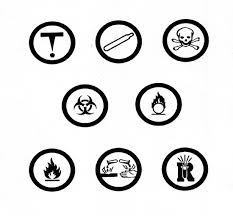
- 7WHMISWorkplace Hazardous Materials Information System
- 8—Poisonous add Infectious Material
Compressed Gas
Poisonous Causing Immediate Effect
Biohazardous Infectious Materials
Oxidizing Materials
Flammable
Corrosive Material
angerously Reactive Material - 9ProtonNucleus
Positive - 10NeutronNucleus
Neutral - 11ElectronSurrounding Nucleus
Negative - 12Heating and FreezingHeating (Temporary) usually sealed in an oxygen free atmosphere
Freezing (Almost Indefinite) - 13Salting-Method of preserving meat or fish usually
-Dries the food by drawing out water which leaves bacteria inactive or dead.
-This method was used by sailors. - 14Fermentation-Biochemical preservation technique which uses lactobacilli
-This bacteria preserves food while increasing the vitamin level
-This was useful in the times where people suffered from Scurvy. - 15MetallergyThe science of producing and using metals
- 16Copper (History)Hammered into tools but became brittle.
- 17Annealing (Definition)Heating copper before it is hammered, to avoid brittle tools
- 18SmeltingThe process of separating metals from other elements by melting
- 19BronzeSumerians smelting copper ores and tin ores to make bronze
- 20Smelting IronSmelting Iron became common in 1200 BCE
- 21ARISTOTLE'S DESCRIPTION OF MATTERAristotle thought that all matter was made of water, fire, air and earth.
- 22DemocritusThought that matter was made of tiny particles which he called atomos which means 'indivisible'
- 23Alchemy (Definition)Alchemy was a mix of magic and chemistry. Alchemists tried to get rich by turning ordinary elements like copper into gold.
- 24Alchemy (Chemical Discoveries)-Mercury was discovered
-Procedures for making mineral acids were developed
-laboratory equipment was improved - 25Job in Chemistry: AgrochemistBachelor in Science in Chemistry or closely related field
- Work in the agricultural field
- Study food of plants, livestock and humans
- They also examine chemicals used to increase crop yields
- Examine pesticides, herbicides and insecticides. - 26Job in Chemistry : Forensic ChemistBachelors in Chemistry or Forensic Science
- Analyze hairs, blood, etc, from crime scenes.
- Analyze non-biological
- Forensic labs, toxicology lab, police departments
Informações
- Descrição
- High School Science FlashCards sobre WHMIS and The Structure of Matter, criado por Mariapaula AR em 16-12-2014.
- Criado por
- Mariapaula AR
- Visualizações
- 61
- Tags
- Avaliação