
Flashcards
Vision
Flashcards do conjunto (29)
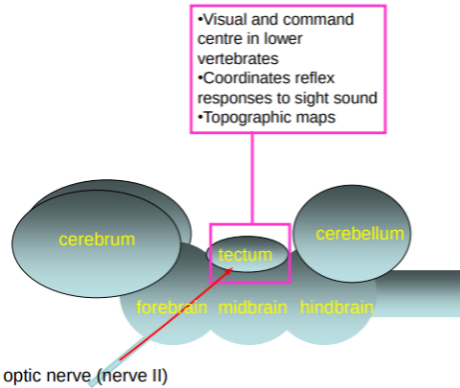
- 1What is the tectum?It is between the cerebrum and cerebellum and is the visual and command center in lower vertebrates like fish and amphibians. It coordinates reflect responses to sight and sound and has the ability to make topographic maps.
- 2Diagram of basic structure of the brain?
- 3General structure of frogs brain?There is the forebrain (cerebrum) at the front with the thalamus behind it. Then there is the midbrain which has the tectum at the roof of it and the optic nerve goes through midbrain to tectum. Behind the midbrain there is the hindbrain.
- 4How does visual information get to the brain?Visual information travels from the retina to the brain along the optic nerve. some processing happens in the retina (such as shape and movement) but info from the optical nerve forms a map in the visual center of the brain and projects it onto the tectum at the top of the midbrain
- 5What is the structure of the tectum?It is a layered structure. It has nine 'plexiform' (collection of nerves) layers in total which means they aren't always different layers cellularly but when you stain them they appear as nine different layers. Lots of neurones.
- 6How are the tectum layers arranged?The ninth is the one that is closest to the membrane, the first is the deepest in the midbrain and is the one that the optical nerve will hit first. The ninth layer is also further sub-layered. Layer 9 is where the tectum projects visual information.
- 7Through which method did we realise that retino-tectal projection occurs on layer 9?Cobalt filling (electrical current deposits cobalt into a base structure). We put the marker on the tip of the cut optic nerve and then could observe where the marker was picked up as this would show where the optic nerve traveled to. Inject cobalt as the stain.
- 8How are retinas and tectum parts joined?Contralaterally - the retina on the left side sends images to the layer 9 of the tecum on the right side and vice versa. Each point in the retina goes to a specific point on the tectum.
- 9What kind of experiments could be done to show this?Experiments were we shone light spots to illuminate different places on the frog's eyes and measure which parts of the tectum responded to this light. So, retino-tectal connections are not just to specific layers but also to specific points.
- 10What experiments have been done to test these connections between the retina and the tectum?Scientists used to surgically remove frog's eyes and put them back in at 180 degree rotation (upside down). Then, when a frog saw a fly above it, it would aim its tongue downwards. Also, if the frog was behind it, it would aim forwards. Shows the nerves didn't reconnect and there is huge specificity in its connections and labelling.
- 11What other ways can we alter frog's eyes?If we swapped the left and the right eye around, the frog then had left/right confusion because the right retina was going to the right tectum and not the contralateral tectum. The only way of making the frogs able to see properly again was to swap the eyes back around.
- 12What is binocularity?The use of two eyes to give slightly different versions of the same image. Used mostly to judge angular difference and distance. The further away something is, the more similar the images in both eyes.
- 13How is human binocular vision split?It is split into fields of view - left and right of the nose. Each eye is actually split between left and right parts of the brain, again, contralaterally.
- 14How vision progresses in human eyes/brain:
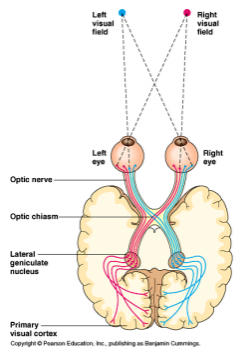
- 15How can binocular vision help detect distance?Because the more far away something is, the more similar the two images in both sides of the brain. If closer, the images are quite different.
- 16In binocular vision, the left eye and the right eye will both get information about the left/right visual field. What does it do with these two separate maps of the visual field?The visual cortex snips them up. The map of the right visual field from the left eye and the map from the right eye will get snipped up and interdigitated so the brain gets the same bits of the same map sitting next to each other. Each side of the brain is looking for the part of the map from the other side that sees the same as it does
- 17Do frogs have this?No, the splitting of the visual fields is in humans not not frogs. In frogs, left visual field goes to right eye and vice versa only.
- 18Experiment on frogs to see if they could interdigitate?Scientists placed a third eye on a frog and hooked it up to both the left and the right tectum. It had to choose which to go to. Found out that one of the tectums would start interdigitizing like mammals as it now had the information from the third eye going to it too.
- 19If frogs do have the ability to process images like humans, they choose not to use it. It was believed this was because they used another mechanism to judge distance, so tested this with...An experiment where prismatic glasses were put onto frogs. When presented a fly, the frog would aim to where the prismatic image of the fly would be and not the real fly. So they do use eyes to judge distance. Why don't they use interdigitizing?
- 20So how do frogs judge distance?There is more going on in the frogs visual system, it is just in different layers of the tectum. The right and left tectum shared information between each other but to different layers of the tectum. Layer 9 gives information to layer 5 of the opposite tectum. Measures distance. Ipsilateral map.
- 21Mammals and other sensory maps?Most visual processing is done in the forebrain in mammals but midbrain still has sensory function as it has a stack of sensory space maps like auditory, somatosensory, visual. Each one laid out as 2D map of space around the animal. Maps can be correlated and compared.
- 22How are auditory maps computed?The brain compares the intensity and time of arrival of the sound at ears to calculate where the sound came from?
- 23How do sound maps evolve over time?When mammals are very young, they won't be able to judge where a sound is coming from. As they age, the auditory maps become more specific. The auditory cells are 'tuned' after 30 days, in mice at least.
- 24If an experiment is picking up responses to sounds in the tectum by recording from the front of the tectum, middle of it and back of it, what would you expect to see?The front of the tectum should respond to sounds that are in front of the organism, the middle tectum to things besides the organism and back tectum to things behind it. Because they use a representative map.
- 25Where are auditory maps formed?In a different layer of the tectum to visual maps.
- 26What was noticed if animals were raised in the dark?Their auditory maps never became specific - the front of the tectum never specialised to only respond to sounds coming from in front, for example. Shows visualisation plays a role?
- 27What is believed?That auditory and visual maps evolve together - hearing a noise come from somewhere and seeing the source of that noise reinforced the direction it came from and leads to specificity. Things are occurring at same place in visual map as they are in auditory map.
- 28Theory of audio visual relationship:Tectum visual layer triggered, specific cell responds. Tectum auditory layer responds, all cells respond. If these two layers are connected, the visual map can tell the auditory map where the sound happened, so theres one place on auditory map that is receiving visual confirmation as well as auditory input.
- 29How does the specificity to responding to sound then develop?The auditory cells in the auditory tectum layer that respond to sound that isn't reinforced by the visual layer eventually begin to have a weaker and weaker response and are eventually lost
Informações
- Descrição
- - Animal Biology FlashCards sobre Vision, criado por Emma Lloyd em 09-05-2019.
- Criado por
- Emma Lloyd · mai 2019
- Atualizado
- 9 mai 2019
- Visualizações
- 0
- Avaliação