
Flashcards
Comp sci All topics part 1

Flashcards do conjunto (55)
- 1What does a not gate look like and what are it's outputs
- 2What does an And gate look like and what are it's outputs

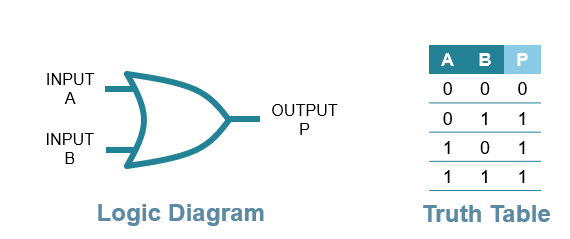
- 3What does an Or gate look like and what are it's outputs?
- 4What does an Xor gate look like and what are it's outputs?

- 5What does a Nand gate look like and what are it's outputs

- 6What does a Nor gate look like like and what are it's outputs?

- 7Why is Nand the universal gate?As it combines two gates in a single gate, different combinations can be used to recreate other gates
- 8Define HardwareHardware is the mechanical and electrical components of a computer
- 9Define SoftwareSoftware are the programs on the computer
- 10Define system softwareA program that manages the operation of the computer
- 11What is the role of an operating system?To manage the hardware resources in order to provide for an orderly and controlled allocation of the programs, memories and I/O devices among the various programs competing for them and manage the storage of data. It also hides the complexities of the hardware
- 12Define utility softwareUtility software is programs that assist with the running of a computer
- 13Define a LibraryA library is a collection of pre-compiled routines that can be used by other programs
- 14Define application softwarecomputer software designed to perform a group of coordinated functions, tasks or activities for the benefit of the user
- 15What is a program counter?A program Counter is a register in a processor that contains the address of the instruction being executed at that time
- 16What is a memory buffer register?A register that stores the data being transferred ti and from the immediate access store
- 17What is the fetch execute cycle?1. Address of next instruction transferred from PC to MAR
2. PC incremented by 1
3.Instruction stored in location addressed by MAR is transferred to MBR
4.Instruction transferred from MBR to CIR
5.Instruction in CIR is decoded
6.Additional data if required by the instruction is fetched from memory and passed to the registers
7.Instruction is executed by the ALU
8.Registers are used to store intermediate data or results
9.The result is stored in the accumulator or general purpose register or memory - 18Define opcodeThe basic machine operation and the addressing code
- 19Define operandThe data or the address of the data depending on addressing mode
- 20What is the difference between immediate and direct addressing?Immediate is where the operand is the bit of data whilst in direct the operand is the location of the data.
- 21Define bit rateHow many bits can be sent per unit time
- 22How many bytes are in KiB, KB, MiB, MB, GiB, GB, TiB, TB?KiB = 1024
KB = 1000
MiB = 1024 * 1024
MB = 1000 * 1000
GiB 1024 * 1024 * 1024
GB 1000 * 1000 * 1000
TiB 1024 * 1024 * 1024* 1024
TB 1000 * 1000 * 1000 * 1000 - 23What's the difference between signed and unsigned binarySigned uses a bit at the beginning to decide whether the number is positive or negative
- 24What are the minimum and maximum values for unsigned binary given n bits?0 and 2^(n) -1
- 25Multiply the two unsigned binary numbers 10110 and 11010110
110
101100
1011000
10000100 - 26Convert the two's compliment binary number 10110101 into decimal-128 + 32 + 16 + 4 + 1 = -75
- 27subtract 24 from 63 using two's compliment binary63 -24 = 63 +(-24) = 39
63 = 0111111
-24 = 1101000
(1)0100111
Remove carry bit as it is overflow
0100111 =
32 + 4 + 2 + 1 = 39 - 28convert 14.675 to 8 bit fixed point binary1110.1010
- 29What does ASCII stand for?American Standard Code for Information Interchange
- 30What is ASCII?ASCII is a binary representation of characters
- 31What is the difference between ASCII and unicode?Unicode uses 16 bits whilst ASCII uses 8
- 32What are the advantages of unicode over ASCII?Since unicode has more bits more characters can be represented. This has lead to characters from others languages to be represented in unicode
- 33Name four different types of error checking and correctionParity bits
majority voting
check digits
checksums - 34What are the two types of protocol used in parity bit checking?Odd parity and even parity
- 35How does parity bit error checking work?One bit in the byte of data sent is the parity bit. this dictates the total number of 1's and 0's in the byte. If even parity is used then the parity bit will be used to make sure there is an even number of 1's and 0's.
If odd parity is used then the parity bit will be used to make sure there is an odd number of 1's and 0's - 36How does majority voting work?The byte is sent 3 times then each bit is checked against the other two and the most common occurrence for each bit is selected
- 37What sets are denoted by the following letters : ℕ, Z, Q and RN = natural numbers e.g. positive integers
Z = Integers
Q = Rational e.g. any number that can be defined by a fraction of two integers
R = Any number - 38Why are fixed point and floating point binary sometimes inaccurate?They can only go to a certain degree of accuracy as they can only represent some numbers
- 39How do you calculate the absolute and relative error between a number and it's fixed/ floating binary equivalent?Absolute :
fixed/floating number - actual number
Relative :
Absolute error/actual number - 40What are the advantages of and disadvantages of fixed point binary compared to floating point binary?fixed has a lower range and is generally less precise however it is quicker to calculate
- 41Normalise the following binary number with a 5 bit mantissa and a 3 bit exponent 11011001001 = 1
move floating point one to the right so that number start with 10
since we moved the point one to the right we minus 1 off the exponent
1-1 = 0
new exponent = 0 = 000
mantissa = 10110
new binary number = 10110000 - 42Explain underflow and overflow errors and explain when they occurAn underflow error is when a number is represented in binary it's lower than the actual value. An overflow error is when a number is represented in binary it's value is lower than the actual value. These occur when the number is a value that can't be represented in binary using either floating or fixed point so the number closest is used instead
- 43Explain how a check digit is used for verification on a barcodeAdd all the numbers up on the barcode except for the check digit(the far most right digit)
Add up all the numbers in the odd positions, then double it and add it to the the previous calculation
Subtract the last digit from the calculation from 10. the difference should be the check digit - 44How do checksums work?The data value is added up and a divisor is chosen. The data value is divided by the divisor and the remainder is taken and sent with the data. The recipient then does the same calculation do see if they get the same remainder
- 45Describe how bit patterns may represent other forms of data.The computer converts the form of media into a binary representation this is called a bit pattern. Different amount of bits are allocated depending on how much variation there is in the data
- 46Whats the difference between analogue and digital data?analogue is the data is its natural form while digital is it's encoded form
- 47Whats the difference between analogue and digital signals?Analogue signals are the signals in their natural form whilst digital is the signal encoded.
- 48Describe how an analogue to digital converter worksAn analogue to digital converter samples the analogue signal on each falling or rising edge of a sample clock. In each cycle, the ADC gets the analogue signal, measures and converts it into a digital value. The ADC converts the output data into a series of digital values
- 49Describe how a digital to analogue converter worksThe DAC converts the digital signals into analogue signals and then sends them to an amplifier to play out the signals
- 50What are bitmaps?Bitmaps are a regular mesh of cells called pixels. Each pixel contains a colour value.
- 51What is the resolution of a bitmap?It's height in pixels x it's width in pixels
- 52What is the colour depth of a bitmap?Number of bits stored for each pixel
- 53What is the size in pixels of an image?It's width in pixels x it's height in pixels
- 54How do you calculate the storage requirements for a bit mapped image?size in pixels x colour depth
- 55Give 3 examples of metadatawidth, height, colour depth, author, date created, date modified, file size
Informações
- Descrição
- A level Computing FlashCards sobre Comp sci All topics part 1, criado por Ben Stevenson em 09-06-2019.
- Criado por
- Ben Stevenson
- Visualizações
- 2
- Histórico
-
- Criado por daniel upton · 4 mar 2019
- Copiado por Ben Stevenson · 9 jun 2019
- Avaliação