
20753690
Descrição

Criado por Marissa Alvarez

|
Criado por Marissa Alvarez
mais de 6 anos atrás
|
|
| Questão | Responda |
| Concepts to understand | Enzymes catalyze reactions by: -Bringing reacting groups to close proximity -3D positioning of the groups by forming bonds, hydrophobic effect, water exclusion, role of polar residues and pH. -Formation of transient bonds that reduce the activation energy -Major types of reactions occurring in the active site -Cofactors: essential ions and coenzymes -Vitamins |
| Proximity effect = effecctive ___ increase | concentration |
| In 1894, Emil Fischer proposed an explanation of enzyme catalysis. It is often called 'lock and key' model The model explained catalysis due to proximity and enzyme specificity. However, it is failed to explain: enzyme ___ (tight fit should make ES quite stable); and why small changes in substrate molecules strongly reduce enzyme activity. In addition, the "lock and key" model does not explain ___ inhibition. | kinetics allosteric |
| In 1958, Danial Koshland proposed a modification of the lock and key model, which is referred to as an 'induced fit model'. The model takes into account that enzymes have flexible and ___ structures. More importantly, in this model, it is not the ES complex but the transition state ES that is ___. | dynamic stabilized |
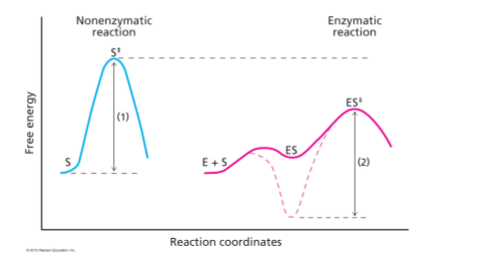
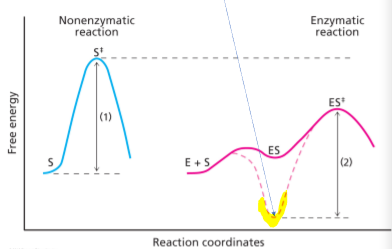
| Catalysis is achieved due to: (i) energy increase ES vs. E+S (weak non-covalent bonds) (ii) energy decrease of ES vs. S (in ___ states) (iii) alternative reaction paths by forming transient bonds (iv) water displacement and ___ effect | transition hydrophobic |
| Goldilocks balance in the formation of the transition state: Reactions with enzymes are reversible and intermediate complexes are not too stable to form _____ pits. |
thermodynamic
Image:
Pits (binary/octet-stream)
|
| Enzyme ___ the transition state Transition state analogs are better matched vs. substrates Transition state analogs act as more ____ competitive inhibitors | stabilizes efficient |
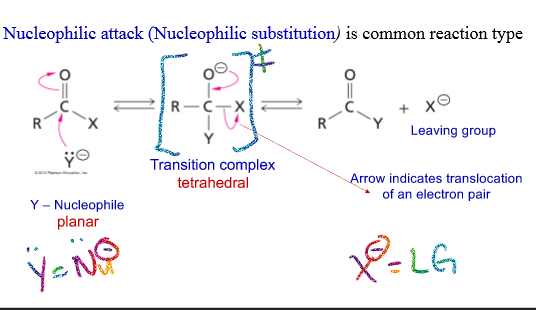
| Enzyme catalyzed reaction proceeds through several transient chemical transformations that often include formation and breakage of ____ covalent bonds between E-S, S-P, and E-P. Nucleophilic attack (Nucleophilic substitution) is a common reaction type Other types of cleavage reactions include: -Oxidation-reduction (redox) rxns -->___ (electron gain) of oxygen is often source of energy | transient Reduction |
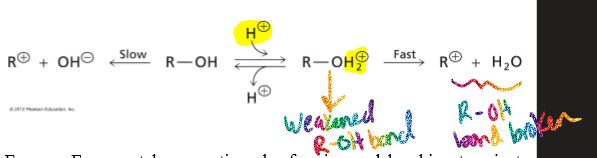
| Protonation of -OH group is often used in biochemistry to weaken R-OH bond snd break it | |
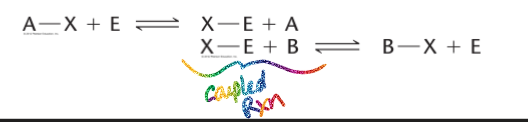
| Enzyme E can catalyze reaction by forming and breaking covalent bonds. Enzyme active residue may be either ____ (more often) or electrophile. Transferases use coupled reactions (see figure) | nucleophile |
| What we have learned so far about enzyme catalysis: • Enzyme is a protein (often globular) that have a catalytic site(s) -This site is ___ with the inclusion of polar residues -These residues (often His) form ___ bonds with the substrate -Reacting groups have to be oriented in space and brought ___ • Formation of transient bonds between enzyme and substrate (ES) -Lowering of activation energy What we are about to learn: • Enzymes may NOT only be made out of proteins -Bio-catalysis often requires the help of non-protein molecules -These both organic and inorganic molecules & ions are ____ | hydrophobic transient close cofactors |
| Example: Heme is a part of hemoglobin, but can also be a part of a protein ____. Cytochrome (co-enzyme) is a part of Cytochrome c Reductase. Cytochrome c Reductase is a part of the electron transfer chain | cytochrome |
| Magnesium ion (Mg2+) are ___ for DNA polymerases They position and stabilize deoxynucleotide triphosphates (dNTPs) Negative charges of phosphate groups are compensated by ____ Mg2+ ions | cofactors positive |
| Cofactors • Coenzymes are __-protein (for the most part) organic molecules -They often ___ a group of atoms or electron(s) to substrate -Nonfunctional enzyme that requires cofactor(s) to work: ___ • Complete and activated enzyme is ____ -Many coenzymes are __ synthesized. VITAMINS are precursors. -Co-enzymes can be continuously ___ without being consumed. | non- transfer Apoenzyme Holoenzyme not recycled |
| A, D, E, and K are the ___ vitamins; contain long hydrophobic chains. These fat-soluble vitamins are stored in fat tissues and the liver. Vitamin A deficiency is the leading cause of preventable childhood ___ in developing countries. Vitamin A is the precursor for a light-sensitive pigment in rhodopsin. | lipid blindness |
Quer criar seus próprios Flashcards gratuitos com GoConqr? Saiba mais.