
Flashcards
Analytical Techniques
Flashcards do conjunto (55)
- 1What are the main uses for analytical techniques?1.Determination of the structure
2. Analysis of the composition
3. To determine purity - 2What is the use of atomic absorption spectroscopy?Analysis of metal ions in water, blood, soils and foods
- 3What is the use of infrared spectroscopy?1.Determining the organic structure -finding information on the strength of the bonds
2. Finding the secondary structure in proteins
3. Finding the degree of unsaturation in oils and fats
4. Determining the level of alcohol in the breath - 4What is the main use of mass spectroscopy?1. Determining the organic structure
2. Isotopic dating (14C) - 5What is the main use of 1H nuclear magnetic resonance?1. Organic structural determination
2. Body scanning - 6What is the main use of Chromatography?1. Drug testing in the blood and urine
2. Food testing
3. Forensic Science - 7What is the electromagnetic spectrum?X/ gamma rays are highest energy and involve the inner electron
Ultraviolet involves the outer electron
Visible (Purple to red)
IR involves molecular vibrations
Microwaves involve molecular rotations
Radiowaves involve nuclear spin - 8What is emission spectroscopy?Involves the analysis of light emitted by excited atoms or molecules returning to their ground state
- 9What is absorption spectroscopy?When radiation is passed through a sample, some of the energy is absorbed by the sample to excite the atom/molecule
The energy transmuted relative to incident energy is measured
Only radiation with a frequency corresponding to the difference in energy levels is absorbed - 10What is the relationship between energy and frequency?E = hf
(Where h is plancks constant)
(6.626 x 10⁻³⁴ Js)
The greater the energy difference between the levels, the higher the absorption frequency (shorter wavelength) of light absorbed - 11Define transition metalElement that have an incomplete d sub-level in one or more of their oxidation states
- 12What determines the colour of a transition metal?1. The nature of the transition element
2. The oxidation state
3. The identity of the ligand
4. The stereochemistry of the complex (shape) - 13What is meant by splitting of the d-orbital and what is the order of splitting?In the free ion, the 5 d orbitals are degenerate - of equal energy. As the ligands approach the metal along the axis to form an octahedral complex, the non-bonding pairs on the ligands repel x,y,z and cause the 5 d orbitals to split (3 at lower energy, 2 at higher)
The difference between the two levels corresponds to the wavelength of visible light
Cl- < H2O < NH3 < CN- - 14What are ligands and what do they do?Ligands act as lewis bases and donate a non-bonding pair of electrons to form a
co-ordinate bond - 15What is meant by complementary colour?When white light falls onto the aqueous solution of the complex, the colour corresponding to the energy change is absorbed and transmitted light is of the complementary colour (Red -- Blue)
Amount d orbitals are split is caused by the ligand density and determines the colour absorbed - 16What type compounds can absorb UV or visible light?Compounds containing unsaturated groups (double bonds) e.g. C=C or N=N or the benzene ring - CHROMOPHORES
Precise energy is then determined by the other attached groups - 17What happens to the colour of phenolphthalein in acid and alkali?In acid it is colourless
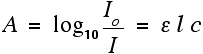
In alkali it is pink, as there is more conjugation - 18What is the beer- lambert law?
- 19What does the beer lambert law measure?(Only for dilute solutions)
How the intensity of the incident radiation is related to the intensity of the transmitted radiation
(e is the molar absorption co-efficiant)
(l is the path length of the absorbing solution - usually 1cm)
(c is the concentration) - 20What does the intensity of light transmitted depend on?The wavelength
This means experiments using the beer lambert law are carried out at the maximum wavelength (wishbone max) - 21How are concentrations of unknown solutions determined?Most dilute solutions will follow the beer-lambert law and can be used to determine the concentration of an unknown - (amount of iron in the blood/percentage of copper in brass)
A calibration curve of concentration vs. absorbance is plotted with a line of best fit and then it can be read off the graph - 22What are the principal ideas behind atomic absorption spectroscopy?1. Each element will produce its own unique emission spectrum
2. Electrons in ground state are excited to higher energy levels
3. A unique energy change is created a quantum of energy is absorbed
4. A photon of energy is emitted, with a unique colour and wavelength
5. Flame colours are seen - 23What are the flame colours for potassium, sodium, lithium and barium?Potassium - lilac
Sodium - yellow
Litium - red
Barium - green - 24How does the atomic absorption spectrum work?1. Atoms are given sufficient energy (heat)
2. Electrons are excited to higher energy levels, absorbing just enough energy
3. The spectrophotometer records the amount of light absorbed, determining concentration to one part per million - 25What are the components of the atomic absorption spectrometer?Fuel, atomiser, monochromatic light source, monochromatic detector and a read-out
1.The specific monochromatic lamp is used (elements have their own unique one - as electron arrangements are different, therefore so is the amount of energy needed) and light of a specific frequency is passed through the sample - the analyte
2. The nebuliser turns the sample into a fine mist (individual atoms)
3. It is then mixed with fuel (ethyne) and an oxidising agent (air)
4. The light passes through the vaporised sample in the flame
5. The amount of light absorbed is detected using a photomultiplier and converted into an electrical signal - 26What is the function of the monochromator?Produces radiation of one frequency
- 27Why does the light split into two beams?One for the reference, one for the actual sample
- 28What do the wavelengths of absorption in infra red spectroscopy correspond to?The stretching and bending frequencies of the covalent bonds present in the structures as the vibrations occur - THEY HAVE TO HAVE A DIPOLE TO ABSORB IN IR
- 29What is the process used for infra red spectroscopy?1. A source provides a beam of infrared radiation
2. The beam is split into two - one for the reference, one for the sample
3. The beams then go through a monochromator, a detector and a recorder. The detector compares the intensities of the differences in the beams - 30What does absorptions look like on an infrared spectroscopy graph?Troughs
The data book can be used to find which bond the shape relates to - 31What is NMR spectroscopy?Involves the interaction of nuclei with uneven mass numbers and electromagnetic radiation
The nuclei spin in opposite directions and in the presence of a magnetic field, have slightly different energy levels
The nuclei absorb energy to move from one level to another corresponding to particular radio frequencies - 32How is an NMR spectrum obtained?The sustance to be looked at is either in solution or a pure liquid and us placed, together with a reference, on a cylindrical tube
The tube is placed between the poles of a powerful electromagnet and it is connected to a radio frequency generator and receiver - 33What are the main features of a ^1HNMR spectra?1. THE NUMBER OF DIFFERENT PEAKS (ABSORPTIONS)
Each proton in a particular chemical environment absorbs at particular frequencies. The number of peaks = the number of different hydrogen environments
2. THE AREA UNDER EACH PEAK
Is proportional to the number of hydrogen atoms in the particular chemical environment
3. THE CHEMICAL SHIFT
Because neighbouring spinning electrons create their own magnetic field, the surrounding electrons exert a shielding effect and the greater the shielding, the lower the frequency of resonance that occurs
4. THE SPLITTING PATTERN
In 1HNMR spectroscopy, the chemical shift of protons within a molecule is slightly altered by protons bonded to adjacent carbon atoms - the spin spin coupling shows up as splitting patterns - 34What is used as the reference sample in 1HNMR spectroscopy and why?Tetramethylsilane
As all proteins are in the same environment and it gives a strong single peak
It is not toxic and is very unreactive so doesn't interfere with the sample
It absorbs upfield well away from most other protons
It is volatile so can easily be removed from the sample - 35What are the uses of 1HNMR?1. STRUCTURAL DETERMINATION
Information on the precise chemical environment of all hydrogens in the molecule can be found. This is particularly useful for distinguishing between cis and trans isomers
2. MEDICAL
Radio waves are completely harmless and have no known side effects so it is very useful. Can determine the extent of damage from heart attacks and used in diagnosing and monitoring diabetes, cancer, MS
Used in body scanning as the protons in the lipids/water/carbs give different signals, making an image of the body - 36What is spin spin coupling in 1HNMR?The splitting patterns are due to spin-spin coupling (protons adjacent to groups will either line with the magnetic field or against it)
The pattern of splitting can be predicted using pascals triangle
If there is two hydrogens adjacent to the group, then there are three possible energy states for the proton (triplet) if there are 3, there are four possible every states (quartet) - 37What is the purpose of chromatography?To separate mixtures into individual components
- 38What is meant by a stationary phase and the mobile phase of chromatography?Chromatography is made up of a stationary phase (that stays fixed) and a mobile phase (that moves)
The chromatography depends upon how, in a mixture, components have different tendencies to adsorb onto a surface or dissolve in a solvent, providing a way of seperation - 39What is adsorption in chromatography?Involves a solid stationary phase and a moving liquid phase
Liquid (column) chromatography, high performance liquid chromatography and sometimes thin layer chromatography work by this
The rate at which the solute moves through the solid phase depends on the equilibrium between the solubility in the liquid phase and the adsorption in the solid phase - 40What is partition in chromatography?Involves a stationary liquid phase and a mobile gaseous or liquid phase
paper and gas liquid chromatography work by this
It is dependant on the solubility of each component in the two phases if both are liquid
If the mobile phase is gaseous, then the rate of movement depends upon the volatility of the componants - 41What is the mobile phase and the stationary phase of paper chromatography?Mobile phase - the solvent
Stationary phase - The water on the fibres of the paper - 42How is the Rf value calculated? (retention factor)Rf = distance moved by solute/ distance moved by solvent
- 43What occurs in thin layer chromatography?1. A thin layer of solid (alumina or silica) is put on an inert support (glass)
2. When it is completely dry, it works like adsorption. However alumina and silica have a high affinity for water and it therefore separation occurs more by partition
3. The separated components can be recovered pure by scraping off the section containing it and dissolving in a suitable solvent
Pregnancy test can use TLC to detect pregnanediol in urine - 44What are colourless samples developed by in paper and TLC chromatography?Colourless samples are developed using a localising agent, normally ninhydrin
- 45What happens in column (liquid) chromatography?Usually used to separate a mixture for further use rather than identification,
1. The stationary phase is alumina or silica gel
2. The column is set up by packing the dry stationary phase on top of a piece of glass wool in a long column with a tap on the end and saturating it with eluting solvent
3. The sample is added at the top and as it moves down the column, more eluent is added
4. After some components have been eluted, then the solvent can be changed in order to elute the more tightly held components - 46What happens in high performance liquid chromatography?Usually occurs by partition
The mobile phase is forced under pressure (otherwise much like column)
The stationary phase is normally silica particles with long chain alkanes adsorbed to the surface
Seperation is efficient as long columns not needed
Separated components are usually detected by UV spectroscopy
Results are recorded on a chart showing the different retention times
Can be used for identification as well as separation
It is particularly useful for non-volatile components or components that decompose near their boiling point
Can separate enantiomers using columns containing optically active materials - 47What is the process of gas-liquid chromatography?The (inert) gas is the mobile phase
The liquid (normally long chain alkane) is the stationary phase and is coated onto a solid support in long thin capillary tubes
It works by partition and is often coupled with mass spectroscopy
It is used to separate and identify components that do not decompose at temperatures at or near their boiling points
1. The sample is injected through a self sealing cap into an oven for vaporisation
2. The sample is carried by the inert gas into the column where it is coiled and fitted into an over
3. At the end on the column, the separated components exit into a detector (usually a flame ionisation detector connected to a chart recorder) - 48What is the special feature of gas-liquid chromatography?Each component has a separate reaction time and the area under the peak is proportional to the amount of component present
It can therefore detect alcohol concentration in a blood sample (drink driving cases) it is also possible to programme the temperature for the oven to increase during the operation to speed up the elution of the less volatile components - 49How does high resolution mass spectroscopy work?In the high resolution version, it is possible to identify individual samples from the value of the molecular ion (M+) alone
- 50What is the importance of isotopes in mass spectroscopy?The different peaks can sometimes be caused by the probabilities of different isotopes being recorded
- 51What does mass spectroscopy do?Enables the molecular mass of a compound to be determined from the mass spectrum
The mass spectrum plots relative abundance of ions on the y axis against m/x (mass/charge) on the x
Ions at particular m/z values are seen as peaks on the spectrum
Organic molecules are ionised in a mass spectrometer to form molecular ions - (they have mass equal to the Mr of the compound (peak furthest to the right gives the Mr))
Some molecular ions fragment, producing other ions, which appear as peaks in the spectrum - 52What happens in IR spectroscopy?Detects the presence and absence of functional groups
When infra-red radiation across a full range of frequencies is passed through a compound, the bonds absorb energy corresponding to their natural frequency of variation
IR spectrums plot the % absorbance against the wavenumber or IR radiation
Absorptions are therefore seen as inverted peaks on the spectrum
The exact position of the peak produced by a type of bond depends on its environment, so each type of bond is given a band of wavenumbers in which it could produce the peak
Comparison of known and unknown spectrums can give identification - 53What can happen to the polar molecule in IR spectroscopy?*Asymmetrical stretching
* Symmetrical stretching
* Bending - 54What is the finger print region in IR spectroscopy?The right of the graph - it gives the actual compound and can just be looked by in data tables now
- 55How does the infrared spectrometer operate on a principle of a double beam?By using a rotating mirror, the beam of monochromatic radiation is alternatively passed through the sample and a reference
A photomultiplier converts photons of radiation into electrical currents - spectrum is generated by comparison of the currents produced by the sample and reference beams