
3461034
Descrição

FlashCards por Holly Bamford, atualizado more than 1 year ago
|
|
Criado por Holly Bamford
aproximadamente 11 anos atrás
|
|
| Questão | Responda |
| What is the monomer DNA is made up of? | Nucleotide |
| What are the parts of a DNA nucleotide? | Phosphate Deoxyribose sugar Nitrogenous base |
| What are the bases in DNA? | Adenine===Thymine Guanine===Cytosine |
| What are the base pairs in RNA? | Adenine===Uracil Cytosine===Guanine |
| What are the main differences between RNA and DNA? | DNA has deoxyribose sugar but RNA has ribose sugar DNA is double starnded RNA is single stranded DNA is a longer chain but RNA is shorter |
| Where is a phosphodiester bond formed? | Between the phosphate group and the sugar in a polynucleotide chain |
| Where are hydrogen bonds formed in DNA? | Between the nitrogenous bases |
| What are three monosaccharides? | Glucose Galactose Fructose |
| What three elements do all carbohydrates contain? | Carbon Hydrogen Oxygen |
| Glucose + Glucose= | Maltose |
| Maltose= | Glucose+Glucose |
| Glucose + Galactose= | Lactose |
| Lactose= | Glucose + Galactose |
| Glucose + Fructose= | Sucrose |
| Sucrose= | Glucose + Fructose |
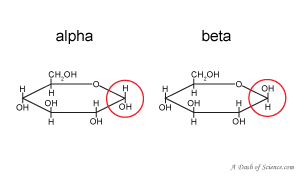
| What is the difference between α glucose and β glucose? | |
| What reaction is involved in the formation of disaccharides? | Condensation reaction |
| What is eliminated in a condensation reaction? | A molecule of water |
| What reaction would split a disaccharide? | Hydrolysis reaction |
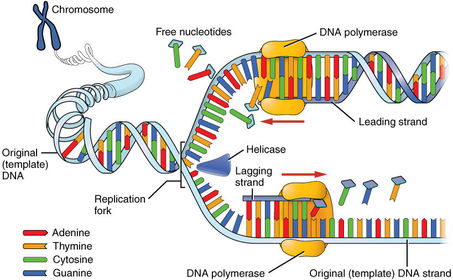
| What is DNA Helicase? | The enzyme that splits the DNA double helix into two strands |
| What is DNA polymerase? | The enzyme that catalyses the addition of nucleotide substatates |
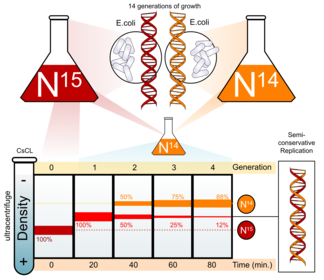
| How does DNA replicate itself? | Semi-conservative replication |
| What proof is there for semi-conservative replication of DNA? | Meselson and Stahl experiment |
| What does DNA polymerase? | Joins the nucleotides together via a condensation reaction (phosphodiester bond) |
| What does DNA Helicase do? | breaks the hydrogen bonds and causes polynucleotide chains to unzip |
| What bond joins nucleotides together? | Phosphodiester bonds |
| What makes up the nucleus? | Nuclear pores Nuclear envelope Chromatin Nucleolus Nucleoplasm |
| What is the difference between smooth and rough ER? | Smooth ER does not have ribosomes attached Rough ER does |
| What is the function of smooth ER? | Lipid, steroid and carbohydrate synthesis, storage and transport |
| What is the function of rough ER? | Protein synthesis and transport |
| What is the function of chloroplasts? | Makes glucose via photosynthesis Key defence against pathogens |
| What is the function of mitochondria? | Converts energy from the breakdown of glucose into ATP via aerobic respiration |
| How is energy stored in ATP? | In the phosphate bonds |
| What is resolution? | The smallest distance between two particles which allows them to be distinguished as separate articles |
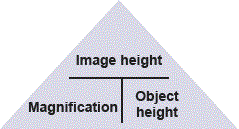
| What is the equation for magnification? | |
| What is a TEM? | Transmitting electron microscope Best resolution Beam of electrons pass through substance detected on fluorescent screen produces a 2D image |
| What is SEM? | Scanning electron microscope Specimen coated in heavy metals Thicker structures can be seen 3D image |
| What is a globular protein? | Metabolic functions Tertiary structure compact shape Not stable |
| What is a fibrous protein? | Structural functions Long chains wound into a helix linked by cross bridges very stable |
| What is the primary structure of a protein? | A Linear sequence of amino acids |
| What is the secondary structure of a protein? | Polypeptide chain coiled or twisted into an α helix or β sheet |
| What is the tertiary structure of a protein? | Compact globular chain |
| What is the quaternary structure of a protein? | More than one polypeptide chain |
| What is the monomer in protein and what is its structure? | Amino acid Contains amino group and carboxyl group |
| What is an enzyme? | Biological catalyst |
| What is the structure of the active site? | A specific pattern of amino acids that is complementary to a specific substrate |
| What is the name of a protein digesting enzyme secreted by the pancreas to act in the small intestine? | Tyripsin |
| What is the name of a protein digesting enzyme produced by the stomach? | Pepsin |
| What does the enzyme lactase do? | Breaks down lactose to glucose and galactose |
| What does the enzyme sucrase do? | breaks down sucrose into glucose and fructose |
| What does the enzyme maltase do? | Breaks down maltose into two molecules of glucose |
| What enzyme acts on triglycerides and is stored in bile | Pancreatic lipase |
| What is a diploid cell? | A cell with two sets of chromosomes |
| What is a haploid cell? | A cell with half the number of chromosomes |
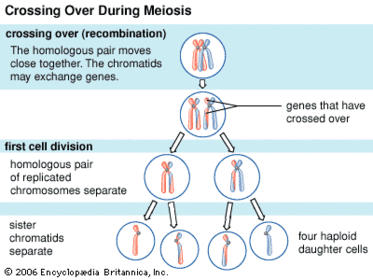
| How does meiosis bring about genetic variation? | Independent segregation of homologous chromosomes Recombination of homologous chromosomes by crossing over |
| What is crossing over in meiosis? | |
| What is independent segregation in meiosis? | The random way in which each chromosome lines up alongside it's homologous pair |
| What happens in prophase? | Chromosomes condense and the nuclear envelope disintergrates |
| What happens in metaphase? | The chromosomes line up at the equator of the nucleus and become attached to spindle fibres |
| What happens in anaphase? | The chromatids of each chromosome are pulled and separated by the spindle towards opposite poles of the nucleus |
| What happens in telophase? | Nuclear envelope reforms and two daughter neuclei are made |
| What is interphase? | The resting phase between mitosis or between meiosis I and meiosis II |
| What happens in cytokensis? | The cell organelles and cytoplasm is repliated. |
Quer criar seus próprios Flashcards gratuitos com GoConqr? Saiba mais.