
Flashcards
operating system
Flashcards do conjunto (30)
- 1what is an operating system?an operating system is a program or set of program manages the operations of the computer software and hardware for the user.
It acts as an interface between the user and the hardware - 2what is the general pattern/path (s) of the relationship between OS, User, and hardware?USER > OS > HARDWARE
or
USER > APPLICATION SOFTWARE > OS > HARDWARE
most times user interact with hardware via application software and the operating system provides a platform on which the software can run
its the application software that creates the user interface - 3what are the functions of OS apart from user interface?the functions involve:
memory management
interrupt service routines
processor scheduling
backing store management
management of input and output devices
providing utilities
providing security - 4what is memory management?it is the process of allowing more than one task to run seemingly simultaneously within the limitations of the available memory without overwriting each other
- 5how does the operating system handle files?it allows a logical structure in which the files and folders are organised and allows files to be renamed, deleted, copied or moved
- 6how does operating system control user management?OS allows multiple people to log into the same computer
the OS retains the settings for each user such as icons, desktops and backgrounds - 7what is paging and segmentationthey're techniques for making the optimum use of memory by splitting into small sections
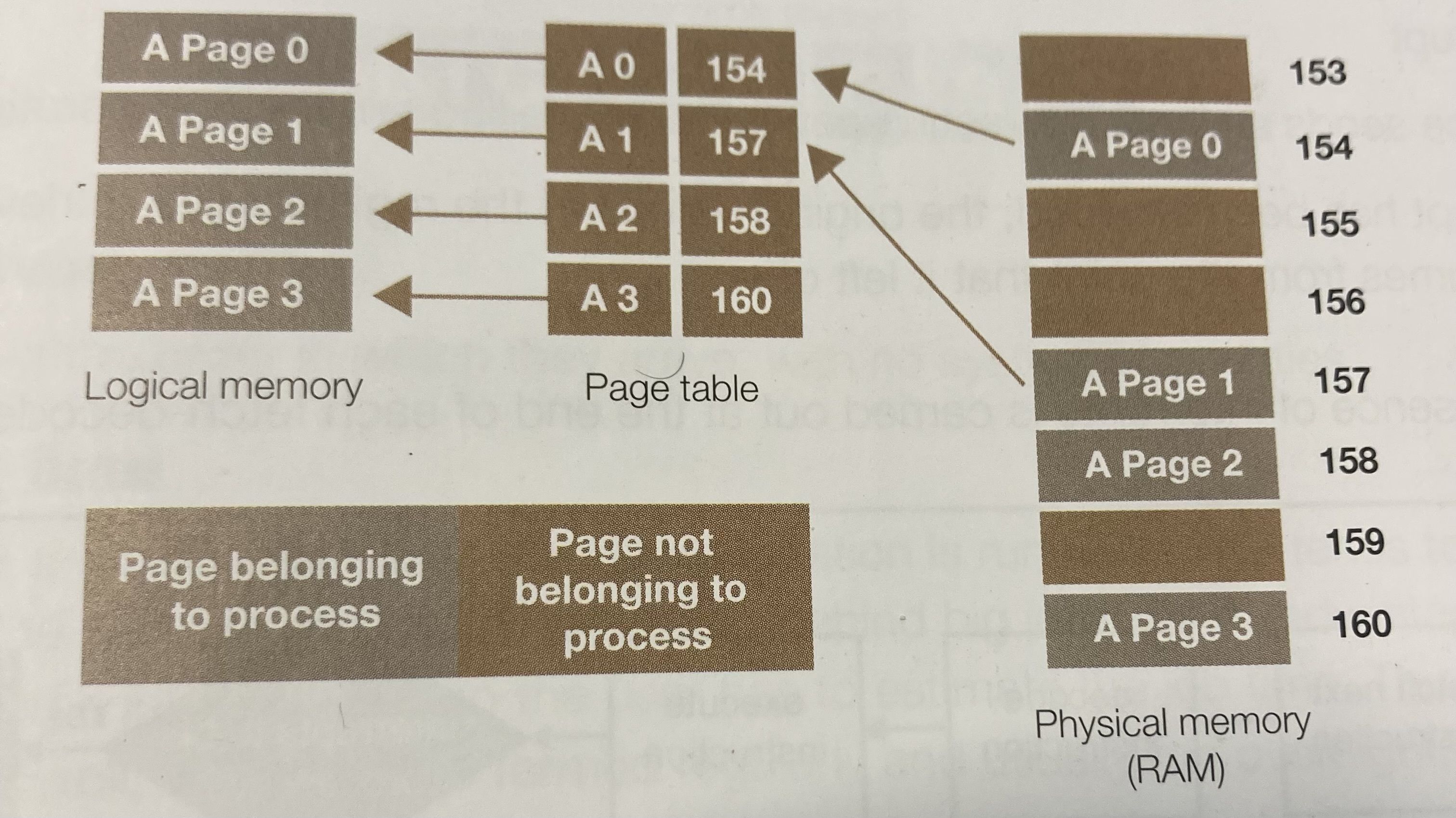
- 8what is paging?paging is the process whereby Physical memory (RAM) is divided into fixed size pages. programs are split into equal size pages
The OS determines how much memory the program requires, and allocates enough pages to hold it.
because the pages may be held non-contiguously the os uses page table to keep track of which pages programs are held
When the program is closed, the allocated pages are freed up - 9what is the issue with paging?it splits the entire program into equal sized pages and takes no account of how the program is split up
could separate the instructions or code of a loop condition so theyre in two different locations and would harm efficiency - 10what is segmentation?this is where the program is split into logical sized divisions,
which vary in size based on the structure and flow of the actual program
a bigger size program can be split into smaller chunks based on logical divisions and be put into different parts of the physical memory - 11differences and similarities between paging and segmentationboth allow programs to run concurrently despite insufficient memory/ however pages are fixed size while segments vary
pages are physical divisions. segments are logical divisions - 12what is virtual memory?virtual memory is a a space on the hard disk that is used to store running programs when there is insufficient space on the physical memory.
Operating system moves programs between RAM and virtual memory depending on the whether or not they're currently being used
when the ram is full the operating system focuses on switching programs between virtual and physical memory which is called thrashing and it slows down the performance of the system - 13what is an interruptan interrupt is a process whereby a device or application sends a signal to the processor to alert it that it requires attention. Each interrupt has a priority level
When an interrupt occurs, the system runs the appropriate ISR - 14what actually happens during an interrupt? (explain interrupt service routine)- at the end of every fetch decode execute cycle the processor checks for any interrupts
- if the priority is higher than the process being executed then the processor diverts its attention to it.
-what happens is, the values held within the program counter and other registers are copied into the memory stack for later retrieval
- the relevant interrupt can now be executed by changing the program counter to the value of where the isr starts in memory
-once it is complete, the values are popped from the top of the stack back into the cpu and the execution is continued from where it was left off - 15what is schedulingscheduling is the process of allocating an amount of time that a process has in the cpu and managing the next process to be executed. a scheduler does this
it allows multiple processes to run seemingly simultaneously.
there are different scheduling algorithms - 16what are the round robin scheduling algorithmsround robin: processes are dispatched on a (FIFO) basis and are allocated a limited amount of time called a time slice inside the cpu for processing. if it doesn't finish by end of time slice it goes to the back of the ready queue and next process is loaded into cpu
- 17what is the first come first serve algorithm?jobs are processed strictly in the order that they arrive and the process is run entirely till completed. Other jobs arrived have to wait till the preceding job is complete.
- 18what is the shortest job first algoritm?it is the algorithm that selects the job with the shortest estimated running time and runs it first until it is complete.
it requires knowledge of how long all the waiting processes will take
reduces number of waiting processes - 19what is the shortest remaining time algorithm?this is where the scheduler estimates the completion time for each process then takes the one with the least time and runs it.
it is pre emptive so it can suspend current process if higher priority or shorter timed process arrives - 20what is multi level feedback queueswhen a computer has more than one processor it can handle more than one process at a time
this algorithm uses multiple queues which all have different priority levels.
the scheduler moves jobs between queues depending on priority and processor time. - 21potential pros and cons from schedulingpro for shortest time remaining or shortest job first: reduces the number of pending jobs and reduces number of small jobs behind big jobs of its efficient.
however there is a case where longer jobs could take an unnecessarily long time to be attended to by the cpu because shorter jobs are continuo usly being added. - 22what are the different types of operating systemsmulti tasking
multi user
distributed OS
Embedded OS
Real time OS - 23what is a multi tasking OSthis is the type of operating system that allows multiple programs to be running simultaneously e.g word processor, web browser, media player.
theyre given a time slice of processor time to execute jobs.
billions of jobs can be processed per second, giving the illusion of simultaneous running - 24what is multi user OSthese are Operating systems that allows more than one to use and share the computers resources at the same time.
computer manages the users rights and permissions for access when they log on
server software will handle the request of multiple computers on the same network - 25what is a distributed system?this is a system that allows the processing power of multiple computers be used to complete a single task.
the distributed system can control and coordinate the many computers, presenting them to the end user as if it a singular system
e.g shopping site, may have different servers for different specific tasks however it all appears on one computer - 26what is an embedded system?special purpose computer system that is built into dedicated hardware that perform a specific task.
they run with maximum efficiency using low powered processors and little memory - 27what is real time OSit is a system that is designed to carry out actions within a guaranteed time frame. usually within a fraction of a second.
these are usually in safety critical systems like planes and stuff
lots of redundancy so it can take sudden increases in input and accommodate for component failure - 28what is the biosthis is the "basic input output system" it loads the operating system when the computer is first turned on
it checks that the computer is functional, memory is installed and accessible and that the processor is working in the P-O-S-T
Once done it uses the bootstrap to load the OS kernel from ROM into memory - 29what is a device driver?a device driver is a program that provides a software interface for a particular hardware device by telling the operating system how it can communicate with the device.
for example for printer:
the driver will translate the operating systems print instructions to one that the printer will understand - 30what is a virtual machine?a virtual machine is a program that has the same functionality as a physical computer.
an emulator gives the impression that a program or operating system is running on its native hardware but its running within another system
e,g arcade games from 80's being run on modern PC's
Ads; can run and test programs from one OS on another. Can be backed up and duplicated. More Than one can be run at a time
Informações
- Descrição
- Highers computing (semester 1) FlashCards sobre operating system , criado por Daniel Nnajiuba em 28-07-2022.
- Criado por
- Daniel Nnajiuba
- Visualizações
- 0
- Avaliação