
4656892
Descrição

FlashCards por Sarah Baldwin, atualizado more than 1 year ago

|
Criado por Sarah Baldwin
mais de 10 anos atrás
|
|
| Questão | Responda |
| Developmental Psychologist | studies physical, cognitive, and social changes of humans throughout their life cycle |
| Nature vs. Nurture | what makes us who we are and drives how we behave, our genes (nature) or our experiences (nurture)? |
| Cross-Sectional Research | one type of research in which people of different ages are examined at the same time(s) |
| Longitudinal Research | people are studied and restudied over a period of time |
| Zygote | when a human female egg is fertilized |
| Embryo | early, prenatal stage from about 2 weeks to 2 months after fertilization |
| Fetus | the longest stage of prenatal, human development that lasts from 9 weeks after conception to birth |
| Teratogens | anything that can disrupt the development of an embryo or fetus in a pregnant mother's womb; may cause a birth defect, malformation, or terminate the pregnancy altogether |
| Fetal Alcohol Syndrome (FAS) | physical, cognitive, and psychological abnormalities that result from consuming alcohol during pregnancy |
| Rooting Reflex | a tendency for an infant, when stroked on the side of the face, to move its face in the direction being stroked, open its mouth, and search for a nipple |
| Moro Reflex | a normal reflex for an infant when he or she is startled or feels like they are falling; the infant will have a "startled" look and the arms will fling out sideways with the palms up and the thumbs flexed |
| Babinski Reflex | a physical reflex shown when the bottom of the foot is stimulated by a blunt instrument; also known as the Plantar Reflex |
| Harry Harlow's Attachment Research | contact comfort: a monkey would rather be with a soft loving mother rather than a wire one, even if the wire one provides food |
| Contact Comfort | the physical and emotional comfort that an infant receives from being in physical contact with its mother |
| Konrad Lorenz | best remembered for his study of imprinting in birds (the tendency of birds to identify the first being seen after birth as their "mother") |
| Critical Period | a specific time during which an organism has to experience stimuli in order to progress through developmental stages properly |
| Mary Ainsworth | researched attachment with her experiment "the strange situation"; multiple types of attachment, mainly secure and insecure |
| Secure Attachments | children with secure attachments show minimal distress when their mother left them alone and sought comfort when their mother returned |
| Avoidant Attachments | do not orientate to their attachment figure while investigating the environment; very independent of the attachment figure both physically and emotionally |
| Anxious/Ambivalent Attachments | a child with this type of insecure attachment tends to ignore the caregiver, sometimes almost completely |
| Authoritarian Parenting Style | allows for little discussion or explanation of the firm controls placed on the child; a restrictive style that emphasizes respect for work and effort |
| Permissive Parenting Style | characterized by having few and inconsistent rules and a relaxed attitude to parenting that is more like a friend than a parent |
| Authoritative Parenting Style | parents closely interact with their children, while maintaining high expectations for behavior and performance, as well as a firm adherence to schedules and discipline |
| Piaget's Theory of Cognitive Development | Four stages: 1) Sensorimotor (0-2 years) 2) Preoperational (2-7 years) 3) Concrete Operational (7-11 years) 4) Formal Operational (11+ years) |
| Object Permanence | understanding that objects, people, etc. continue to exist even when they cannot be seen; babies understand this at about 4 to 6 months of age |
| Schema | a framework that organizes and interprets information |
| Assimilation | process of absorbing new information into an existing schema (ex: a child thinks that all four-legged animals are dogs) |
| Accommodation | happens when children adjust, change, or develop their schema to incorporate new information (ex: a child knows the difference between a cat and a dog) |
| Animistic Thinking | preoperational stage; children believe that inanimate objects have feelings and are real (ex: personification) |
| Egocentrism | preoperational stage; children assume that others think and feel the same as they do, and are not able to understand other perspectives |
| Irreversibility | preoperational stage; child's inability to mentally reverse a sequence of events (ex: child flattens a ball of playdoh and doesn't realize that it can be reformed) |
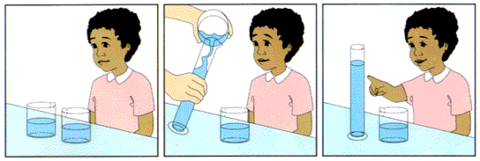
| Law of Conservation | concrete operational stage; a child does not understand that something stays the same even after its appearance changes |
| What are some criticisms of Piaget's theory? | 1) underestimated the age at which children reach these milestones 2) Lev Vygotsky criticized that Piaget did not take into account cultural and social influences on development |
| Erik Erikson's Theory of Psychosocial Development | states that we progress through eight different stages of development from infancy to old age; each stage has a crisis with a positive or negative outcome |
| Stage 1) Trust vs. Mistrust (age 0-1 years) | if mother is loving and nurturing, infant will develop a sense of trust; if not, the infant will not trust people |
| Elizabeth Kubler Ross's Stages of Death/Grief | 1) Denial 2) Anger 3) Bargaining 4) Depression 5) Acceptance |
| Stage 2) Autonomy vs. Shame/Doubt |
Quer criar seus próprios Flashcards gratuitos com GoConqr? Saiba mais.