
Flashcards
Rapid Tooling
Flashcards do conjunto (25)
- 1ToolingWorking or manufacturing aids of a specialized nature which are limited in use to a specific production line or the performance of a specific contract/job
such as cutting tools, dies, fixtures, gauges, jigs, molds and patterns - 2Problem with conventional toolingHigh cost
Long lead time
few design iterations due to cost - 3Difference between indirect and direct rapid toolingIndirect tooling is a multiple stage process used to create tooling which uses layer manufacturing at some point in its production. Involves the production of a master or pattern from which the tool is produced.
Direct - Direct production of the tool from sliced CAD data. - 4What influences choice?1. Production material of parts
2. Number of parts
Additional:
1. Complexity
2. How quick required
3. In house manufacture eg secrecy - 5Normal investment casting process1. Master mould produced from alloy such as aluminium.
2. Master mould filled with wax pattern to produce wax version of part.
3. Wax pattern coated with ceramic material.
4. Wax melted out and molten material poured into cavity. - 6What is Quickcast?Process by 3D systems that allows the creation of a hollow pattern using SLA with an internal hexagonal structure. Replaces the traditional wax patterns in investment casting
Used in the investment casting industry for indirect rapid tooling. - 7Advantages of Quikcast by 3D systems1. Hexagonal structure provides strength.
2. Easy drainage
3. Facilitates collapse of the pattern during thermal expansion to help avoid cracking of the shell (ceramic part can expand).
4. Low moisture absorption.
5. High finish.
6. Dimensional stability.
7. Capability of producing large assemblies. - 8Benefits of Indirect tooling1. Once AM component manufactured, materials/moulds/processes well understood by casting industry.
2. Fine detail, short run moulds without skilled model maker.
3. Full cast material properties.
4. Cost for short/single run components reduced.
5. Time taken from design to casting reduced. - 9What is direct tooling used for?Production of tools for injection moulding.
Some forms suitable for die casting - 10Steps in direct tooling1. CAD model of part (not mould)
2. STL file of reverse of part
3. Add required features (parting lines ejector holes etc)
4. Slice/produce tool using RP equipment
5. Manufacture and test (iterate if required)
6. Begin full production - 11Benefits of direct rapid tooling1. High geometric complexity - conformal channels and mass reduction
2. Shorter lead times, lower cost
3. Mass reduction
4. Functionally graded materials - hard wearing surface, thermally conductive heating/cooling channels
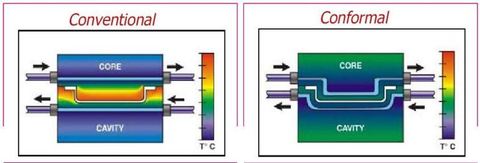
5. Design iterations possible - improved design and quality - 12Conformal channelsGeometric complexity allows conformal channels that follow the mould core or cavity to provide uniform cooling reducing warping of final part.
- 13Mass reductionAchieved through complex but lightweight geometry
- reduces energy and time to heat/cool mould
- Increase effective thermal diffusivity of tool
- Reduces material use and build time - 14Hybrid high performance toolingCombination of technology to get the best solution
Layer manufacturing core and machining of cavity - combines internal complexity and surface finish
Layer manufactured tools often post machined
Machined tools include layer manufactured inserts for engineering changes - 15Rapid tooling disadvantages1. Material choice
2. Surface finish
3. Geometric accuracy
4. Small to medium manufacture - 16Examples of Indirect tooling1. Quickcast - steering lock bezel
2. Invisalign
3. Objet investment casting
4. SL master mould from which rtv transfer mould created - 17Invisalign1. Impression trays filled with material and pressed over teeth.
2. Impression is set.
3. Impression used to create 3D model of teeth.
4. Software plans movement from current to desired position.
5. SL production of reverse required part.
6. Patterns used to produce aligners - 18Quickcast investment casting eg Steering lock bezelAllows the creation of a hollow pattern using SLA with an internal hexagonal structure.
Replaces the traditional wax patterns in investment casting avoiding the need for an expensive metal master mould and the long lead time that comes with it.
The process follows a similar process to traditional investment casting.
Pattern coated in ceramic slurry, firing procedure to burn SLA pattern out.
Metal poured into ceramic shell to form final part.
1. Laser scans liquid photopolymer surface causing it to polymerise depending on x-y data for particular layer from stl file.
2. Platform drops one layer.
3. Recoating step with sweeper.
4. Process repeated.
Post processing: Support removal, suncured resin removal with solvent, post cure.
Usually die cast
Now achieved 30% time saving and 50% cost saving - 19Objet investment castingIndirect rapid tooling process to create a master mould to create a wax investment.
Material jetting
1. Photosensitive material jetted.
2. UV light cures each layer.
3. Print head moves in X-Y to build each layer.
4. Platform moves down in z and process repeated to build investment casting pattern.
5. Wax poured in pattern.
6. Pattern separated to remove wax part.
7. Wax part coated in ceramic slurry, dried
8. Wax melted out.
9. Molten material poured in mould - 20Direct rapid tooling examples1. Exone sand printing (binder jetting for mold for casting metal parts
2. EOS Injection moulds (SLM)
3. Gordon Murray design - (FDM for casting door seals)
4. Stratasys FDM injection moulding tools made out of ABS for printing plastic parts. - 21Exone sand printingFor casting moulds and cores using binder jetting (direct rapid tooling)
1. Mold is designed
2. Mold produced using binder jeting
4. Casting poured to produce metal part.
4. Tool destroyed to reveal part. - 22EOS injection mouldsDirect rapid tooling process
1. Pre-milled tool insert - hybrid design save time and cost.
2. Tool insert placed in build chamber and position checked
3. Powder distributed.
4. Melting of powder to build up geometry layer by layer around insert with recoating step and build platform moves down one layer.
5. Remaining powder removed and recycled.
6. Hardening process.
7. Milling to final dimensions and polished.
8. Installed in injection moulding machine. - 23Gordon Murray design FDMMade rubber door seals by direct rapid tooling of the tool and soluble core with material extrusion.
Cast elastomer polyurethane resin to form the seals. - 24Plaster casting mouldsBinder jetting process
For casting non-ferrous metals due to sulphur in gypsum reacts with iron.
Powder must be thoroughly removed and are dried in oven to remove moisture.
No need to split mould - 25Benefits of direct rapid tooling over indirect1. Cheaper due to less processing steps required.
2. For bespoke geometry more appropriate as only producing one part, so point in developing whole process.
Informações
- Descrição
- Masters AM FlashCards sobre Rapid Tooling, criado por Jack Moule em 12-03-2016.
- Criado por
- Jack Moule
- Visualizações
- 0
- Avaliação