
Mapa mental
elements of life part 1
Conteúdo do mapa
elements of life part 1
sub atomic particle
- proton: mass 1,charge +1 ,location in atom.electron:mass 0, charge -1, location in
- the nucleus can be described as two different parts the atomic number z and the mass number A. the atomic number is number of protons. it is numerically the charge on the nucleus.mass number =atomic number +number of neutrons.
- isotopes are the same element with different mass numbers.differences in mass are caused by the difference in neutrons
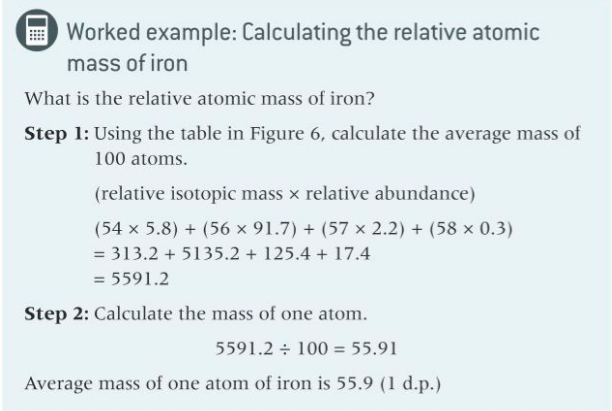
- most elements exist as isoptopes, the relative atomic mass is an average of relative isotopic masses taking in count their abundances a techinque called mass spectrometry
mass spectrometry
- mass spec measures the atomic or molecular mass of different particles in a sample and the relative abundance of different isotopes in the element
- the atoms are ionised to positively charged cations. these ions are separated according to their mass m to change z ratios. m/z. seperate ions are detected along with their relative abundance
nuclear fission
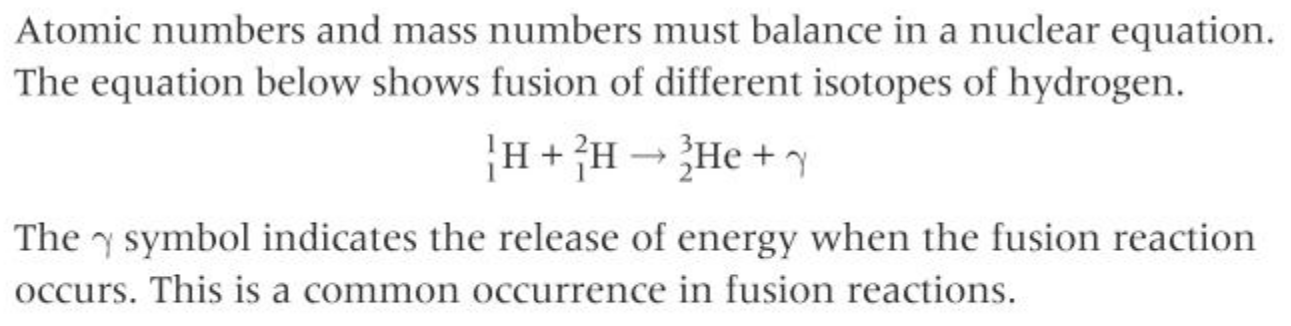
- two light nuclei fuse together forming a single heavier nucleus of a new element releasing enormous amounts of energy. for two nuclei to fuse they must be very close together.
- on normal temperatures on earth this will not happen as the positive nuclei repel so strongly the fusion can not happen
- in very high temperatures like stars the nuclei are moving quickly and collide with so much energy the repulsion is overcome
spectroscopy
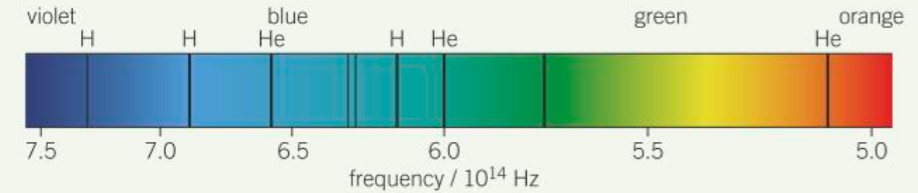
- glowing stars emit across the board of frequencies. the sun mainly emits visible light but other hotter stars emit mainly ultraviolet light
- outside the star's surface is a region called the photosphere contains things like the ions and atoms these are the molecules that absorb some of emitted light so the frequencies from the stars are missing. the absorption lines are black lines.
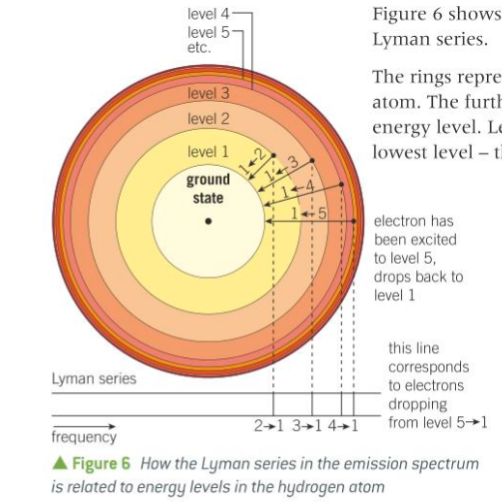
- emission . when atoms are raised from their ground state to higher energy states called excited states.the particles can lose their energy by emitting electromagnetic radiation.
Bohr's theory
- the theory that light is a wave and a particle none of them explains all the properties of light
- particle theory- this shows that light is a stream of tiny packets of photons.the energy of the photons is related to the position in the em scale.photons energy is 3 x10^-19
- energy of a photon(E) = plancks constant x frequency
- plancks constant = 6.63 x 10^-34
- energy of a photon(E) = plancks constant x frequency
- particle theory- this shows that light is a stream of tiny packets of photons.the energy of the photons is related to the position in the em scale.photons energy is 3 x10^-19
- the wave theory -a wave of light travels the distance between two points in a certain time, it does not matter what light and the time is always the same. the speed waves moves is at the speed of c which is light and is 3.00 x 10^8 when traveling in a vacuum.
- speed of c =wavelength(M) x frequency(s-1)
- when an atom is excited it will raise an energy level later they will drop back down emitting the extra energy
- when light light passes through a cool sample of a gaseous sample black lines appear in the otherwise continuous absorption spectrum. each element has it's own line pattern and can be used to identify if an element is present in a mixture
- however Bohr's can only explain absorption and emission spectrum and the electronic structure of atoms
- main points:the electron in the hydrogen atom exists only certain definite energy or electron levels, a photon of light is emitted or absorbed when the electrons changes from one energy level to another,the energy of a photon is equal to the difference between two levels,since E=hv it follows that the frequency of emitted or absorbed light is related to delta E by delta E=hv
- when light light passes through a cool sample of a gaseous sample black lines appear in the otherwise continuous absorption spectrum. each element has it's own line pattern and can be used to identify if an element is present in a mixture
- energy levels and quanta
- the theory that light is a wave and a particle none of them explains all the properties of light
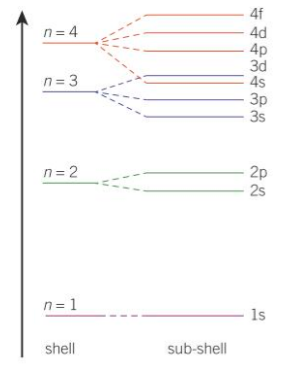
shells
- 1: 2 electrons, 2: 8 electrons,3:18 electrons,4:32 electrons
- sub shells: s shell is containing two electrons ,p has 6 electrons ,d has 10 electrons and, f is 14 electrons
- s has one orbital
- p has three
- d has five
- f has seven
- d has five
- p has three
- each orbital can contain two electrons, electrons in a atom spin, electrons can only occupy the same orbital if they have opposite spins
- the box represents the atomic orbital and the arrows represent the electrons four pieces of information are needed when describing an electron
- the electron shell it is in ,it's sub shell,it's orbital within the shell,it's spin
- the box represents the atomic orbital and the arrows represent the electrons four pieces of information are needed when describing an electron
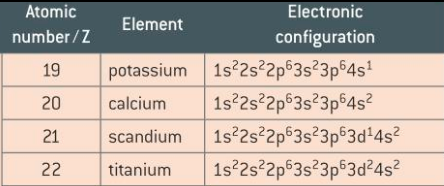
- the electron configuration of an atom is the arrangement of shells and orbitals. the orbitals are filled in order of increasing energy when there is more than one orbital with the same energy these first orbitals are first occupied singly by electrons this keeps the electrons as far apart as possible
- s has one orbital
periodic table
- Mendeleev arranged the periodic table in order of increasing mass and elements with similar properties were in the same vertical group, however his values were incorrect becayse they had not discovered isoptopes yet
- he left gaps in the table for elements that has not been discovered yet. his prediction for the gaps in the table was accurate with the newly discovered element at the time gernamium in 1886
- periodicity
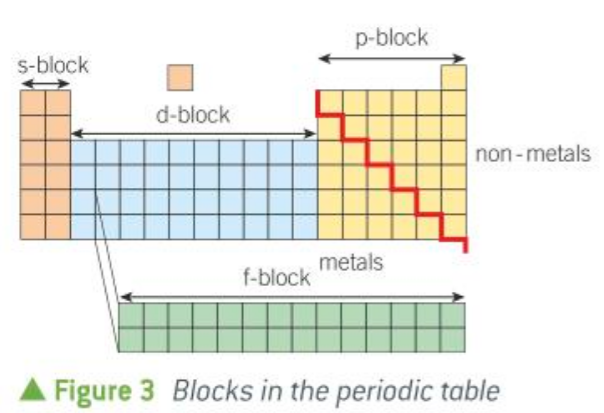
- in the new table it seem it the same going up in atomic mass but it is not it's going up in the number of protons in the nucleus with the exception of hydrogen the periodic table can be put into the orbital blocks
- vertical columns are called groups
- horizontal columns are called periods
- there are trends in the properties as you go down the group but properties vary in a fairly regular way as you move across a period from left to right,
- the most obvious one is the zig-zag line across the p block the elements to the left of it have the properties of metals and element to the right the properties of non metals
elements of life part 2
Imagens e arquivos do mapa

Informações
- Descrição
- elements of life (unfinished)
- Criado por
- Shontel McLaughlan
- Visualizações
- 17
- Avaliação