
Mapa mental
Product Design
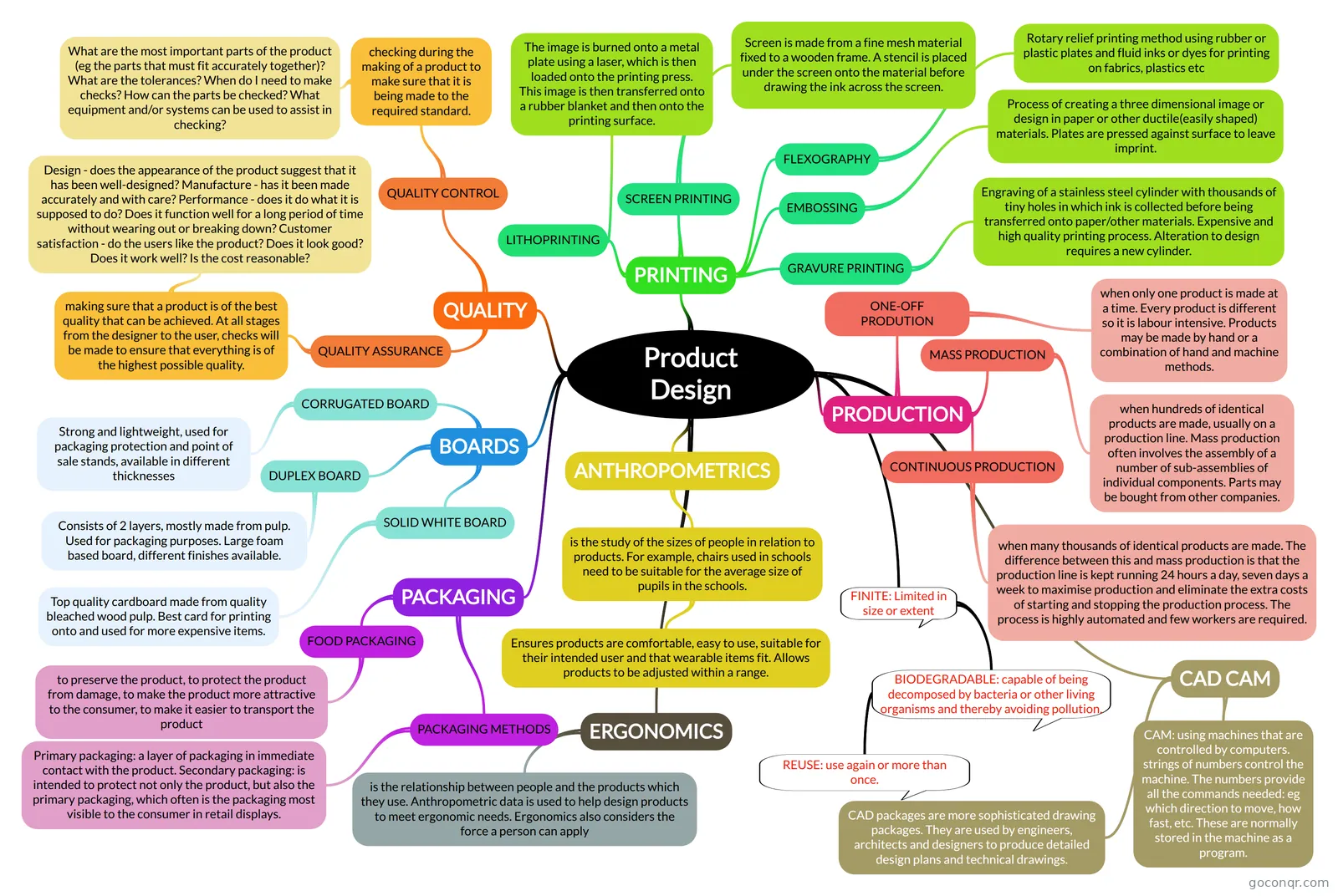
Mind map: Product design
Conteúdo do mapa
Product Design
PRINTING
- LITHOPRINTING
- The image is burned onto a metal plate using a laser, which is then loaded onto the printing press. This image is then transferred onto a rubber blanket and then onto the printing surface.
- SCREEN PRINTING
- Screen is made from a fine mesh material fixed to a wooden frame. A stencil is placed under the screen onto the material before drawing the ink across the screen.
- FLEXOGRAPHY
- Rotary relief printing method using rubber or plastic plates and fluid inks or dyes for printing on fabrics, plastics etc
- EMBOSSING
- Process of creating a three dimensional image or design in paper or other ductile(easily shaped) materials. Plates are pressed against surface to leave imprint.
- GRAVURE PRINTING
- Engraving of a stainless steel cylinder with thousands of tiny holes in which ink is collected before being transferred onto paper/other materials. Expensive and high quality printing process. Alteration to design requires a new cylinder.
- LITHOPRINTING
BOARDS
- SOLID WHITE BOARD
- Top quality cardboard made from quality bleached wood pulp. Best card for printing onto and used for more expensive items.
- CORRUGATED BOARD
- Strong and lightweight, used for packaging protection and point of sale stands, available in different thicknesses
- DUPLEX BOARD
- Consists of 2 layers, mostly made from pulp. Used for packaging purposes. Large foam based board, different finishes available.
- SOLID WHITE BOARD
PRODUCTION
- ONE-OFF PRODUTION
- when only one product is made at a time. Every product is different so it is labour intensive. Products may be made by hand or a combination of hand and machine methods.
- MASS PRODUCTION
- when hundreds of identical products are made, usually on a production line. Mass production often involves the assembly of a number of sub-assemblies of individual components. Parts may be bought from other companies.
- CONTINUOUS PRODUCTION
- when many thousands of identical products are made. The difference between this and mass production is that the production line is kept running 24 hours a day, seven days a week to maximise production and eliminate the extra costs of starting and stopping the production process. The process is highly automated and few workers are required.
- ONE-OFF PRODUTION
QUALITY
- QUALITY ASSURANCE
- making sure that a product is of the best quality that can be achieved. At all stages from the designer to the user, checks will be made to ensure that everything is of the highest possible quality.
- Design - does the appearance of the product suggest that it has been well-designed? Manufacture - has it been made accurately and with care? Performance - does it do what it is supposed to do? Does it function well for a long period of time without wearing out or breaking down? Customer satisfaction - do the users like the product? Does it look good? Does it work well? Is the cost reasonable?
- making sure that a product is of the best quality that can be achieved. At all stages from the designer to the user, checks will be made to ensure that everything is of the highest possible quality.
- QUALITY CONTROL
- checking during the making of a product to make sure that it is being made to the required standard.
- What are the most important parts of the product (eg the parts that must fit accurately together)? What are the tolerances? When do I need to make checks? How can the parts be checked? What equipment and/or systems can be used to assist in checking?
- checking during the making of a product to make sure that it is being made to the required standard.
- QUALITY ASSURANCE
PACKAGING
- FOOD PACKAGING
- to preserve the product, to protect the product from damage, to make the product more attractive to the consumer, to make it easier to transport the product
- PACKAGING METHODS
- Primary packaging: a layer of packaging in immediate contact with the product. Secondary packaging: is intended to protect not only the product, but also the primary packaging, which often is the packaging most visible to the consumer in retail displays.
- FOOD PACKAGING
ANTHROPOMETRICS
- is the study of the sizes of people in relation to products. For example, chairs used in schools need to be suitable for the average size of pupils in the schools.
- Ensures products are comfortable, easy to use, suitable for their intended user and that wearable items fit. Allows products to be adjusted within a range.
- is the study of the sizes of people in relation to products. For example, chairs used in schools need to be suitable for the average size of pupils in the schools.
ERGONOMICS
- is the relationship between people and the products which they use. Anthropometric data is used to help design products to meet ergonomic needs. Ergonomics also considers the force a person can apply
CAD CAM
- CAD packages are more sophisticated drawing packages. They are used by engineers, architects and designers to produce detailed design plans and technical drawings.
- CAM: using machines that are controlled by computers. strings of numbers control the machine. The numbers provide all the commands needed: eg which direction to move, how fast, etc. These are normally stored in the machine as a program.
FINITE: Limited in size or extent
- BIODEGRADABLE: capable of being decomposed by bacteria or other living organisms and thereby avoiding pollution.
- REUSE: use again or more than once.
- BIODEGRADABLE: capable of being decomposed by bacteria or other living organisms and thereby avoiding pollution.
Informações
- Descrição
- Year 11 Design and Technology Mapa Mental sobre Product Design, criado por shuba sohel em 03-12-2017.
- Criado por
- shuba sohel
- Visualizações
- 1
- Avaliação