
Mapa mental
Globalisation
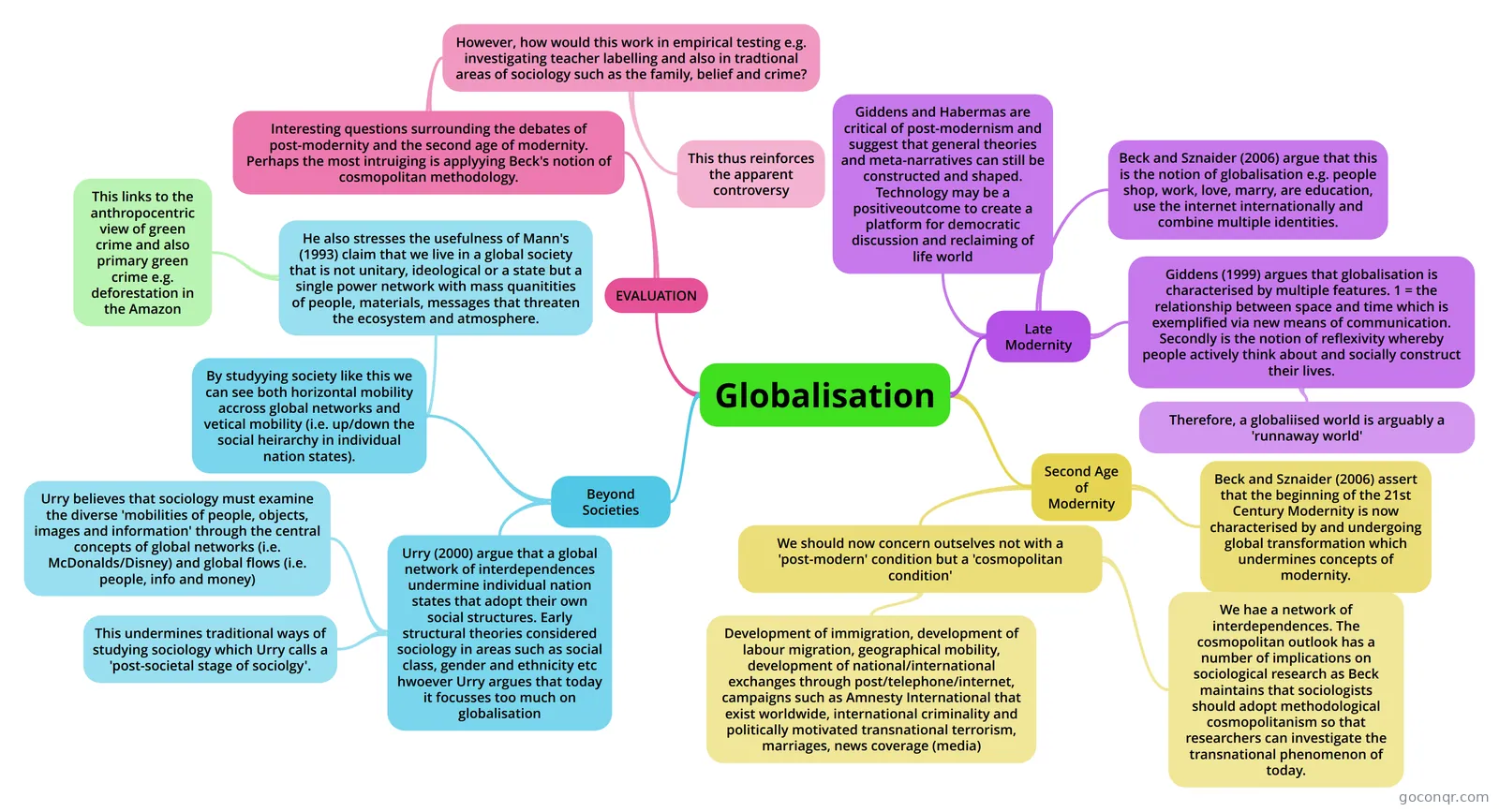
Mind map: globalisation sociology
Conteúdo do mapa
Globalisation
Late Modernity
- Giddens and Habermas are critical of post-modernism and suggest that general theories and meta-narratives can still be constructed and shaped. Technology may be a positiveoutcome to create a platform for democratic discussion and reclaiming of life world
- Beck and Sznaider (2006) argue that this is the notion of globalisation e.g. people shop, work, love, marry, are education, use the internet internationally and combine multiple identities.
- Giddens (1999) argues that globalisation is characterised by multiple features. 1 = the relationship between space and time which is exemplified via new means of communication. Secondly is the notion of reflexivity whereby people actively think about and socially construct their lives.
- Therefore, a globaliised world is arguably a 'runnaway world'
Second Age of Modernity
- Beck and Sznaider (2006) assert that the beginning of the 21st Century Modernity is now characterised by and undergoing global transformation which undermines concepts of modernity.
- We should now concern outselves not with a 'post-modern' condition but a 'cosmopolitan condition'
- Development of immigration, development of labour migration, geographical mobility, development of national/international exchanges through post/telephone/internet, campaigns such as Amnesty International that exist worldwide, international criminality and politically motivated transnational terrorism, marriages, news coverage (media)
- We hae a network of interdependences. The cosmopolitan outlook has a number of implications on sociological research as Beck maintains that sociologists should adopt methodological cosmopolitanism so that researchers can investigate the transnational phenomenon of today.
Beyond Societies
- Urry (2000) argue that a global network of interdependences undermine individual nation states that adopt their own social structures. Early structural theories considered sociology in areas such as social class, gender and ethnicity etc hwoever Urry argues that today it focusses too much on globalisation
- This undermines traditional ways of studying sociology which Urry calls a 'post-societal stage of sociolgy'.
- Urry believes that sociology must examine the diverse 'mobilities of people, objects, images and information' through the central concepts of global networks (i.e. McDonalds/Disney) and global flows (i.e. people, info and money)
- By studyying society like this we can see both horizontal mobility accross global networks and vetical mobility (i.e. up/down the social heirarchy in individual nation states).
- He also stresses the usefulness of Mann's (1993) claim that we live in a global society that is not unitary, ideological or a state but a single power network with mass quanitities of people, materials, messages that threaten the ecosystem and atmosphere.
- This links to the anthropocentric view of green crime and also primary green crime e.g. deforestation in the Amazon
- He also stresses the usefulness of Mann's (1993) claim that we live in a global society that is not unitary, ideological or a state but a single power network with mass quanitities of people, materials, messages that threaten the ecosystem and atmosphere.
- Urry (2000) argue that a global network of interdependences undermine individual nation states that adopt their own social structures. Early structural theories considered sociology in areas such as social class, gender and ethnicity etc hwoever Urry argues that today it focusses too much on globalisation
EVALUATION
- Interesting questions surrounding the debates of post-modernity and the second age of modernity. Perhaps the most intruiging is applyying Beck's notion of cosmopolitan methodology.
- However, how would this work in empirical testing e.g. investigating teacher labelling and also in tradtional areas of sociology such as the family, belief and crime?
- This thus reinforces the apparent controversy
- However, how would this work in empirical testing e.g. investigating teacher labelling and also in tradtional areas of sociology such as the family, belief and crime?
- Interesting questions surrounding the debates of post-modernity and the second age of modernity. Perhaps the most intruiging is applyying Beck's notion of cosmopolitan methodology.
Informações
- Descrição
- Mapa Mental sobre Globalisation, criado por Sarah Mather em 11-06-2013.
- Criado por
- Sarah Mather
- Visualizações
- 95
- Avaliação
Mais sobre Theories and debates about globalisation