
Mapa mental
Lecture 2 - trust
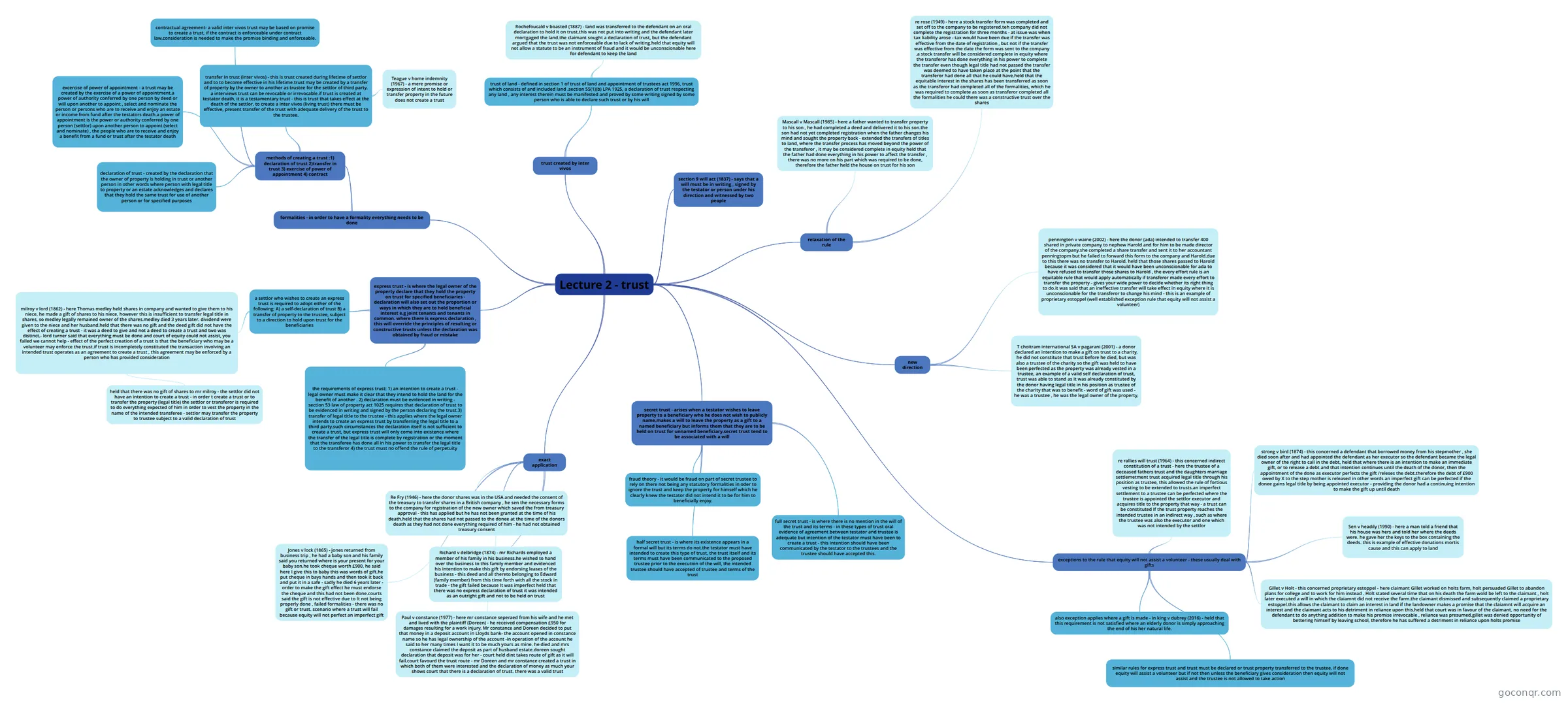
Mind map: Trust law principles and types
Conteúdo do mapa
Lecture 2 - trust
section 9 will act (1837) - says that a will must be in writing , signed by the testator or person under his direction and witnessed by two people
secret trust - arises when a testator wishes to leave property to a beneficiary who he does not wish to publicly name.makes a will to leave the property as a gift to a named beneficiary but informs them that they are to be held on trust for unnamed beneficiary.secret trust tend to be associated with a will
- full secret trust - is where there is no mention in the will of the trust and its terms - in these types of trust oral evidence of agreement between testator and trustee is adequate but intention of the testator must have been to create a trust - this intention should have been communicated by the testator to the trustees and the trustee should have accepted this.
- half secret trust - is where its existence appears in a formal will but its terms do not.the testator must have intended to create this type of trust, the trust itself and its terms must have been communicated to the proposed trustee prior to the execution of the will, the intended trustee should have accepted of trustee and terms of the trust
- fraud theory - it would be fraud on part of secret trustee to rely on there not being any statutory formalities in oder to ignore the trust and keep the property for himself which he clearly knew the testator did not intend it to be for him to beneficially enjoy.
express trust - is where the legal owner of the property declare that they hold the property on trust for specified beneficiaries - declaration will also set out the proportion or ways in which they are to hold beneficial interest e.g joint tenants and tenants in common. where there is express declaration , this will override the principles of resulting or constructive trusts unless the declaration was obtained by fraud or mistake
- the requirements of express trust: 1) an intention to create a trust - legal owner must make it clear that they intend to hold the land for the benefit of another . 2) declaration must be evidenced in writing - section 53 law of property act 1025 requires that declaration of trust to be evidenced in writing and signed by the person declaring the trust.3) transfer of legal title to the trustee - this applies where the legal owner intends to create an express trust by transferring the legal title to a third party.such circumstances the declaration itself is not sufficient to create a trust, but express trust will only come into existence where the transfer of the legal title is complete by registration or the moment that the transferee has done all in his power to transfer the legal title to the transferor 4) the trust must no offend the rule of perpetuity
- a settlor who wishes to create an express trust is required to adopt either of the following: A) a self-declaration of trust B) a transfer of property to the trustee, subject to a direction to hold upon trust for the beneficiaries
- milroy v lord (1862) - here Thomas medley held shares in company and wanted to give them to his niece, he made a gift of shares to his niece, however this is insufficient to transfer legal title in shares, so medley legally remained owner of the shares.medley died 3 years later. dividend were given to the niece and her husband.held that there was no gift and the deed gift did not have the effect of creating a trust - it was a deed to give and not a deed to create a trust and two was distinct.- lord turner said that everything must be done and court of equity could not assist, you failed we cannot help - effect of the perfect creation of a trust is that the beneficiary who may be a volunteer may enforce the trust.if trust is incompletely constituted the transaction involving an intended trust operates as an agreement to create a trust , this agreement may be enforced by a person who has provided consideration
- held that there was no gift of shares to mr milroy - the settlor did not have an intention to create a trust - in order t create a trust or to transfer the property (legal title) the settlor or transferor is required to do everything expected of him in order to vest the property in the name of the intended transferee - settlor may transfer the property to trustee subject to a valid declaration of trust
- milroy v lord (1862) - here Thomas medley held shares in company and wanted to give them to his niece, he made a gift of shares to his niece, however this is insufficient to transfer legal title in shares, so medley legally remained owner of the shares.medley died 3 years later. dividend were given to the niece and her husband.held that there was no gift and the deed gift did not have the effect of creating a trust - it was a deed to give and not a deed to create a trust and two was distinct.- lord turner said that everything must be done and court of equity could not assist, you failed we cannot help - effect of the perfect creation of a trust is that the beneficiary who may be a volunteer may enforce the trust.if trust is incompletely constituted the transaction involving an intended trust operates as an agreement to create a trust , this agreement may be enforced by a person who has provided consideration
trust created by inter vivos
- trust of land - defined in section 1 of trust of land and appointment of trustees act 1996, trust which consists of and included land .section 55(1)(b) LPA 1925, a declaration of trust respecting any land , any interest therein must be manifested and proved by some writing signed by some person who is able to declare such trust or by his will
- Rochefoucald v boasted (1887) - land was transferred to the defendant on an oral declaration to hold it on trust.this was not put into writing and the defendant later mortgaged the land.the claimant sought a declaration of trust, but the defendant argued that the trust was not enforceable due to lack of writing.held that equity will not allow a statute to be an instrument of fraud and it would be unconscionable here for defendant to keep the land
- trust of land - defined in section 1 of trust of land and appointment of trustees act 1996, trust which consists of and included land .section 55(1)(b) LPA 1925, a declaration of trust respecting any land , any interest therein must be manifested and proved by some writing signed by some person who is able to declare such trust or by his will
formalities - in order to have a formality everything needs to be done
- methods of creating a trust :1) declaration of trust 2)transfer in trust 3) exercise of power of appointment 4) contract
- declaration of trust - created by the declaration that the owner of property is holding in trust or another person in other words where person with legal title to property or an estate acknowledges and declares that they hold the same trust for use of another person or for specified purposes
- transfer In trust (inter vivos) - this is trust created during lifetime of settlor and to to become effective in his lifetime.trust may be created by a transfer of property by the owner to another as trustee for the settlor of third party. a interviews trust can be revocable or irrevocable.if trust is created at testator death, it is a testamentary trust - this is trust that takes effect at the death of the settlor. to create a inter vivos (living trust) there must be effective, present transfer of the trust with adequate delivery of the trust to the trustee.
- Teague v home indemnity (1967) - a mere promise or expression of intent to hold or transfer property in the future does not create a trust
- excercise of power of appointment - a trust may be created by the exercise of a power of appointment.a power of authority conferred by one person by deed or will upon another to appoint , select and nominate the person or persons who are to receive and enjoy an estate or income from fund after the testators death.a power of appointment is the power or authority conferred by one person (settlor) upon another person to appoint (select and nominate) , the people who are to receive and enjoy a benefit from a fund or trust after the testator death
- contractual agreement- a valid inter vivos trust may be based on promise to create a trust, if the contract is enforceable under contract law.consideration is needed to make the promise binding and enforceable.
- methods of creating a trust :1) declaration of trust 2)transfer in trust 3) exercise of power of appointment 4) contract
exact application
- Re Fry (1946) - here the donor shares was in the USA and needed the consent of the treasury to transfer shares in a British company , he sen the necessary forms to the company for registration of the new owner which saved the from treasury approval - this has applied but he has not been granted at the time of his death.held that the shares had not passed to the donee at the time of the donors death as they had not done everything required of him - he had not obtained treasury consent
- Jones v lock (1865) - jones returned from business trip , he had a baby son and his family said you returned where is your present for your baby son.he took cheque worth £900, he said here I give this to baby this was words of gift.he put cheque in bays hands and then took it back and put it in a safe - sadly he died 6 years later - order to make the gift effect he must endorse the cheque and this had not been done.courts said the gift is not effective due to It not being properly done , failed formalities - there was no gift or trust. scenario where a trust will fail because equity will not perfect an imperfect gift
- Richard v delbridge (1874) - mr Richards employed a member of his family in his business.he wished to hand over the business to this family member and evidenced his intention to make this gift by endorsing leases of the business - this deed and all thereto belonging to Edward (family member) from this time forth with all the stock in trade - the gift failed because It was imperfect held that there was no express declaration of trust it was intended as an outright gift and not to be held on trust
- Paul v constance (1977) - here mr constance seperaed from his wife and he met and lived with the plaintiff (Doreen) - he received compensation £950 for damages resulting for a work injury. Mr constance and Doreen decided to put that money in a deposit account in Lloyds bank- the account opened in constance name so he has legal ownership of the account -in operation of the account he said to her many times I want it to be much yours as mine. he died and mrs constance claimed the deposit as part of husband estate.doreen sought declaration that deposit was for her - court held dint takes route of gift as it will fail.court favourd the trust route - mr Doreen and mr constance created a trust in which both of them were interested and the declaration of money as much your shows court that there is a declaration of trust. there was a valid trust
relaxation of the rule
- re rose (1949) - here a stock transfer form was completed and set off to the company to be registered.teh company did not complete the registration for three months - at issue was when tax liability arose - tax would have been due if the transfer was effective from the date of registration , but not if the transfer was effective from the date the form was sent to the company .a stock transfer will be considered complete in equity where the transferor has done everything in his power to complete the transfer even though legal title had not passed the transfer was deemed to have taken place at the point that the transferor had done all that he could have.held that the equitable interest in the shares has been transferred as soon as the transferor had completed all of the formalities, which he was required to complete as soon as transferor completed all the formalities he could there was a constructive trust over the shares
- Mascall v Mascall (1985) - here a father wanted to transfer property to his son , he had completed a deed and delivered it to his son.the son had not yet completed registration when the father changes his mind and sought the property back - extended the transfers of titles to land, where the transfer process has moved beyond the power of the transferor , it may be considered complete in equity held that the father had done everything in his power to affect the transfer , there was no more on his part which was required to be done, therefore the father held the house on trust for his son
new direction
- T choitram international SA v pagarani (2001) - a donor declared an intention to make a gift on trust to a charity, he did not constitute that trust before he died, but was also a trustee of the charity so the gift was held to have been perfected as the property was already vested in a trustee, an example of a valid self declaration of trust, trust was able to stand as it was already constituted by the donor having legal title in his position as trustee of the charity that was to benefit - word of gift was used - he was a trustee , he was the legal owner of the property,
- pennington v waine (2002) - here the donor (ada) intended to transfer 400 shared in private company to nephew Harold and for him to be made director of the company.she completed a share transfer and sent it to her accountant penningtopm but he failed to forward this form to the company and Harold.due to this there was no transfer to Harold. held that those shares passed to Harold because it was considered that it would have been unconscionable for ada to have refused to transfer those shares to Harold , the every effort rule is an equitable rule that would apply automatically if transferor made every effort to transfer the property - gives your wide power to decide whether its right thing to do.it was said that an ineffective transfer will take effect in equity where it is unconscionable for the transferor to change his mind - this is an example of proprietary estoppel (well established exception rule that equity will not assist a volunteer)
exceptions to the rule that equity will not assist a volunteer - these usually deal with gifts
- strong v bird (1874) - this concerned a defendant that borrowed money from his stepmother , she died soon after and had appointed the defendant as her executor so the defendant became the legal owner of the right to call in the debt, held that where there is an intention to make an immediate gift, or to release a debt and that intention continues until the death of the donor, then the appointment of the done as executor perfects the gift /releses the debt.therefore the debt of £900 owed by X to the step mother is released in other words an imperfect gift can be perfected if the donee gains legal title by being appointed executor - providing the donor had a continuing intention to make the gift up until death
- re rallies will trust (1964) - this concerned indirect constitution of a trust - here the trustee of a deceased fathers trust and the daughters marriage settlemetment trust acquired legal title through his position as trustee, this allowed the rule of fortious vesting to be extended to trusts.an imperfect settlement to a trustee can be perfected where the trustee is appointed the settlor executor and acquires title to the property that way - a trust can be constituted If the trust property reaches the intended trustee in an indirect way , such as where the trustee was also the executor and one which was not intended by the settlor
- Gillet v Holt - this concerned proprietary estoppel - here claimant Gillet worked on holts farm, holt persuaded Gillet to abandon plans for college and to work for him instead . Holt stated several time that on his death the farm wold be left to the claimant , holt later executed a will in which the claiamnt did not receive the farm.the claimant dismissed and subsequently claimed a proprietary estoppel.this allows the claimant to claim an interest in land if the landowner makes a promise that the claiamnt will acquire an interest and the claimant acts to his detriment in reliance upon this.held that court was in favour of the claimant, no need for the defendant to do anything addition to make his promise irrevocable , reliance was presumed.gillet was denied opportunity of bettering himself by leaving school, therefore he has suffered a detriment in reliance upon holts promise
- Sen v headily (1990) - here a man told a friend that his house was hers and told her where the deeds were. he gave her the keys to the box containing the deeds. this is example of effective donations mortis cause and this can apply to land
- also exception applies where a gift is made - in king v dubrey (2016) - held that this requirement is not satisfied where an elderly donor is simply approaching the end of his her natural life.
- similar rules for express trust and trust must be declared or trust property transferred to the trustee. if done equity will assist a volunteer but if not then unless the beneficiary gives consideration then equity will not assist and the trustee is not allowed to take action
Informações
- Descrição
- Law Mapa Mental sobre Lecture 2 - trust, criado por Anika B em 03-12-2018.
- Criado por
- Anika B
- Visualizações
- 0
- Avaliação