
Mapa mental
trust - lecture 5
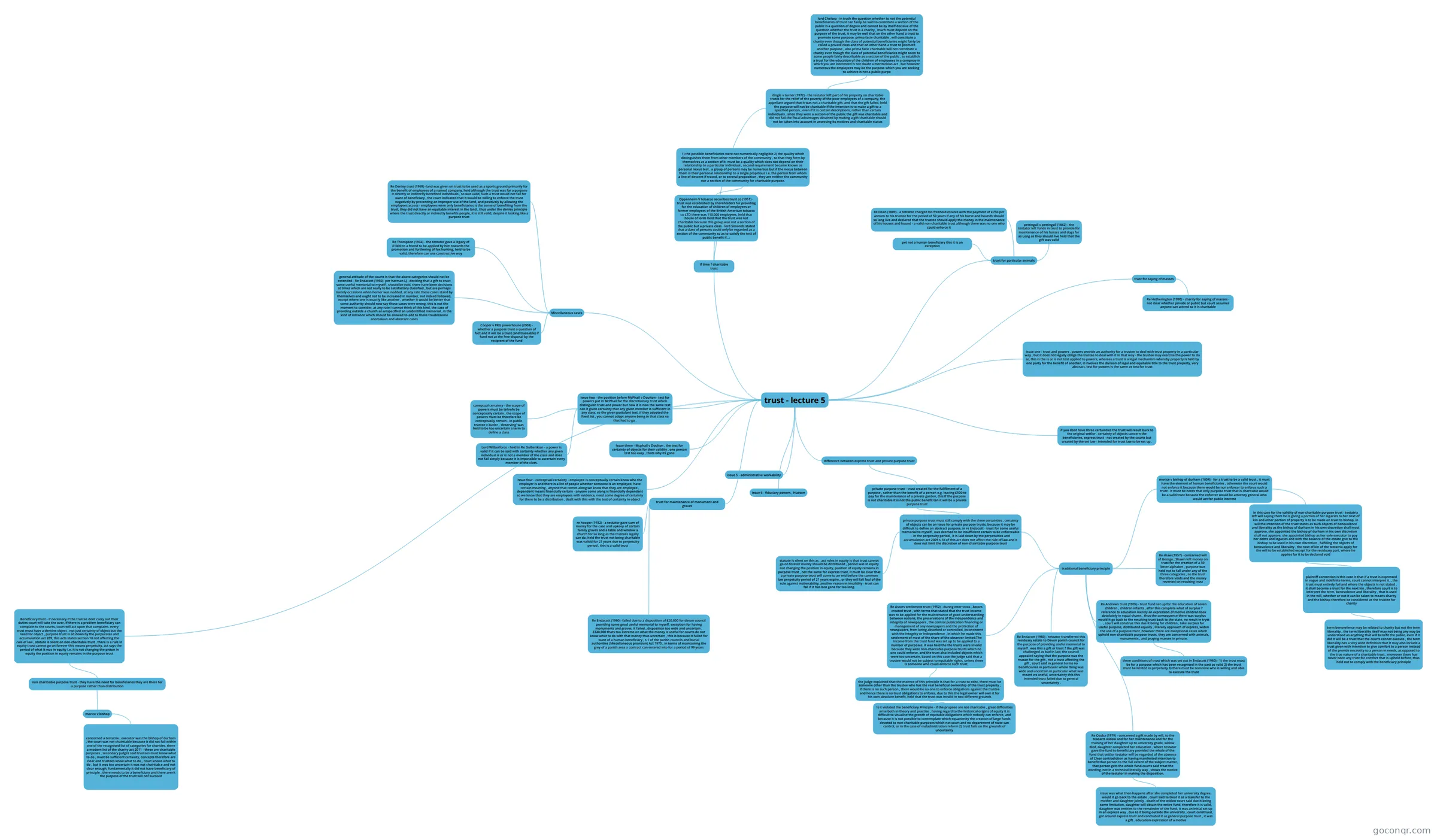
Mind map: Trust certainty lecture 5
Conteúdo do mapa
trust - lecture 5
if you dont have three certainties the trust will result back to the original settlor , certainty of objects concern the beneficiaries, express trust - not created by the courts but created by the set law - intended for trust law to be set up .
issue one - trust and powers , powers provide an authority for a trustee to deal with trust property in a particular way , but it does not legally oblige the trustee to deal with it in that way - the trustee may exercise the power to do so, this is the is or is not test applied to powers, whereas a trust is a legal mechanism whereby property is held by one party for the benefit of another, it involves the division of legal and equitable title to the trust property, very abstract, test for powers is the same as test for trust
issue two - the position before McPhail v Doulton - test for powers put in McPhail for the discretionary trust which distinguish trust and power but now it is now the same test can it given certainty that any given member is sufficient in any class, so the given postulant test .if they adopted the fixed list , you cannot adopt anyone being in that class so that had to go .
- Lord Wilberforce - held in Re Gulbenkian - a power is valid if it can be said with certainty whether any given individual is or is not a member of the class and does not fail simply because it is impossible to ascertain every member of the class.
- coneptual certainty - the scope of powers must be tehrofe be conceptually certain , the scope of powers must be therefore be conceptually certain - In public trustee v butler , 'deserving' was held to be too uncertain a term to define a class
difference between express trust and private purpose trust
- private purpose trust - trust created for the fullfilment of a purpose , rather than the benefit of a person e.g. leaving £500 to pay for the maintenance of a private garden, this If the purpose is not charitable it is not the public benefit ten it will be a private purpose trust
- private purpose trust must still comply with the three certainties , certainty of objects can be an issue for private purpose trusts, because it may be difficult to define an abstract purpose, in re Endacott - trust for some useful memorial to myself , was deemed to be insufficient certain to be enforceable - in the perpetuity period , it is laid down by the perpetuities and accumulation act 2009 s.18 of this act does not affect the rule of law and it does not limit the discretion of non-chairitable purpose trust
- statute is silent on this ac , act rules in equity is that trust cannot go on forever money should be distributed , period was in equity not changing the position in equity, position of equity remains in purpose trust , not the same for express trust, it must be clear that a private purpose trust will come to an end before the common law perpetuity period of 21 years expire,, or they will fall foul of the rule against inalienability, another reason in invalidity - trust can fail if it has ben gone for too long.
- traditional beneficiary principle
- morice v bishop of durham (1804) - for a trust to be a valid trust , it must have the element of human beneficiaries , otherwise the court would not enforce it because there would be nor enforcer to enforce such a trust . it must be notes that only purpose trust that is charitable would be a valid trust because the enforcer would be attorney general who would act for public interest
- in this case for the validity of non-charitable purpose trust - testatrix left will saying thats he is giving a portion of her legacies to her next of kin and other portion of property is to be made on trust to bishop, in will the intention of the trust states as such objects of benevolence and liberality as the bishop of durham in his own discretion shall most approve, she appointed the bishop pf durham in his own discretion shall not approve, she appointed bishop as her sole executor to pay her debts and legacies and with the balance of the estate give to the bishop to be used in his own discretion , fulfilling the objects of benevolence and liberality , the next of kin of the testatrix apply for the will to be established except for the residuary part, where he applies for it to be declared void
- plaintiff contention is this case is that if a trust is expressed in vague and indefinite terms, court cannot interpret it. , the trust must entirely fail and where the objects is not stated , it shall become a trust for the next kin , therefore court is to interpret the term, benevolence and liberality , that is used in the will, whether or not it can be taken to means charity and the bishop therefore be considered as the trustee for charity
- term benovelence may be related to charity but not the term liberality , the term liberality itself may not being any way be understood as anything that will benefit the public, even if it did it will be a trust that the courts cannot execute , the term liberality has a very wide definition that it may also include a trust given with intention to give comfort to a person instead of the provide necessity to a person in needs, as opposed to the true nature of a charitable trust , moreover there has never been any trust for comfort that is upheld before, thus held not to comply with the beneficiary principle
- plaintiff contention is this case is that if a trust is expressed in vague and indefinite terms, court cannot interpret it. , the trust must entirely fail and where the objects is not stated , it shall become a trust for the next kin , therefore court is to interpret the term, benevolence and liberality , that is used in the will, whether or not it can be taken to means charity and the bishop therefore be considered as the trustee for charity
- in this case for the validity of non-charitable purpose trust - testatrix left will saying thats he is giving a portion of her legacies to her next of kin and other portion of property is to be made on trust to bishop, in will the intention of the trust states as such objects of benevolence and liberality as the bishop of durham in his own discretion shall most approve, she appointed the bishop pf durham in his own discretion shall not approve, she appointed bishop as her sole executor to pay her debts and legacies and with the balance of the estate give to the bishop to be used in his own discretion , fulfilling the objects of benevolence and liberality , the next of kin of the testatrix apply for the will to be established except for the residuary part, where he applies for it to be declared void
- Re Astors settlement trust (1952) - during inter vivos , Astors created trust , with terms that stated that the trust income was to be applied for the maintenance of good understanding between nations, the preservations of the independence and integrity of newspapers , the control publication financing or management of any newspapers and the protection of newspapers, from being absorbed or controlled, inconsistent with the integrity or independence , in which he made this settlement of most of the share of the observer limited.The income from the trust fund was set up to be applied to a number of purposes. it was held the the trusts were invalid because they were non-charitable purpose trusts which no one could enforce, and the trust also included objects which were too uncertain, based on this case the judge said that a trustee would not be subject to equitable rights, unless there is someone who could enforce such trust.
- the judge explained that the essence of this principle is that for a trust to exist, there must be someone other than the trustee who has the real beneficial ownership of the trust property , if there is no such person , there would be no one to enforce obligations against the trustee and hence there is no trust obligations to enforce, due to this the legal owner will own it for his own absolute benefit, held that the trust was invalid in two different grounds
- 1) it violated the beneficiary Principle - if the prupseo are not charitable , great difficulties arise both in theory and practise , having regard to the historical origins of equity it is difficult to visualise the growth of equitable obligations which nobody can enforce, and because it is not possible to contemplate which equanimity the creation of large funds devoted to non-charitable purposes which not court and no department of state can control, or in the case of maladmistration reform 2) trust fails on the grounds of uncertainty
- the judge explained that the essence of this principle is that for a trust to exist, there must be someone other than the trustee who has the real beneficial ownership of the trust property , if there is no such person , there would be no one to enforce obligations against the trustee and hence there is no trust obligations to enforce, due to this the legal owner will own it for his own absolute benefit, held that the trust was invalid in two different grounds
- Re shaw (1957) - concerned will of George , Shawn left money on trust for the creation of a 40 letter alphabet , purpose was held not to fall under any of the three categories , so the trust therefore voids and the money reverted on resulting trust
- Re Endacott (1960) - testator transferred this residuary estate to Devon parish council.for the purpose of providing useful memorial to myself , was this a gift or trust ? the gift was challenged as bad in law, the council appealed saying that the purpose was the reason for the gift , not a trust affecting the gift , court said in general terms no beneficiaries in particular whole thing was wide and uncertain in particular what was meant ws useful, uncertainty this this intended trust failed due to general uncertainty .
- Re Osoba (1979) - concerned a gift made by will, to the teacarts widow and for her maintenance and for the training of her daughter up to university grade, widow died, daughter completed her education , where testator gave the fund to beneficiary provided the whole of the fund that settlor testator will be regarded of the absence of Clear contradiction as having manifested intention to benefit that person to the full extent of the subject matter, that person gets the whole fund.courts said treat the wording, not in a technical literally way , shows the motive of the testator in making the disposition.
- issue was what then happens after she completed her university degree, would it go back to the estate , court said to treat it as a transfer to the mother and daughter jointly , death of the widow court said due it being some limitation, daughter will obtain the entire fund, therefore it is valid, daughter was entitles to the remainder of the fund, it was an initial set up in an express way , due to it being outside the university , court construed, got around express trust and concluded it as general purpose trust , it was a gift , education expression of a motive
- Re Andrews trust (1905) - trust fund set up for the education of seven children , children infants , after this complete what of surplus ? reference to education merely an expression of motive children took absolutely in equal shares , thus the consequence there was surplus would it go back to the resulting trust back to the state, no result in tryst , court will construe this due it being for children , take surplus for useful purpose, distributed equally , literally approach of express, widen the use of a purpose trust ,however there are exceptional cases which uphold non-chairtiable purpose trusts, they are concerned with animals, monuments , and praying masses in private,
- three conditions of trust which was set out in Endacott (1960) - 1) the trust must be for a purpose which has been recognised in the past as valid 2) the trust must be limited in perpetuity 3) there must be someone who is willing and able to execute the trust
- morice v bishop of durham (1804) - for a trust to be a valid trust , it must have the element of human beneficiaries , otherwise the court would not enforce it because there would be nor enforcer to enforce such a trust . it must be notes that only purpose trust that is charitable would be a valid trust because the enforcer would be attorney general who would act for public interest
- private purpose trust must still comply with the three certainties , certainty of objects can be an issue for private purpose trusts, because it may be difficult to define an abstract purpose, in re Endacott - trust for some useful memorial to myself , was deemed to be insufficient certain to be enforceable - in the perpetuity period , it is laid down by the perpetuities and accumulation act 2009 s.18 of this act does not affect the rule of law and it does not limit the discretion of non-chairitable purpose trust
- private purpose trust - trust created for the fullfilment of a purpose , rather than the benefit of a person e.g. leaving £500 to pay for the maintenance of a private garden, this If the purpose is not charitable it is not the public benefit ten it will be a private purpose trust
trust for maintenance of monument and graves
- re hooper (1932) - a testator gave sum of money for the case and upkeep of certain family graves and a table and window a church for so long as the trustees legally can do, held the trust not being charitable was validd for 21 years due to perpetuity period , this is a valid trust
- Re Endacott (1960) -failed due to a disposition of £20,000 for devon council providing some good useful memorial to myself, exception for having monuments and graves, it failed , disposition too wide and uncertain , £320,000 thats too extreme on what the money is useful for courts do not know what to do with that money thus uncertain , this is because it failed for want of a human beneficiary , s.1 of the parish councils and burial authorities (Miscellaneous provision) Act 1970 , in terms of maintaining the grey of a parish area a contract can entered into for a period of 99 years
trust for saying of masses
- Re Hetherington (1990) - charity for saying of masses - not clear whether private or public but court assumes anyone can attend so it is charitable
trust for particular animals
- pet not a human beneficiary this it is an exception
- pettingall v pettingall (1842) - the testator left funds in trust to provide for maintenance of his horses and dogs for as Long as they should live held that the gift was valid
- Re Dean (1889) - a testator charged his freehold estates with the payment of £750 per annum to his trustee for the period of 50 years if any of his horse and hounds should so long live and declared that the trustee should apply the money in the maintenance of his houses and hound - a valid non-charitable trust although there was no one who could enforce it
Miscellaneous cases
- Re Thompson (1934) - the testator gave a legacy of £1000 to a friend to be applied by him towards the promotion and furthering of fox hunting, held to be valid, therefore can use constructive way
- Cooper v PRG powerhouse (2008) - whether a purpose trust a question of fact and it will be a trust (and traceable) if fund not at the free disposal by the recipient of the fund
- Re Denley trust (1969) -land was given on trust to be used as a sports ground primarily for the benefit of employees of a named company, held although the trust was for a purpose it directly or indirectly benefited individuals , so was valid, such a trust would not fail for want of beneficiary , the court indicated that it would be willing to enforce the trust negatively by preventing an improper use of the land, and positively by allowing the employees access - employees were only beneficiaries is the sense of benefiting from the trust, they did not have an equitable interest in the land , thus under the denley principle where the trust directly or indirectly benefits people, it is still valid, despite it looking like a purpose trust
- general attitude of the courts is that the above categories should not be extended - Re Endacott (1960)- per harman LJ , deciding that a gift to eract some useful memorial to myself , should be void, there have been decisions at times which are not really to be satisfactory classified , but are perhaps merely occasions when homer was nodded, at any rate these cases stand by themselves and ought not to be increased in number, not indeed followed, except where one is exactly like another , whether it would be better that some authority should now say those cases were wrong, this is not the moment to consider, at any rate I cannot think of this kind, the case of providing outside a church an unspecified an unidentified memorial , is the kind of instance which should be allowed to add to those troublesome anomalous and aberrant cases
If time ? charitable trust
- dingle v turner (1972) - the testator left part of his property on charitable trusts for the relief of the poverty of the poor employees of a company, the appellant argued that it was not a charitable gift, and that the gift failed, held the purpose will not be charitable if the intention is to make a gift to a specified person , even if it is certain descriptions, rather than certain individuals , since they were a section of the public the gift was charitable and did not fail.the fiscal advantages obtained by making a gift charitable should not be taken into account in assessing its motives and charitable status
- lord Chelsea - in truth the question whether to not the potential beneficiaries of trust can fairly be said to constitute a section of the public is a question of degree and cannot be by itself decisive of the question whether the trust is a charity , much must depend on the purpose of the trust, it may be well that on the other hand a trust to promote some purpose, prima facie charitable , will constitute a charity even though the class of potential beneficiaries might fairly be called a private class and that on other hand a trust to promote another purpose , also prima facie charitable will not constitute a charity even though the class of potential beneficiaries might seem to some people fairly describable as a section of the public , to establish a trust for the education of the children of employees in a compnay in which you are interested is not doubt a meritorious act , but however numerous the employees may be the purpose which you are seeking to achieve is not a public purpo
- Oppenheim V tobacco securities trust co (1951) - trust was established by shareholders for providing for the education of children of employees or former employees of the British American tobacco co LTD there was 110,000 employees, held that house of lords held that the trust was not charitable because this group was not a section of the public but a private class - lord Simonds stated that a class of persons could only be regarded as a section of the community so as to satisfy the test of public benefit if...:
- 1) the possible beneficiaries were not numerically negligible 2) the quality which distinguishes them from other members of the community , so that they form by themselves as a section of it, must be a quality which does not depend on their relationship to a particular individual , second requirement became known as personal nexus test , a group of persons may be numerous but if the nexus between them is their personal relationship to a single propitious i.e. the person from whom a line of descent if traced, or to several proposition , they are neither the community nor a section of the community for charitable purpose.
- dingle v turner (1972) - the testator left part of his property on charitable trusts for the relief of the poverty of the poor employees of a company, the appellant argued that it was not a charitable gift, and that the gift failed, held the purpose will not be charitable if the intention is to make a gift to a specified person , even if it is certain descriptions, rather than certain individuals , since they were a section of the public the gift was charitable and did not fail.the fiscal advantages obtained by making a gift charitable should not be taken into account in assessing its motives and charitable status
Issue three - Mcphail v Doulton , the test for certainty of objects for their validity , one person test too easy , thats why its gone
Issue four - conceptual certainty - employee is conceptually certain know who the employer is and there is a list of people whether someone is an employee, have certain meaning , anyone that comes along we know that they are employee , dependent means financially certain - anyone come along is financially dependent so we know that they are employees with evidence, need some degree of certainty for there to be a distribution , dealt with this with the test of certainty in object
issue 5 - administrative workability
issue 6 - fiduciary powers , Hudson
Beneficiary trust - if necessary If the trustee dont carry out their duties court will take the over, if there is a problem beneficiary can complain to the courts, court will act upon that complaint. every trust must have a dentine object , not just certainty of object but the need for object , purpose trust is lid down by the purpurates and accumulation act 209, this acts states section 18 not affecting the rule of law , statute is silent on non-charitable trust , there is a rule in equity trust cannot go on forever this means perpetuity, act says the period of what It was in equity i.e. it is not changing the piston in equity the position in equity remains in the purpose trust
- non charitiable purpose trust - they have the need for beneficiaries they are there for a purpose rather than distribution
- morice v bishop
- concerned a testatrix , executor was the bishop of durham , the court was not chairtiable because it did not fail within one of the recognised list of categories for charities, there a modern list of the charity act 2011 - these are charitable purposes , secondary judges said trustees must know what to do , must be sufficient certainty, concepts therefore are clear and trustees know what to do , court knows what to do , but it was too uncertain it was not chairtiab,e and not clear enough, fundamentally it did not have beneficiary of principle , there needs to be a beneficiary and there aren't the purpose of the trust will not succeed
- morice v bishop
- non charitiable purpose trust - they have the need for beneficiaries they are there for a purpose rather than distribution
Informações
- Descrição
- Law Mapa Mental sobre trust - lecture 5, criado por Anika B em 14-12-2018.
- Criado por
- Anika B
- Visualizações
- 0
- Avaliação