
Mapa mental
Physics 1
Conteúdo do mapa
Physics 1
Energy Transfers by heating
- Infrared radiation
- Infrared radiation is energy transferred by electromagnetic waves. The higher the temperature of an object, the more radiation is emitted each second. Infrared cameras can pick up infrared radiation and the higher temperatures have a white-yellow colour; lower are purple. All hot objects emit infrared radiation, e.g. humans or an iron.
- Convection & Conduction
- Conduction occurs through electrons, in solids best but also in liquids. Metals are better conductors than nonmetals.
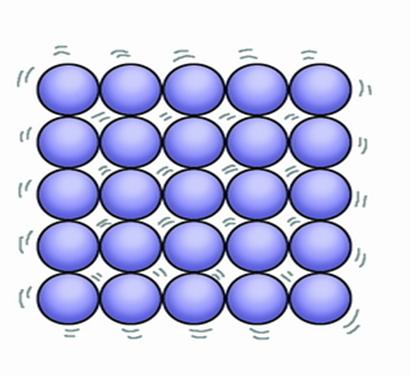
- Why? Metals are good conductors of energy because the electrons of the atoms are delocalised, which means they can move freely. In a solid, the atoms are packed closely together so the electrons do not have to travel far to transfer the energy through vibrations. In a nonmetal solid the electrons are attached to their atoms and the energy transfer can only happen through the vibration of the atoms, not movement. The metals can conduct much faster because of the free-moving electrons in the solid.
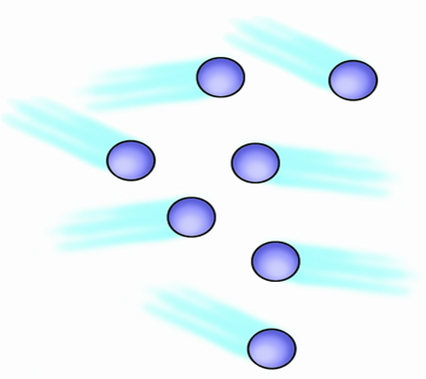
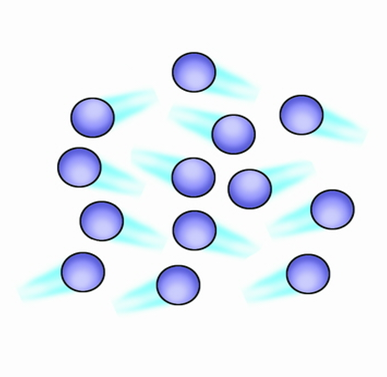
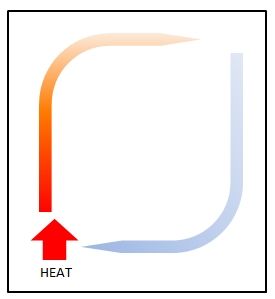
- Convection happens in the air. It can't happen in solids because the particles are more dense than those in a liquid or gas and there is no room in the solid for the particles to rise and sink.
- Heated particles gain energy and move further apart. Since they are less dense, they rise in the water/air.
- Heated particles displace colder, denser water.
- Colder water sinks as it is more dense.
- Heated particles displace colder, denser water.
- Heated particles gain energy and move further apart. Since they are less dense, they rise in the water/air.
- Conduction occurs through electrons, in solids best but also in liquids. Metals are better conductors than nonmetals.
- Evaporation & Condensation
- Factors increasing the rate of evaporation: increasing the surface area of the liquid, increasing the temperature of the liquid, creating a draught of air acacross the liquid's surface
- Factors increasing the rate of condensation: reducing the surface area and reducing the temperature of the surface.
- A vacuum is a space void of particles or matter.
- Infrared radiation
Specific heat capacity
- e = m x c x (theta)
- Definition: the specific heat capacity of a substance is the amount of energy required to raise the temperature of 1kg of the substance by 1 degree Celsius.
Solid, liquid and gas
Using energy
- Types of energy: kinetic, light, sound, nuclear, electrical, gravitational potential, elastic potential and thermal.
- Conservation of mass: energy cannot be created or destroyed.
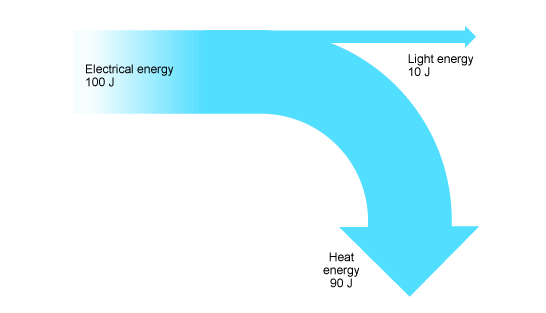
- Sankey diagram
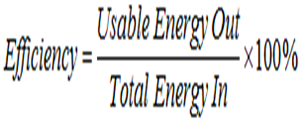
- Efficiency
Electrical energy
- power = energy/time
- Power = W or kW Energy = J Time = s
- power rating = joules per second
- Costs involved in different appliances: capital, running, interest and environmental.
- Kilowatt-hour is one unit of electrical energy
- Payback time = cost/savings each year
- Definition: how long it takes for the saved money to equal the cost.
- power = energy/time
Generating electricity
- Fossil fuels (coal, natural gas and crude oil); Nuclear power stations
- Fossil fuels are used to generate electricity in fossil fuel power stations, about three quarters of the UK's electricity. They release lots of greenhouse gases, like carbon dioxide.
- The release of the energy comes from fission, splitting of the nuclear atom, uranium. The process doesn't release any greenhouse gases.
- Renewable energy sources
- Hydroelectric: a dam creates an artificial reservoir/lake. Once it is released, it spins a turbine and generates electricity.
- Advantage: eco-friendly
- Disadvantage: very expensive.
- Wind: energy from the wind turns the blades, connected to a shaft and spinning a generator.
- Advantage: eco-friendly
- Disadvantage: ugly
- Tidal: energy from the water turns the blades (like underwater windmills)
- Advantage: eco-friendly.
- Disadvantage: very costly.
- Wave: the waves' energy turn the turbine and activate the generator.
- Advantage: eco-friendly
- Disadvantage: expensive to construct
- Solar: energy is absorbed from the sun's rays through solar panels, where it is converted later into electricity.
- Advantage: eco-friendly
- Disadvantage: expensive to buy and install for homeowners.
- Hydroelectric: a dam creates an artificial reservoir/lake. Once it is released, it spins a turbine and generates electricity.
- The National Grid
- Electricity is generated at a power station, transferred to a step-up transformer (which increases the voltage) and across power lines in the pylons, to step-down transformer, decreasing the voltage, and then to the home.
- Carbon capture: it is a rapidly evolving technology that involves separating carbon dioxide from waste gases. The carbon dioxide is then stored underground, for example in old oil fields or gas fields such as those found under the North Sea.
- Fossil fuels (coal, natural gas and crude oil); Nuclear power stations
Refraction
- The angle of refraction is always smaller than the angle of incidence because the light bends as it passes from a medium to a denser one, like air to glass.
- The change of direction of light is known as refraction. It is a property of all forms of waves, including light and sound.
- A light ray: changes direction towards the normal when it changes from air to glass (the angle or fraction (r) is smaller than the angle of incidence (i)); changes direction away from the normal when it travels from glass to air (the angle of refraction is greater than the angle of incidence).
Reflection
- Light consist of waves. When plane (straight) waves reflect from a flat reflector, the reflected waves are at an angle to the reflectors the incident waves.
- The line perpendicular to the mirror is the 'normal'.
- The angle of incidence (i) is the angle between the incidence ray and the normal.
- The angle of reflection (r) is the angle between the reflected ray and the normal.
- angle of reflection = angle of incidence
Diffraction
- Diffraction is the spreading of waves when they pass through a gap or move past an obstacle.
- The narrower the gap, the more the waves spread out. The wider the gap, the less the waves spread out.
- v = f x λ
Electromagnetic waves = transverse Sound waves = longitudinal Mechanical waves = both
- Waves are used to transfer information and energy.
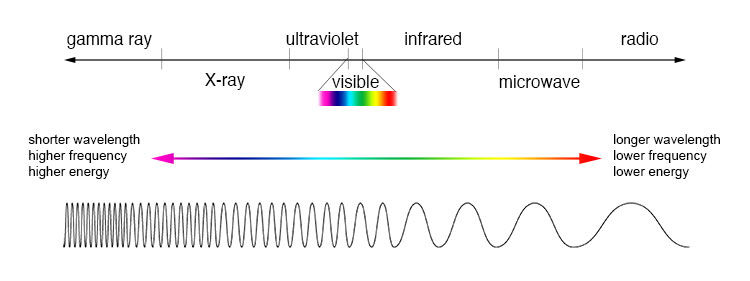
- The Electromagnetic Spectrum
The Big Bang Theory
- The Big Bang theory states that: the universe is expanding after exploding suddenly in the Big Bang; space, time and matter were created in the Big Bang.
- There are other theories as to how the universe was created, but cosmic microwave background radiation (CMBR) can only be explained by the Big Bang theory. It started as high energy gamma radiation that has been travelling through the universe since the Big Bang. As the universe has expanded, the wavelength of the radiation increased and became microwave radiation.
- Red shift is the theory that as noise gets closer to you, the pitch increases because the waves are condensed (squashed) together and the wavelength decreases as the amplitude lengthens.
Imagens e arquivos do mapa
Informações
- Descrição
- Mapa Mental sobre Physics 1, criado por lcoetze em 21-01-2015.
- Criado por
- lcoetze
- Visualizações
- 3
- Avaliação