
Mapa mental
Atomic Structure and the Periodic Table (Paper 1)
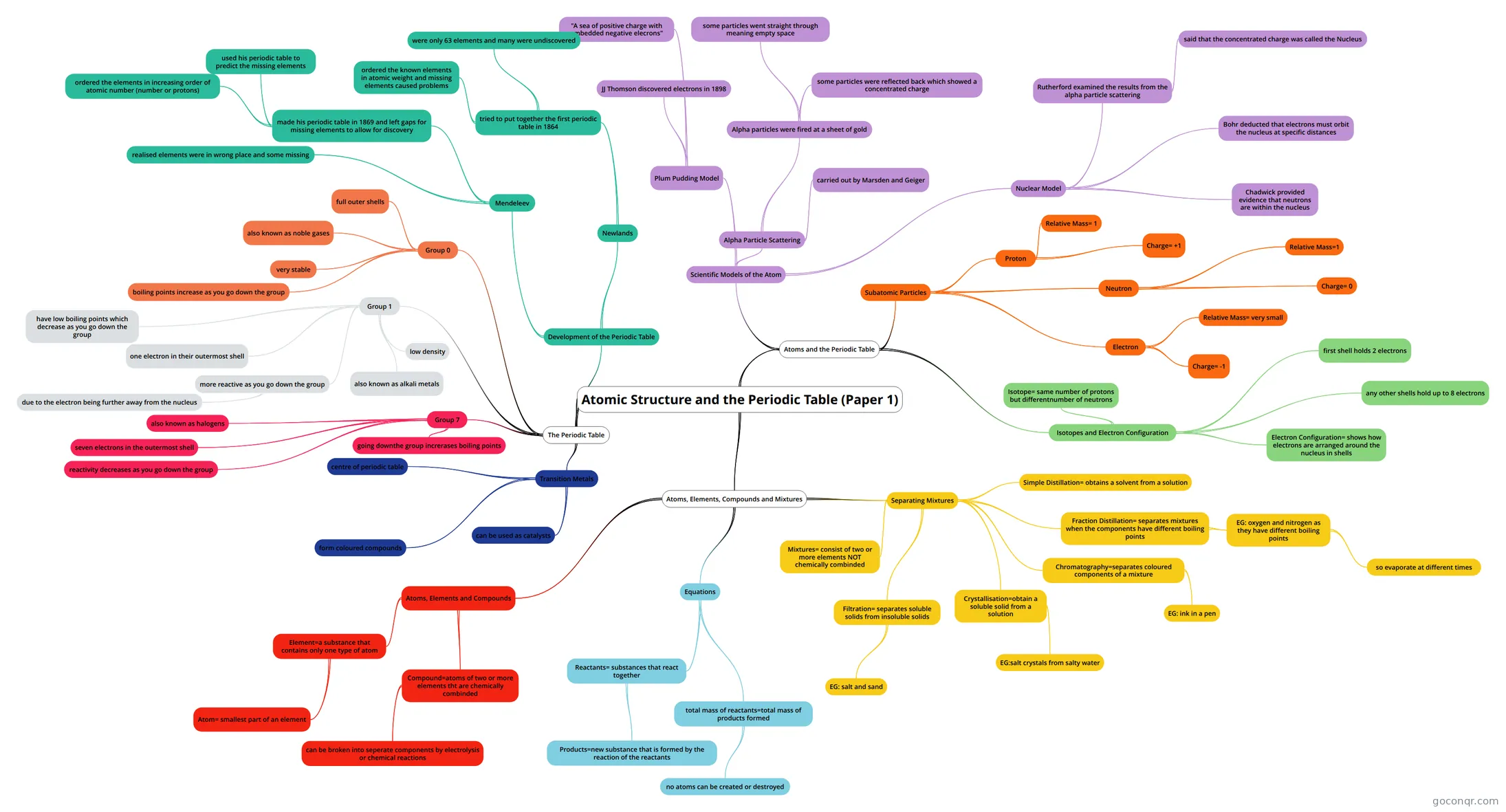
Mind map: Atomic Structure and the Periodic Table
Conteúdo do mapa
Atomic Structure and the Periodic Table (Paper 1)
Atoms, Elements, Compounds and Mixtures
- Atoms, Elements and Compounds
- Element=a substance that contains only one type of atom
- Atom= smallest part of an element
- Compound=atoms of two or more elements tht are chemically combinded
- can be broken into seperate components by electrolysis or chemical reactions
- Element=a substance that contains only one type of atom
- Equations
- Reactants= substances that react together
- Products=new substance that is formed by the reaction of the reactants
- total mass of reactants=total mass of products formed
- no atoms can be created or destroyed
- Reactants= substances that react together
- Separating Mixtures
- Mixtures= consist of two or more elements NOT chemically combinded
- Filtration= separates soluble solids from insoluble solids
- EG: salt and sand
- Crystallisation=obtain a soluble solid from a solution
- EG:salt crystals from salty water
- Simple Distillation= obtains a solvent from a solution
- Fraction Distillation= separates mixtures when the components have different boiling points
- EG: oxygen and nitrogen as they have different boiling points
- so evaporate at different times
- EG: oxygen and nitrogen as they have different boiling points
- Chromatography=separates coloured components of a mixture
- EG: ink in a pen
- Atoms, Elements and Compounds
Atoms and the Periodic Table
- Scientific Models of the Atom
- Plum Pudding Model
- JJ Thomson discovered electrons in 1898
- "A sea of positive charge with embedded negative elecrons"
- Nuclear Model
- Rutherford examined the results from the alpha particle scattering
- said that the concentrated charge was called the Nucleus
- Bohr deducted that electrons must orbit the nucleus at specific distances
- Chadwick provided evidence that neutrons are within the nucleus
- Rutherford examined the results from the alpha particle scattering
- Alpha Particle Scattering
- Alpha particles were fired at a sheet of gold
- some particles went straight through meaning empty space
- some particles were reflected back which showed a concentrated charge
- carried out by Marsden and Geiger
- Alpha particles were fired at a sheet of gold
- Plum Pudding Model
- Subatomic Particles
- Proton
- Relative Mass= 1
- Charge= +1
- Neutron
- Relative Mass=1
- Charge= 0
- Electron
- Relative Mass= very small
- Charge= -1
- Proton
- Isotopes and Electron Configuration
- Isotope= same number of protons but differentnumber of neutrons
- first shell holds 2 electrons
- any other shells hold up to 8 electrons
- Electron Configuration= shows how electrons are arranged around the nucleus in shells
- Scientific Models of the Atom
The Periodic Table
- Development of the Periodic Table
- Newlands
- tried to put together the first periodic table in 1864
- were only 63 elements and many were undiscovered
- ordered the known elements in atomic weight and missing elements caused problems
- tried to put together the first periodic table in 1864
- Mendeleev
- realised elements were in wrong place and some missing
- made his periodic table in 1869 and left gaps for missing elements to allow for discovery
- used his periodic table to predict the missing elements
- ordered the elements in increasing order of atomic number (number or protons)
- Newlands
- Group 0
- also known as noble gases
- full outer shells
- very stable
- boiling points increase as you go down the group
- Group 1
- also known as alkali metals
- one electron in their outermost shell
- more reactive as you go down the group
- due to the electron being further away from the nucleus
- have low boiling points which decrease as you go down the group
- low density
- Group 7
- also known as halogens
- seven electrons in the outermost shell
- reactivity decreases as you go down the group
- going downthe group increrases boiling points
- Transition Metals
- centre of periodic table
- form coloured compounds
- can be used as catalysts
- Development of the Periodic Table
Informações
- Descrição
- GCSE Chemistry (Paper 1) Mapa Mental sobre Atomic Structure and the Periodic Table (Paper 1), criado por Abigail Rodgers em 09-02-2020.
- Criado por
- Abigail Rodgers
- Visualizações
- 2
- Avaliação
Mais sobre Periodic Table and Trends