
Mapa mental
french
Conteúdo do mapa
french
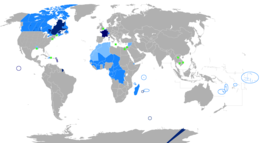
places where french is spoken
- French is also one of the official languages of Belgium (4.3 million French-speaking Belgians), where the official language of Wallonia is, while in the capital, Brussels, it is the most widely spoken language (90% of the inhabitants) and is co-official with the Dutch; It is present in other countries such as Switzerland, where 29% of the population speaks it (1.75 million francophones at the end of 2006), in Monaco it is the only official language since the approval of the 1962 Constitution.9 Although Catalan is the Official language In Andorra, French is commonly spoken, more in some cities than in others, in addition to Spanish, Andorra enjoys three educational systems: Andorran, French and Spanish; in Luxembourg, where he is co-official with Germans and Luxembourgers; in Italy (only in the Aosta Valley) and in the Channel Islands. It is also known in the border areas of northern Spain, where there is a significant percentage of bilinguals, especially in the Llívia enclave. The s
- French is also one of the official languages of Belgium (4.3 million French-speaking Belgians), where the official language of Wallonia is, while in the capital, Brussels, it is the most widely spoken language (90% of the inhabitants) and is co-official with the Dutch; It is present in other countries such as Switzerland, where 29% of the population speaks it (1.75 million francophones at the end of 2006), in Monaco it is the only official language since the approval of the 1962 Constitution.9 Although Catalan is the Official language In Andorra, French is commonly spoken, more in some cities than in others, in addition to Spanish, Andorra enjoys three educational systems: Andorran, French and Spanish; in Luxembourg, where he is co-official with Germans and Luxembourgers; in Italy (only in the Aosta Valley) and in the Channel Islands. It is also known in the border areas of northern Spain, where there is a significant percentage of bilinguals, especially in the Llívia enclave. The s
why it is important?
- French is the second most widely spoken language in the European Union as a mother tongue, after German and ahead of English. It is often called "the language of Molière", named after one of the most famous French writers. It is one of the 24 official and working languages in the EU.
- French is the second most widely spoken language in the European Union as a mother tongue, after German and ahead of English. It is often called "the language of Molière", named after one of the most famous French writers. It is one of the 24 official and working languages in the EU.
history
- Training period
- The history of the French language begins with the invasion of Gaul by the Roman army under the command of Julius Caesar between 58 and 50 B.C. Gaul is considered to have about 10 million inhabitants. After the conquest, the Roman soldiers and merchants imported with them the sermo daily or vulgar Latin. Despite the apparent similarity between both languages (syntax, numbering, morphology ...) Gallic and Vulgar Latin, assimilation is slow, since it is acquired after several centuries, probably after the evangelization of the rural environment under Dagoberto I. Latin functioned as a written and administrative language, although Gallic, orally unwritten, retained its role as a language of exchange until the 3rd century in the urban centers that had developed under the Romans. On the other hand, the advance of Romanization differed markedly from one area to another, it was more intense and faster on the Mediterranean coast and in the regions around Lyon (Lugdunum), Autun (Augustodunum
- Gallo-Romance Period
- For a long time, the language spoken in northern Gaul (in reality already France) was a variety of Latin, influenced by the francico, germanic language spoken by the francs, that influenced fundamentally in the phonetics of French. To the south, evolution is different, so little by little two languages are differentiated with a border that in principle will be marked in the Loire, although at throughout history it will move increasingly southward, due to the political thrust of a France whose political center was in Paris and since the French Revolution the French language it became an identifying and equalizing element of all French. The langue d'oïl (oïl has evolved into oui) was spoken in the north and langue d'oc in the south. The parting line was going from the Massif Central to the mouth of the Loire at Nantes.
- Middle French: 14th and 17th centuries
- This language of transition between old French and modern French remained during the fourteenth and sixteenth centuries, characterized by great disorder. The fourteenth century was marked by the great plague and the Hundred Years War, which led to a great disorganization of institutions. In this period the Livre des merveilles du monde by Jean de Mandeville is important on the linguistic level. This book, which tells the author's trip to China, is a manuscript of which 250 copies in different languages were published. In the 14th century, Les Enseignemenz, a recipe book written between 1304 and 1314, recommends
- Training period
Nationalization and internationalization of the French language
- At the beginning of the French Revolution, it is estimated that only a quarter of the population of France spoke French, the rest spoke regional languages. To the north are the languages of oïl, to the south the languages of oc, regional forms of Occitan, as well as Breton, Euskera, Catalan, Arpitano, Flemish and Alsatian, among others. The unification of French started by Talleyrand and continued by Jules Ferry aimed to create a single French language for the entire French territory. If French prevailed fairly quickly in the regions where dialects of Oïl and Franco-Provençal were spoken, other methods were used to eliminate Breton, Occitan, Catalan, Basque, Corsican, etc. (as physical humiliations for young students). In his June 1794 report, Henri Grégoire revealed that French was only "exclusively" spoken in "some fifteen departments" (out of 83). To him it seemed paradoxical, and almost unbearable, to find that less than three million French out of a total of 28 could speak
José Manuel Machado Villegas
Imagens e arquivos do mapa
Informações
- Descrição
- Mapa Mental sobre french, criado por José Manuel Machado Villegas em 13-04-2020.
- Criado por
- José Manuel Machado Villegas
- Visualizações
- 1
- Avaliação