
Mapa mental
Stress
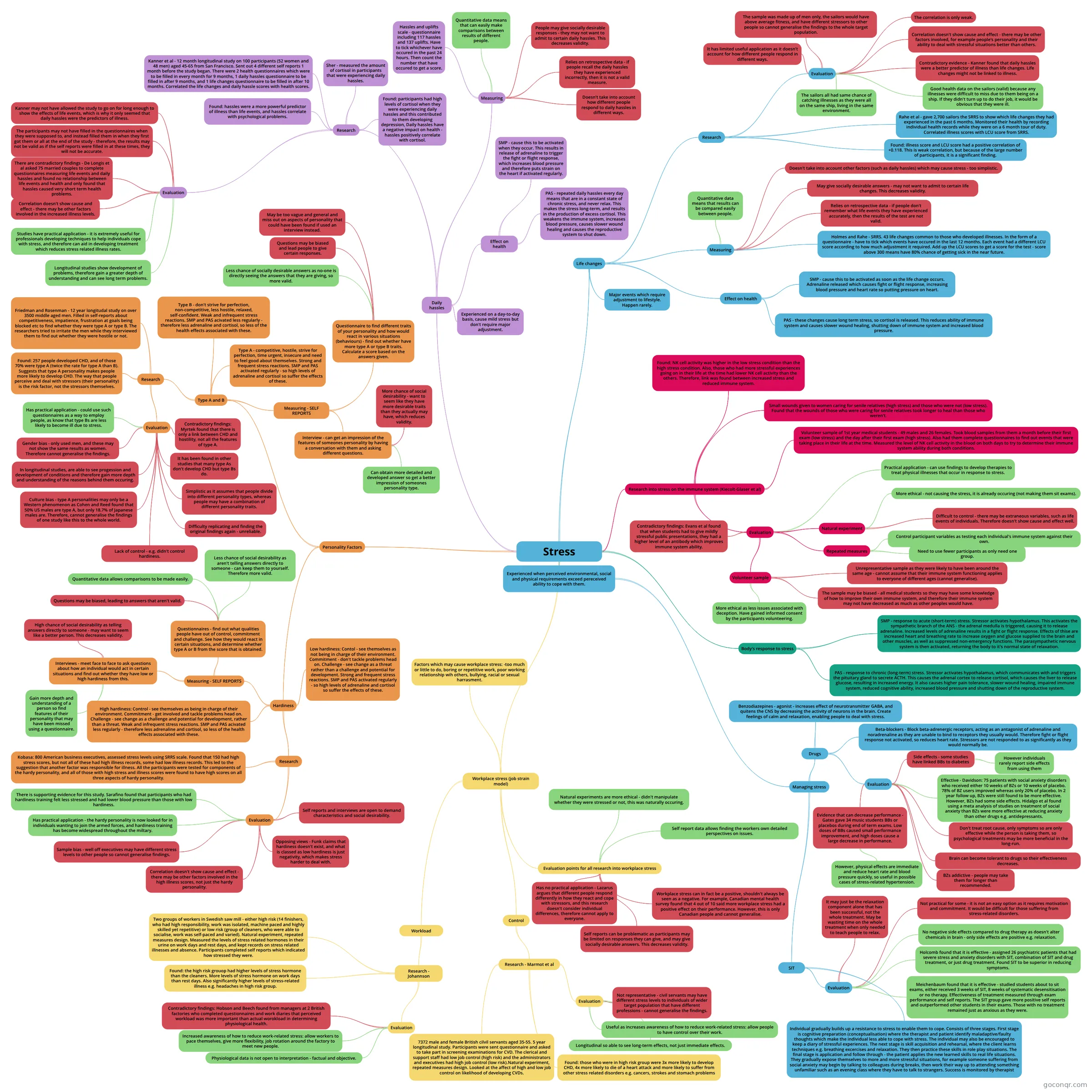
Mind map: Stress
Conteúdo do mapa
Stress
Body's response to stress
- SMP - response to acute (short-term) stress. Stressor activates hypothalamus. This activates the sympathetic branch of the ANS - the adrenal medulla is triggered, causing it to release adrenaline. Increased levels of adrenaline results in a fight or flight response. Effects of thise are increased heart and breathing rate to increase oxygen and glucose supplied to the brain and other muscles, as well as suppressed non-emergency functions. The parasympathetic nervous system is then activated, returning the body to it's normal state of relaxation.
- PAS - response to chronic (long-term) stress. Stressor activates hypothalamus, which communicates with and triggers the pituitary gland to secrete ACTH. This causes the adrenal cortex to release cortisol, which causes the liver to release glucose, resulting in increased energy. It also causes higher pain tolerance, slower wound healing, impaired immune system, reduced cognitive ability, increased blood pressure and shutting down of the reproductive system.
Experienced when perceived environmental, social and physical requirements exceed pereceived ability to cope with them.
- Managing stress
- Drugs
- Benzodiazepines - agonist - increases effect of neurotransmitter GABA, and quitens the CNS by decreasing the activity of neurons in the brain. Create feelings of calm and relaxation, enabling people to deal with stress.
- Beta-blockers - Block beta-adrenergic receptors, acting as an antagonist of adrenaline and noradrenaline as they are unable to bind to receptors they usually would. Therefore fight or flight response not activated, so reduces heart rate. Stressors are not responded to as significantly as they would normally be.
- Evaluation
- Side effects - some studies have linked BBs to diabetes
- However individuals rarely report side effects from using them
- Effective - Davidson: 75 patients with social anxiety disorders who received either 10 weeks of BZs or 10 weeks of placebo. 78% of BZ users improved whereas only 20% of placebo. In 2 year follow up, BZs were still found to be more effective. However, BZs had some side effects. Hidalgo et al found using a meta analysis of studies on treatment of social anxiety than BZs were more effective at reducing anxiety than other drugs e.g. antidepressants.
- Don't treat root cause, only symptoms so are only effective while the person is taking them, so psychological treatments may be more beneficial in the long-run.
- Evidence that can decrease performance - Gates gave 34 music students BBs or placebos during end of term exams. Low doses of BBs caused small performance improvement, and high doses cause a large decrease in performance.
- However, physical effects are immediate and reduce heart rate and blood pressure quickly, so useful in possible cases of stress-related hypertension.
- BZs addictive - people may take them for longer than recommended.
- Brain can become tolerant to drugs so their effectiveness decreases.
- Side effects - some studies have linked BBs to diabetes
- SIT
- Individual gradually builds up a resistance to stress to enable them to cope. Consists of three stages. First stage is cognitive preparation (conceptualisation) where the therapist and patient identify maladaptive/faulty thoughts which make the individual less able to cope with stress. The individual may also be encouraged to keep a diary of stressful experiences. The next stage is skill acquisition and rehearsal, where the client learns techniques e.g. breathing excercises and relaxation. They then practice these skills in role play situations. The final stage is application and follow through - the patient applies the new learned skills to real life situations. They gradually expose themselves to more and more stressful situations, for example someone suffering from social anxiety may begin by talking to colleagues during breaks, then work their way up to attending something unfamiliar such as an evening class where they have to talk to strangers. Success is monitored by therapist
- Evaluation
- Meichenbaum found that it is effective - studied students about to sit exams, either received 3 weeks of SIT, 8 weeks of systematic desensitisation or no therapy. Effectiveness of treatment measured through exam performance and self reports. The SIT group gave more positive self reports and outperformed other students in their exams. Those with no treatment remained just as anxious as they were.
- Holcomb found that it is effective - assigned 26 psychiatric patients that had severe stress and anxiety disorders with SIT, combination of SIT and drug treatment, or just drug treatment. Found SIT to be superior in reducing symptoms.
- No negative side effects compared to drug therapy as doesn't alter chemicals in brain - only side effects are positive e.g. relaxation.
- Not practical for some - it is not an easy option as it requires motivation and commitment. It would be difficult for those suffering from stress-related disorders.
- It may just be the relaxation component alone that has been successful, not the whole treatment. May be wasting time on the whole treatment when only needed to teach people to relax.
- Drugs
- Managing stress
Research into stress on the immune system (Kiecolt-Glaser et al)
- Volunteer sample of 1st year medical students - 49 males and 26 females. Took blood samples from them a month before their first exam (low stress) and the day after their first exam (high stress). Also had them complete questionnaires to find out events that were taking place in their life at the time. Measured the level of NK cell activity in the blood on both days to try to determine their immune system ability during both conditions.
- Found: NK cell activity was higher in the low stress condition than the high stress condition. Also, those who had more stressful experiences going on in their life at the time had lower NK cell activity than the others. Therefore, link was found between increased stress and reduced immune system.
- Small wounds given to women caring for senile relatives (high stress) and those who were not (low stress). Found that the wounds of those who were caring for senile relatives took longer to heal than those who weren't.
- Evaluation
- Natural experiment
- More ethical - not causing the stress, it is already occuring (not making them sit exams).
- Difficult to control - there may be extraneous variables, such as life events of individuals. Therefore doesn't show cause and effect well.
- Repeated measures
- Need to use fewer participants as only need one group.
- Control participant variables as testing each individual's immune system against their own.
- Volunteer sample
- More ethical as less issues associated with deception. Have gained informed consent by the participants volunteering.
- The sample may be biased - all medical students so they may have some knowledge of how to improve their own immune system, and therefore their immune system may not have decreased as much as other peoples would have.
- Unrepresentative sample as they were likely to have been around the same age - cannot assume that their immune system functioning applies to everyone of different ages (cannot generalise).
- Practical application - can use findings to develop therapies to treat physical illnesses that occur in response to stress.
- Contradictory findings: Evans et al found that when students had to give mildly stressful public presentations, they had a higher level of an antibody which improves immune system ability.
- Natural experiment
Life changes
- Research
- Rahe et al - gave 2,700 sailors the SRRS to show which life changes they had experienced in the past 6 months. Monitored their health by recording individual health records while they were on a 6 month tour of duty. Correlated illness scores with LCU score from SRRS.
- Found: illness score and LCU score had a positive correlation of +0.118. This is weak correlation, but because of the large number of participants, it is a significant finding.
- Evaluation
- Good health data on the sailors (valid) because any illnesses were difficult to miss due to them being on a ship. If they didn't turn up to do their job, it would be obvious that they were ill.
- Correlation doesn't show cause and effect - there may be other factors involved, for example people's personality and their ability to deal with stressful situations better than others.
- The sailors all had same chance of catching illnesses as they were all on the same ship, living in the same environment.
- The correlation is only weak.
- The sample was made up of men only, the sailors would have above average fitness, and have different stressors to other people so cannot generalise the findings to the whole target population.
- It has limited useful application as it doesn't account for how different people respond in different ways.
- Contradictory evidence - Kanner found that daily hassles were a better predictor of illness than life changes. Life changes might not be linked to illness.
- Major events which require adjustment to lifestyle. Happen rarely.
- Effect on health
- SMP - cause this to be activated as soon as the life change occurs. Adrenaline released which causes fight or flight response, increasing blood pressure and heart rate so putting pressure on heart.
- PAS - these changes cause long term stress, so cortisol is released. This reduces ability of immune system and causes slower wound healing, shutting down of immune system and increased blood pressure.
- Measuring
- Holmes and Rahe - SRRS. 43 life changes common to those who developed illnesses. In the form of a questionnaire - have to tick which events have occured in the last 12 months. Each event had a different LCU score according to how much adjustment it required. Add up the LCU scores to get a score for the test - score above 300 means have 80% chance of getting sick in the near future.
- Relies on retrospective data - if people don't remember what life events they have experienced accurately, then the results of the test are not valid.
- May give socially desirable answers - may not want to admit to certain life changes. This decreases validity.
- Doesn't take into account other factors (such as daily hassles) which may cause stress - too simplistic.
- Quantitative data means that results can be compared easily between people.
- Research
Daily hassles
- Experienced on a day-to-day basis, cause mild stress but don't require major adjustment.
- Measuring
- Hassles and uplifts scale - questionnaire including 117 hassles and 137 uplifts. Have to tick whichever have occured in the past 24 hours. Then count the number that have occured to get a score.
- Doesn't take into account how different people respond to daily hassles in different ways.
- Relies on retrospective data - if people recall the daily hassles they have experienced incorrectly, then it is not a valid measure.
- People may give socially desirable responses - they may not want to admit to certain daily hassles. This decreases validity.
- Quantitative data means that can easily make comparisons between results of different people.
- Research
- Kanner et al - 12 month longitudinal study on 100 participants (52 women and 48 men) aged 45-65 from San Francisco. Sent out 4 different self reports 1 month before the study began. There were 2 health questionnaires which were to be filled in every month for 9 months, 1 daily hassles questionnaire to be filled in after 9 months, and 1 life changes questionnaire to be filled in after 10 months. Correlated the life changes and daily hassle scores with health scores.
- Found: hassles were a more powerful predictor of illness than life events, and hassles correlate with psychological problems.
- Sher - measured the amount of cortisol in participants that were experiencing daily hassles.
- Found: participants had high levels of cortisol when they were experiencing daily hassles and this contributed to them developing depression, Daily hassles have a negative impact on health - hassles positively correlate with cortisol.
- Evaluation
- Kanner may not have allowed the study to go on for long enough to show the effects of life events, which is why it only seemed that daily hassles were the predictors of illness.
- The participants may not have filled in the questionnaires when they were supposed to, and instead filled them in when they first got them or all at the end of the study - therefore, the results may not be valid as if the self reports were filled in at these times, they will not be accurate.
- Studies have practical application - it is extremely useful for professionals developing techniques to help individuals cope with stress, and therefore can aid in developing treatment which reduces stress related illness rates.
- Correlation doesn't show cause and effect - there may be other factors involved in the increased illness levels.
- There are contradictory findings - De Longis et al asked 75 married couples to complete questionnaires measuring life events and daily hassles and found no relationship between life events and health and only found that hassles caused very short term health problems.
- Longitudinal studies show development of problems, therefore gain a greater depth of understanding and can see long term problems.
- Effect on health
- SMP - cause this to be activated when they occur. This results in release of adrenaline to trigger the fight or flight response, which increases blood pressure and therefore puts strain on the heart if activated regularly.
- PAS - repeated daily hassles every day means that are in a constant state of chronic stress, and never relax. This makes the stress long-term, and results in the production of excess cortisol. This weakens the immune system, increases blood pressure, causes slower wound healing and causes the reproductive system to shut down.
Personality Factors
- Type A and B
- Type A - competitive, hostile, strive for perfection, time urgent, insecure and need to feel good about themselves. Strong and frequent stress reactions. SMP and PAS activated regularly - so high levels of adrenaline and cortisol so suffer the effects of these.
- Type B - don't strive for perfection, non-competitive, less hostile, relaxed, self-confident. Weak and infrequent stress reactions. SMP and PAS acivated less regularly - therefore less adrenaline and cortisol, so less of the health effects associated with these.
- Research
- Friedman and Rosenman - 12 year longitudal study on over 3500 middle aged men. Filled in self-reports about competitiveness, impatience, frustration at goals being blocked etc to find whether they were type A or type B. The researchers tried to irritate the men while they interviewed them to find out whether they were hostile or not.
- Found: 257 people developed CHD, and of those 70% were type A (twice the rate for type A than B). Suggests that type A personality makes people more likely to develop CHD. The way that people perceive and deal with stressors (their personality) is the risk factor, not the stressors themselves.
- Evaluation
- Has practical application - could use such questionnaires as a way to employ people, as know that type Bs are less likely to become ill due to stress.
- Gender bias - only used men, and these may not show the same results as women. Therefore cannot generalise the findings.
- In longitudinal studies, are able to see progession and development of conditions and therefore gain more depth and understanding of the reasons behind them occuring.
- Culture bias - type A personalities may only be a Western phenomenon as Cohen and Reed found that 50% US males are type A, but only 18.7% of Japanese males are. Therefore, cannot generalise the findings of one study like this to the whole world.
- It has been found in other studies that many type As don't develop CHD but type Bs do.
- Simplistic as it assumes that people divide into different personality types, whereas people may have a combination of different personality traits.
- Contradictory findings: Myrtek found that there is only a link between CHD and hostility, not all the features of type A.
- Difficulty replicating and finding the original findings again - unreliable.
- Lack of control - e.g. didn't control hardiness.
- Measuring - SELF REPORTS
- Questionnaire to find different traits of your personality and how would react in various situations (behaviours) - find out whether have more type A or type B traits. Calculate a score based on the answers given.
- Questions may be biased and lead people to give certain responses.
- May be too vague and general and miss out on aspects of personality that could have been found if used an interview instead.
- Less chance of socially desirable answers as no-one is directly seeing the answers that they are giving, so more valid.
- Interview - can get an impression of the features of someones personality by having a conversation with them and asking different questions.
- More chance of social desirability - want to seem like they have more desirable traits than they actually may have, which reduces validity.
- Can obtain more detailed and developed answer so get a better impression of someones personality type.
- Questionnaire to find different traits of your personality and how would react in various situations (behaviours) - find out whether have more type A or type B traits. Calculate a score based on the answers given.
- Hardiness
- Measuring - SELF REPORTS
- Questionnaires - find out what qualities people have out of control, commitment and challenge. See how they would react in certain situations, and determine whether type A or B from the score that is obtained.
- Questions may be biased, leading to answers that aren't valid.
- Quantitative data allows comparisons to be made easily.
- Less chance of social desirability as aren't telling answers directly to someone - can keep them to yourself. Therefore more valid.
- Interviews - meet face to face to ask questions about how an individual would act in certain situations and find out whether they have low or high hardiness from this.
- Gain more depth and understanding of a person so find features of their personality that may have been missed using a questionnaire.
- High chance of social desirability as telling answers directly to someone - may want to seem like a better person. This decreases validity.
- Questionnaires - find out what qualities people have out of control, commitment and challenge. See how they would react in certain situations, and determine whether type A or B from the score that is obtained.
- Research
- Kobasa: 800 American business executives, assessed stress levels using SRRS scale. Found that 150 had high stress scores, but not all of these had high illness records, some had low illness records. This led to the suggestion that another factor was responsible for illness. All the participants were tested for components of the hardy personality, and all of those with high stress and illness scores were found to have high scores on all three aspects of hardy personality.
- Evaluation
- There is supporting evidence for this study. Sarafino found that participants who had hardiness training felt less stressed and had lower blood pressure than those with low hardiness.
- Has practical application - the hardy personality is now looked for in individuals wanting to join the armed forces, and hardiness training has become widespread throughout the miltary.
- Sample bias - well off executives may have different stress levels to other people so cannot generalise findings.
- Correlation doesn't show cause and effect - there may be other factors involved in the high illness scores, not just the hardy personality.
- Opposing views - Funk claims that hardiness doesn't exist, and what is classed as low hardiness is just negativity, which makes stress harder to deal with.
- Self reports and interviews are open to demand characteristics and social desirability.
- High hardiness: Control - see themselves as being in charge of their environment. Commitment - get involved and tackle problems head on. Challenge - see change as a challenge and potential for development, rather than a threat. Weak and infrequent stress reactions. SMP and PAS acivated less regularly - therefore less adrenaline and cortisol, so less of the health effects associated with these.
- Low hardiness: Contol - see themselves as not being in charge of their environment. Commitment - don't tackle problems head on. Challenge - see change as a threat rather than a challenge and potential for development. Strong and frequent stress reactions. SMP and PAS activated regularly - so high levels of adrenaline and cortisol so suffer the effects of these.
- Measuring - SELF REPORTS
- Type A and B
Workplace stress (job strain model)
- Factors which may cause workplace stress: -too much or little to do, boring or repetitive work, poor working relationship wih others, bullying, racial or sexual harrasment.
- Workload
- Research - Johannson
- Two groups of workers in Swedish saw mill - either high risk (14 finishers, who had high responsibility, work was isolated, machine paced and highly skilled yet repetitive) or low risk (group of cleaners, who were able to socialise, work was self-paced and varied). Natural experiment, repeated measures design. Measured the levels of stress related hormones in their urine on work days and rest days, and kept records on stress related illnesses and absence. Participants completed self reports which indicated how stressed they were.
- Found: the high risk grouop had higher levels of stress hormone than the cleaners. More levels of stress hormone on work days than rest days. Also significantly higher levels of stress-related illness e.g. headaches in high risk group.
- Evaluation
- Physiological data is not open to interpretation - factual and objective.
- Increased awareness of how to reduce work-related stress: allow workers to pace themselves, give more flexibility, job rotation around the factory to meet new people.
- Contradictory findings: Hobson and Beech found from managers at 2 British factories who completed questionnaires and work diaries that perceived workload was more important than actual worokload in determining physiological health.
- Research - Johannson
- Control
- Research - Marmot et al
- 7372 male and female British cilvil servants aged 35-55. 5 year longitudinal study. Participants were sent questionnaire and asked to take part in screening examinations for CVD. The clerical and support staff had low job control (high risk) and the administrators and executives had high job control (low risk).Natural experiment, repeated measures design. Looked at the affect of high and low job control on likelihood of developing CVDs.
- Found: those who were in high risk group were 3x more likely to develop CHD, 4x more likely to die of a heart attack and more likely to suffer from other stress related disorders e.g. cancers, strokes and stomach problems
- Evaluation
- Longitudinal so able to see long-term effects, not just immediate effects.
- Useful as increases awareness of how to reduce work-related stress: allow people to have control over their work.
- Not representative - civil servants may have different stress levels to individuals of wider target population that have different professions - cannot generalise the findings.
- Research - Marmot et al
- Evaluation points for all research into workplace stress
- Natural experiments are more ethical - didn't manipulate whether they were stressed or not, this was naturally occuring.
- Self report data allows finding the workers own detailed perspectives on issues.
- Workplace stress can in fact be a positive, shouldn't always be seen as a negative. For example, Canadian mental health survey found that 4 out of 10 said more workplace stress had a positive effect on their performance. However, this is only Canadian people and cannot generalise.
- Has no practical application - Lazarus argues that different people respond differently in how they react and cope with stressors, and this research doesn't consider individual differences, therefore cannot apply to everyone.
- Self reports can be problematic as participants may be limited on responses they can give, and may give socially desirable answers. This decreases validity.
Informações
- Descrição
- Mapa Mental sobre Stress, criado por emilyh_ em 10-04-2015.
- Criado por
- emilyh_
- Visualizações
- 1
- Avaliação