
Mapa mental
Development dilemmas
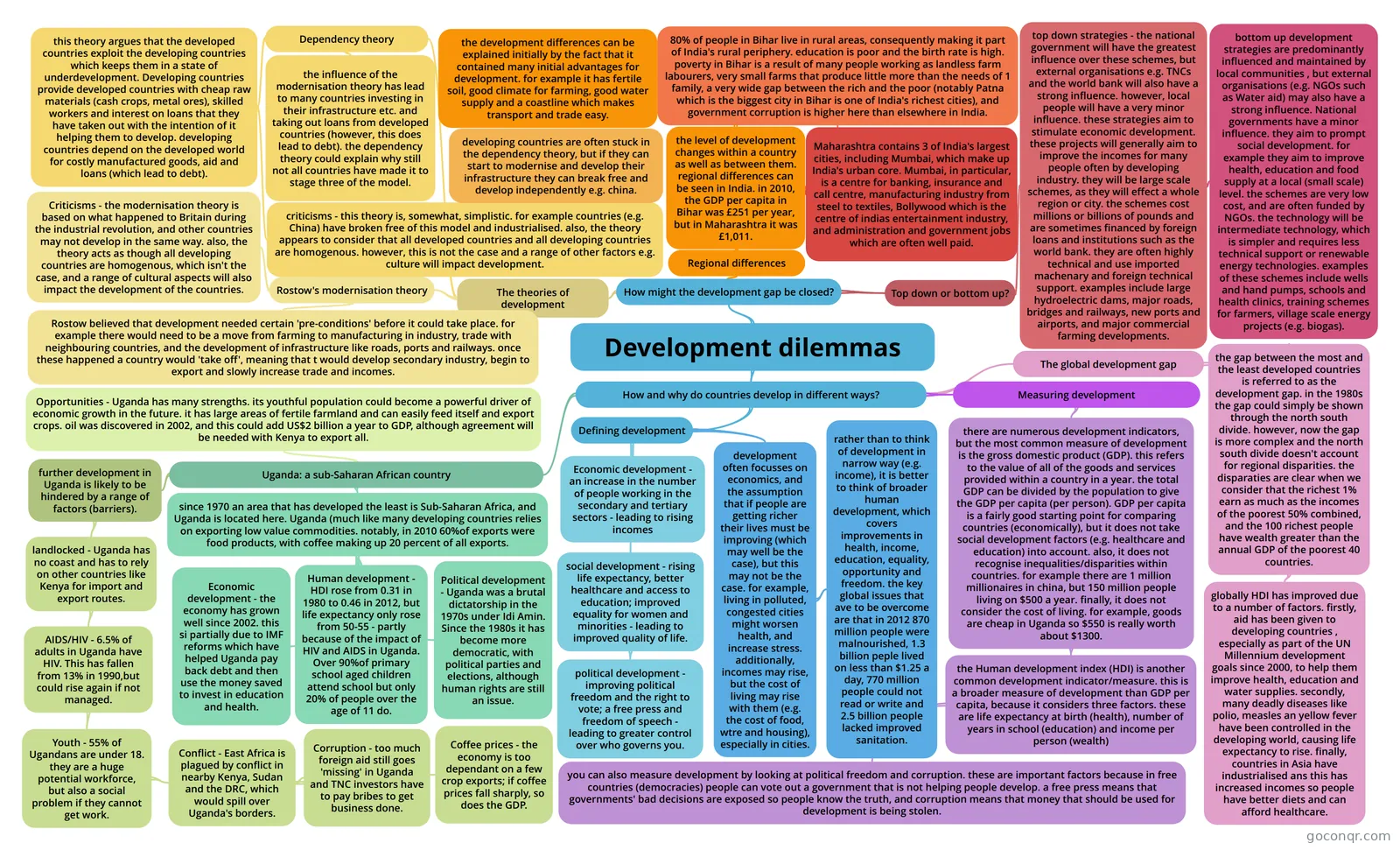
Mind map: Development dilemmas
Conteúdo do mapa
Development dilemmas
How and why do countries develop in different ways?
- Measuring development
- there are numerous development indicators, but the most common measure of development is the gross domestic product (GDP). this refers to the value of all of the goods and services provided within a country in a year. the total GDP can be divided by the population to give the GDP per capita (per person). GDP per capita is a fairly good starting point for comparing countries (economically), but it does not take social development factors (e.g. healthcare and education) into account. also, it does not recognise inequalities/disparities within countries. for example there are 1 million millionaires in china, but 150 million people living on $500 a year. finally, it does not consider the cost of living. for example, goods are cheap in Uganda so $550 is really worth about $1300.
- the Human development index (HDI) is another common development indicator/measure. this is a broader measure of development than GDP per capita, because it considers three factors. these are life expectancy at birth (health), number of years in school (education) and income per person (wealth)
- you can also measure development by looking at political freedom and corruption. these are important factors because in free countries (democracies) people can vote out a government that is not helping people develop. a free press means that governments' bad decisions are exposed so people know the truth, and corruption means that money that should be used for development is being stolen.
- the Human development index (HDI) is another common development indicator/measure. this is a broader measure of development than GDP per capita, because it considers three factors. these are life expectancy at birth (health), number of years in school (education) and income per person (wealth)
- there are numerous development indicators, but the most common measure of development is the gross domestic product (GDP). this refers to the value of all of the goods and services provided within a country in a year. the total GDP can be divided by the population to give the GDP per capita (per person). GDP per capita is a fairly good starting point for comparing countries (economically), but it does not take social development factors (e.g. healthcare and education) into account. also, it does not recognise inequalities/disparities within countries. for example there are 1 million millionaires in china, but 150 million people living on $500 a year. finally, it does not consider the cost of living. for example, goods are cheap in Uganda so $550 is really worth about $1300.
- Defining development
- Economic development - an increase in the number of people working in the secondary and tertiary sectors - leading to rising incomes
- social development - rising life expectancy, better healthcare and access to education; improved equality for women and minorities - leading to improved quality of life.
- political development - improving political freedom and the right to vote; a free press and freedom of speech - leading to greater control over who governs you.
- development often focusses on economics, and the assumption that if people are getting richer their lives must be improving (which may well be the case), but this may not be the case. for example, living in polluted, congested cities might worsen health, and increase stress. additionally, incomes may rise, but the cost of living may rise with them (e.g. the cost of food, wtre and housing), especially in cities.
- rather than to think of development in narrow way (e.g. income), it is better to think of broader human development, which covers improvements in health, income, education, equality, opportunity and freedom. the key global issues that ave to be overcome are that in 2012 870 million people were malnourished, 1.3 billion peple lived on less than $1.25 a day, 770 million people could not read or write and 2.5 billion people lacked improved sanitation.
- The global development gap
- the gap between the most and the least developed countries is referred to as the development gap. in the 1980s the gap could simply be shown through the north south divide. however, now the gap is more complex and the north south divide doesn't account for regional disparities. the disparaties are clear when we consider that the richest 1% earn as much as the incomes of the poorest 50% combined, and the 100 richest people have wealth greater than the annual GDP of the poorest 40 countries.
- globally HDI has improved due to a number of factors. firstly, aid has been given to developing countries , especially as part of the UN Millennium development goals since 2000, to help them improve health, education and water supplies. secondly, many deadly diseases like polio, measles an yellow fever have been controlled in the developing world, causing life expectancy to rise. finally, countries in Asia have industrialised ans this has increased incomes so people have better diets and can afford healthcare.
- the gap between the most and the least developed countries is referred to as the development gap. in the 1980s the gap could simply be shown through the north south divide. however, now the gap is more complex and the north south divide doesn't account for regional disparities. the disparaties are clear when we consider that the richest 1% earn as much as the incomes of the poorest 50% combined, and the 100 richest people have wealth greater than the annual GDP of the poorest 40 countries.
- Uganda: a sub-Saharan African country
- since 1970 an area that has developed the least is Sub-Saharan Africa, and Uganda is located here. Uganda (much like many developing countries relies on exporting low value commodities. notably, in 2010 60%of exports were food products, with coffee making up 20 percent of all exports.
- Economic development - the economy has grown well since 2002. this si partially due to IMF reforms which have helped Uganda pay back debt and then use the money saved to invest in education and health.
- Human development - HDI rose from 0.31 in 1980 to 0.46 in 2012, but life expectancy only rose from 50-55 - partly because of the impact of HIV and AIDS in Uganda. Over 90%of primary school aged children attend school but only 20% of people over the age of 11 do.
- Political development - Uganda was a brutal dictatorship in the 1970s under Idi Amin. Since the 1980s it has become more democratic, with political parties and elections, although human rights are still an issue.
- further development in Uganda is likely to be hindered by a range of factors (barriers).
- landlocked - Uganda has no coast and has to rely on other countries like Kenya for import and export routes.
- AIDS/HIV - 6.5% of adults in Uganda have HIV. This has fallen from 13% in 1990,but could rise again if not managed.
- Youth - 55% of Ugandans are under 18. they are a huge potential workforce, but also a social problem if they cannot get work.
- Conflict - East Africa is plagued by conflict in nearby Kenya, Sudan and the DRC, which would spill over Uganda's borders.
- Corruption - too much foreign aid still goes 'missing' in Uganda and TNC investors have to pay bribes to get business done.
- Coffee prices - the economy is too dependant on a few crop exports; if coffee prices fall sharply, so does the GDP.
- Conflict - East Africa is plagued by conflict in nearby Kenya, Sudan and the DRC, which would spill over Uganda's borders.
- Youth - 55% of Ugandans are under 18. they are a huge potential workforce, but also a social problem if they cannot get work.
- AIDS/HIV - 6.5% of adults in Uganda have HIV. This has fallen from 13% in 1990,but could rise again if not managed.
- landlocked - Uganda has no coast and has to rely on other countries like Kenya for import and export routes.
- Opportunities - Uganda has many strengths. its youthful population could become a powerful driver of economic growth in the future. it has large areas of fertile farmland and can easily feed itself and export crops. oil was discovered in 2002, and this could add US$2 billion a year to GDP, although agreement will be needed with Kenya to export all.
- since 1970 an area that has developed the least is Sub-Saharan Africa, and Uganda is located here. Uganda (much like many developing countries relies on exporting low value commodities. notably, in 2010 60%of exports were food products, with coffee making up 20 percent of all exports.
- Measuring development
How might the development gap be closed?
- The theories of development
- Rostow's modernisation theory
- Rostow believed that development needed certain 'pre-conditions' before it could take place. for example there would need to be a move from farming to manufacturing in industry, trade with neighbouring countries, and the development of infrastructure like roads, ports and railways. once these happened a country would 'take off', meaning that t would develop secondary industry, begin to export and slowly increase trade and incomes.
- Criticisms - the modernisation theory is based on what happened to Britain during the industrial revolution, and other countries may not develop in the same way. also, the theory acts as though all developing countries are homogenous, which isn't the case, and a range of cultural aspects will also impact the development of the countries.
- Dependency theory
- this theory argues that the developed countries exploit the developing countries which keeps them in a state of underdevelopment. Developing countries provide developed countries with cheap raw materials (cash crops, metal ores), skilled workers and interest on loans that they have taken out with the intention of it helping them to develop. developing countries depend on the developed world for costly manufactured goods, aid and loans (which lead to debt).
- criticisms - this theory is, somewhat, simplistic. for example countries (e.g. China) have broken free of this model and industrialised. also, the theory appears to consider that all developed countries and all developing countries are homogenous. however, this is not the case and a range of other factors e.g. culture will impact development.
- developing countries are often stuck in the dependency theory, but if they can start to modernise and develop their infrastructure they can break free and develop independently e.g. china.
- criticisms - this theory is, somewhat, simplistic. for example countries (e.g. China) have broken free of this model and industrialised. also, the theory appears to consider that all developed countries and all developing countries are homogenous. however, this is not the case and a range of other factors e.g. culture will impact development.
- the influence of the modernisation theory has lead to many countries investing in their infrastructure etc. and taking out loans from developed countries (however, this does lead to debt). the dependency theory could explain why still not all countries have made it to stage three of the model.
- this theory argues that the developed countries exploit the developing countries which keeps them in a state of underdevelopment. Developing countries provide developed countries with cheap raw materials (cash crops, metal ores), skilled workers and interest on loans that they have taken out with the intention of it helping them to develop. developing countries depend on the developed world for costly manufactured goods, aid and loans (which lead to debt).
- Rostow's modernisation theory
- Regional differences
- the level of development changes within a country as well as between them. regional differences can be seen in India. in 2010, the GDP per capita in Bihar was £251 per year, but in Maharashtra it was £1,011.
- the development differences can be explained initially by the fact that it contained many initial advantages for development. for example it has fertile soil, good climate for farming, good water supply and a coastline which makes transport and trade easy.
- 80% of people in Bihar live in rural areas, consequently making it part of India's rural periphery. education is poor and the birth rate is high. poverty in Bihar is a result of many people working as landless farm labourers, very small farms that produce little more than the needs of 1 family, a very wide gap between the rich and the poor (notably Patna which is the biggest city in Bihar is one of India's richest cities), and government corruption is higher here than elsewhere in India.
- Maharashtra contains 3 of India's largest cities, including Mumbai, which make up India's urban core. Mumbai, in particular, is a centre for banking, insurance and call centre, manufacturing industry from steel to textiles, Bollywood which is the centre of indias entertainment industry, and administration and government jobs which are often well paid.
- the level of development changes within a country as well as between them. regional differences can be seen in India. in 2010, the GDP per capita in Bihar was £251 per year, but in Maharashtra it was £1,011.
- Top down or bottom up?
- top down strategies - the national government will have the greatest influence over these schemes, but external organisations e.g. TNCs and the world bank will also have a strong influence. however, local people will have a very minor influence. these strategies aim to stimulate economic development. these projects will generally aim to improve the incomes for many people often by developing industry. they will be large scale schemes, as they will effect a whole region or city. the schemes cost millions or billions of pounds and are sometimes financed by foreign loans and institutions such as the world bank. they are often highly technical and use imported machenary and foreign technical support. examples include large hydroelectric dams, major roads, bridges and railways, new ports and airports, and major commercial farming developments.
- bottom up development strategies are predominantly influenced and maintained by local communities , but external organisations (e.g. NGOs such as Water aid) may also have a strong influence. National governments have a minor influence. they aim to prompt social development. for example they aim to improve health, education and food supply at a local (small scale) level. the schemes are very low cost, and are often funded by NGOs. the technology will be intermediate technology, which is simpler and requires less technical support or renewable energy technologies. examples of these schemes include wells and hand pumps, schools and health clinics, training schemes for farmers, village scale energy projects (e.g. biogas).
- top down strategies - the national government will have the greatest influence over these schemes, but external organisations e.g. TNCs and the world bank will also have a strong influence. however, local people will have a very minor influence. these strategies aim to stimulate economic development. these projects will generally aim to improve the incomes for many people often by developing industry. they will be large scale schemes, as they will effect a whole region or city. the schemes cost millions or billions of pounds and are sometimes financed by foreign loans and institutions such as the world bank. they are often highly technical and use imported machenary and foreign technical support. examples include large hydroelectric dams, major roads, bridges and railways, new ports and airports, and major commercial farming developments.
- The theories of development
Informações
- Descrição
- Mapa Mental sobre Development dilemmas, criado por lewis.m.noden em 25-04-2015.
- Criado por
- lewis.m.noden
- Visualizações
- 6
- Avaliação