
Mapa mental
International Relations
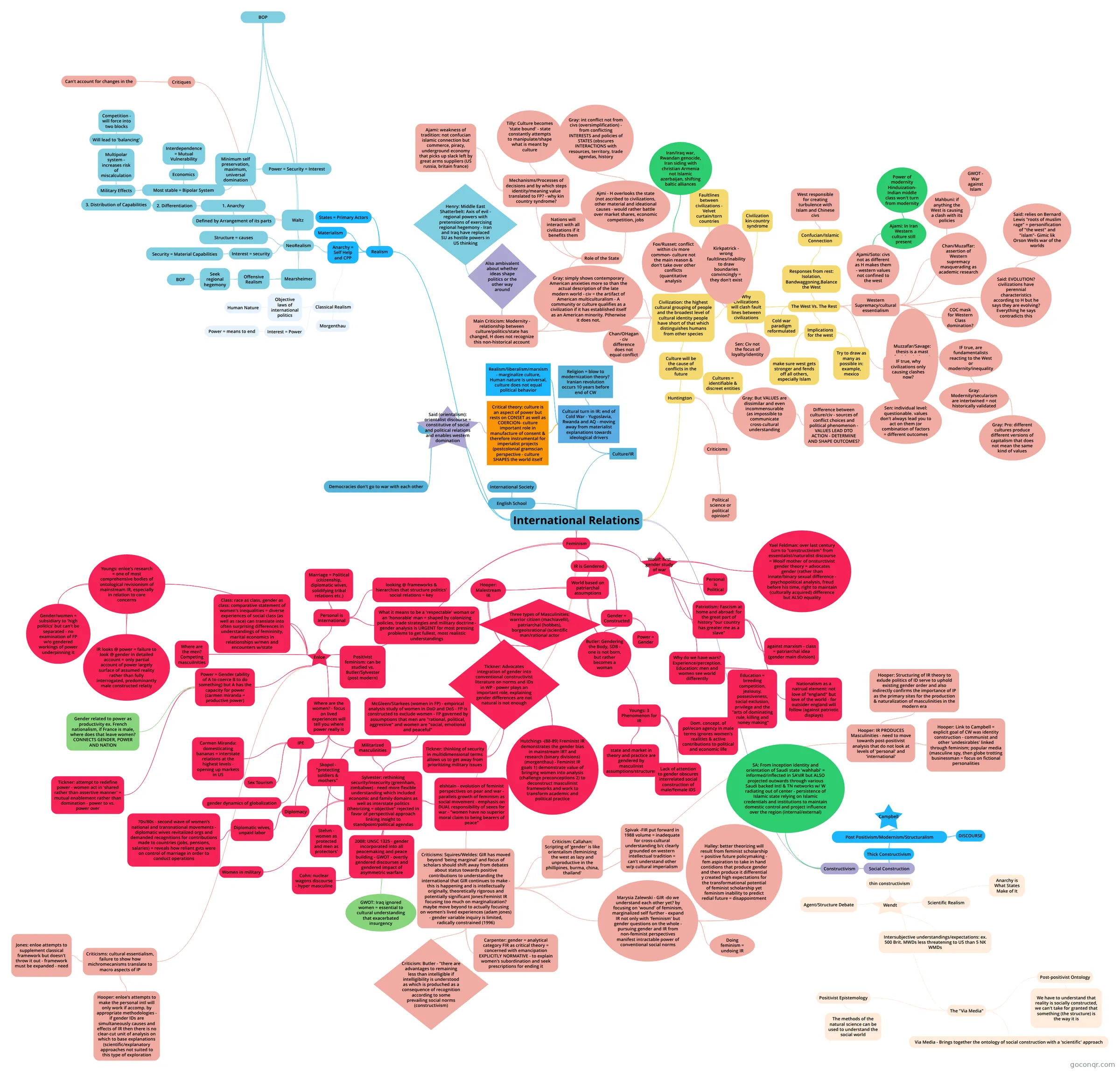
Mind map: International relations theories
Conteúdo do mapa
International Relations
Realism
- Anarchy = Self Help and CPP
- Classical Realism
- Interest = Power
- Power = means to end
- Objective laws of international politics
- Human Nature
- Morgenthau
- Interest = Power
- NeoRealism
- Interest = security
- Security = Material Capabilities
- Structure = causes
- Defined by Arrangement of its parts
- 1. Anarchy
- 2. Differentiation
- 3. Distribution of Capabilities
- 2. Differentiation
- 1. Anarchy
- Defined by Arrangement of its parts
- Waltz
- BOP
- Power = Security = Interest
- Minimum self preservation, maximum, universal domination
- Most stable = Bipolar System
- Economics
- Interdependence = Mutual Vulnerability
- Military Effects
- Multipolar system - increases risk of miscalculation
- Will lead to 'balancing'
- Competition - will force into two blocks
- Will lead to 'balancing'
- Multipolar system - increases risk of miscalculation
- Economics
- Power = Security = Interest
- Critiques
- Can't account for changes in the
- BOP
- Mearsheimer
- Offensive Realism
- Seek regional hegemony
- BOP
- Seek regional hegemony
- Offensive Realism
- Interest = security
- Classical Realism
- Materialism
- States = Primary Actors
- Anarchy = Self Help and CPP
English School
- International Society
Constructivism
- Social Construction
- thin constructivism
- Wendt
- Anarchy is What States Make of It
- The "Via Media"
- Positivist Epistemology
- The methods of the natural science can be used to understand the social world
- Post-positivist Ontology
- We have to understand that reality is socially constructed, we can't take for granted that something (the structure) is the way it is
- Via Media - Brings together the ontology of social construction with a 'scientific' approach
- Positivist Epistemology
- Scientific Realism
- Agent/Structure Debate
- Intersubjective understandings/expectations: ex. 500 Brit. MWDs less threatening to US than 5 NK WMDs
- Wendt
- Thick Constructivism
- Post Positivism/Modernism/Structuralism
- Campbell
- DISCOURSE
- Post Positivism/Modernism/Structuralism
- thin constructivism
- SA: From inception identity and orientation of Saudi state 'wahhabi' = informed/inflected in SA'sIR but ALSO projected outwards through various Saudi backed Intl & TN networks w/ W radiating out of center - persistence of Islamic state relying on Islamic credentials and institutions to maintain domestic control and project influence over the region (internal/external)
- Social Construction
Feminism
- Enloe
- Personal is International
- Marriage = Political (citizenship, diplomatic wives, solidifying tribal relations etc.)
- What it means to be a 'respectable' woman or an 'honorable' man = shaped by colonizing policies, trade strategies and military doctrine - gender analysis is URGENT for most pressing problems to get fullest, most realistic understandings
- looking @ frameworks & hierarchies that structure politics' social relations = key
- Where are the women? - focus on lived experiences will tell you where power really is
- IPE
- Carmen Miranda: domesticating bananas = interstate relations at the highest levels - opening up markets in US
- Sex Tourism
- gender dynamics of globalization
- Diplomacy
- Diplomatic wives, unpaid labor
- 70s/80s - second wave of women's national and transnational movements - diplomatic wives revitalized orgs and demanded recognitions for contributions made to countries (jobs, pensions, salaries) = reveals how reliant gvts were on control of marriage in order to conduct operations
- Diplomatic wives, unpaid labor
- Militarized masculinities
- Sylvester: rethinking security/insecurity (greenham, zimbabwe) - need more flexible understanding which included economic and family domains as well as interstate politics (theorizing = objective" rejected in favor of perspectival approach linking insight to standpoint/political agendas
- 2008: UNSC 1325 - gender incorporated into all peacemaking and peace building - GWOT - overtly gendered discourses and gendered impact of asymmetric warfare
- GWOT: Iraq ignored women = essential to cultural understanding that exacerbated insurgency
- Tickner: thinking of security in multidimensional terms allows us to get away from prioritizing military issues
- Tickner: Advocates integration of gender into conventional constructivist literature on norms and IDs in WP - power plays an important role, explaining gender differences are not natural is not enough
- Three types of Masculinities: warrior citizen (machiavelli), patriarchal (hobbes), borgeoisrational (scientific man/rational actor
- Tickner: Advocates integration of gender into conventional constructivist literature on norms and IDs in WP - power plays an important role, explaining gender differences are not natural is not enough
- elshtain - evolution of feminist perspectives on pear and war - parallels growth of feminism as social movement - emphasis on DUAL responsibility of sexes for war - "women have no superior moral claim to being bearers of peace"
- Women in military
- Skopol - "protecting soldiers & mothers"
- Cohn: nuclear wagons discourse - hyper masculine
- 2008: UNSC 1325 - gender incorporated into all peacemaking and peace building - GWOT - overtly gendered discourses and gendered impact of asymmetric warfare
- McGleen/Starkees (women in FP) - empirical analysis study of women in DoD and DoS - FP is constructed to exclude women - FP governed by assumptions that men are "rational, political, aggressive" and women are "social, emotional and peaceful"
- Stehm - women as protected and men as protectors'
- Sylvester: rethinking security/insecurity (greenham, zimbabwe) - need more flexible understanding which included economic and family domains as well as interstate politics (theorizing = objective" rejected in favor of perspectival approach linking insight to standpoint/political agendas
- IPE
- Positivist feminism: can be studied vs. Butler/Sylvester (post modern)
- Power = Gender (ability of A to coerce B to do something) but A has the capacity for power (carmen miranda = productive power)
- Gender related to power as productivity ex. French nationalism, if France is male, where does that leave women? CONNECTS GENDER, POWER AND NATION
- Tickner: attempt to redefine power - women act in 'shared rather than assertive manner' = mutual enablement rather than domination - power to vs. power over
- Class: race as class, gender as class: comparative statement of women's inequalities = diverse experiences of social class (as well as race) can translate into often surprising differences in understandings of femininity, marital economics in relationships w/men and encounters w/state
- Youngs: enloe's research = one of most comprehensive bodies of ontological revisionism of mainstream IR, especially in relation to core concerns
- Gender/women = subsidiary to 'high politics' but can't be separated - no examination of FP w/o gendered workings of power underpinning it
- IR looks @ power = failure to look @ gender in detailed account = only partial account of power largely surface of assumed reality rather than fully interrogated, predominantly male constructed relatiy
- Where are the men? Competing mascuilnities
- Criticisms: cultural essentialism, failure to show how michromecanisms translate to macro aspects of IP
- Jones: enloe attempts to supplement classical framework but doesn't throw it out - framework must be expanded - need
- Hooper: enloe's attempts to make the personal intl will only work if accomp. by appropriate methodologies - if gender IDs are simultaneously causes and effects of IR then there is no clear-cut unit of analysis on which to base explanations (scientific/explanatory approaches not suited to this type of exploration
- Personal is International
- Woolf: first gender study of war
- Personal is Political
- Yael Feldman: over last century turn to "constructivism" from essentialist/naturalist discourse = Woolf mother of onsturctivist gender theory = advocates gender (rather than innate/binary sexual difference - psychopolitical analysis, freud before his time, right to maintain (culturally acquired) difference but ALSO equality
- Why do we have wars? Experience/perception. Education: men and women see world differently
- Education = breeding competition, jealousy, possesiveness, social exclusion, privilege and the "arts of dominating rule, killing and money making"
- Patriotism: Fascism at home and abroad: for the great part of history "our country has greater me as a slave"
- Nationalism as a natrual element: not love of "england" but love of the world - for outsider england will follow (against patriotic displays)
- against marxism - class = patriarchal idea (gender main division)
- IR is Gendered
- Gender = Constructed
- Power = Gender
- Butler: Gendering the Body, SDB - one is not born, but rather becomes a woman
- World based on patriarchal assumptions
- Hooper: Malestream IR
- Hutchings -(88-89) Freminist IR demonstrates the gender bias in mainstream IRT and research (binary divisions) (morgenthau) - Feminist IR goals 1) demonstrate value of bringing women into analysis (challenge preconceptions 2) to deconstruct masculinist frameworks and work to transform academic and political practice
- Youngs: 3 Phenomenon for IR
- state and market in theory and practice are gendered by masculinist assumptions/structures
- Dom. concept. of pol/econ agency in male terms ignores women's realities & active contributions to political and economic life
- Lack of attention to gender obscures interrelated social construction of male/female IDS
- Hooper: Malestream IR
- Gender = Constructed
- Criticisms: Squires/Weldes: GIR has moved beyond 'being marginal' and focus of scholars should shift away from debates about status towards positive contributions to understanding the international that GIR continues to make - this is happening and is intellectually originally, theoretically rigorous and potentially significant Jones:Feminist IR focusing too much on marginalization? maybe move beyond to actually focusing on women's lived experiences (adam jones) - gender variable inquiry is limited, radically constrained (1996)
- Criticism: Callahan: Scripting of 'gender' is like orientalism (feminizing the west as lazy and unproductive in the phillipines, burma, china, thailand'
- Spivak -FIR put forward in 1988 volume = inadequate for cross-cultural understanding b/c clearly grounded on western intellectual tradition = can't understand other w/p cultural imperialism
- Criticism: Butler - "there are advantages to remaining less than intelligible if intelligibility is understood as which is produched as a consequence of recognition according to some prevailing social norms (constructivism)
- Marysia Zalewski - GIR -do we understand each other yet? by focusing on 'wound' of feminism, marginalized self further - expand IR not only with 'feminism' but gender questions on the whole - pursuing gender and IR from non-feminist perspectives manifest intractable power of conventional social norms
- Doing feminism = undoing IR
- Halley: better theorizing will result from feminist scholarship = positive future policymaking - fem aspiration to take in hand contidions that produce gender and then produce it differential y created high expectations for the transformational potential of feminist scholarship yet feminism inability to predict redial future = disappointment
- Carpenter: gender = analytical category FIR as critical theory = concerned with emancipation EXPLICITLY NORMATIVE - to explain women's subordination and seek prescriptions for ending it
- Hooper: IR PRODUCES Masculinities - need to move towards post-positivist analysis that do not look at levels of 'personal' and 'international'
- Hooper: Link to Campbell = explicit goal of CW was identity construction - communist and other 'undesirables' linked through feminism; popular media (masculine spy, then globe trotting businessman = focus on fictional personalities
- Hooper: Structuring of IR theory to exlude politics of ID serve to uphold existing gender order and also indirectly confirms the importance of IP as the primary sites for the production & naturalization of masculinities in the modern era
- Criticism: Callahan: Scripting of 'gender' is like orientalism (feminizing the west as lazy and unproductive in the phillipines, burma, china, thailand'
- Enloe
Huntington
- Culture will be the cause of conflicts in the future
- Civilization: the highest cultural grouping of people and the broadest level of cultural identity people have short of that which distinguishes humans from other species
- Why Civilizations will clash fault lines between civilizations
- The West Vs. The Rest
- Responses from rest: Isolation, Bandwaggoning,Balance the West
- Confucian/Islamic Connection
- West responsible for creating turbulence with Islam and Chinese civs
- Confucian/Islamic Connection
- Implications for the west
- make sure west gets stronger and fends off all others, especially Islam
- Try to draw as many as possible in: example, mexico
- Cold war paradigm reformulated
- Western Supremacy/cultural essentialism
- Said: EVOLUTION? civilizations have perennial characteristics according to H but he says they are evolving? Everything he says contradicts this
- Said: relies on Bernard Lewis "roots of muslim rage" = personification of "the west" and "islam"- Gimic lik Orson Wells war of the worlds
- Ajami/Soto: civs not as different as H makes them - western values not confined to the west
- Ajami: In Iran Western culture still present
- Power of modernity Hinduization- Indian middle class won't turn from modernity
- Ajami: In Iran Western culture still present
- COC mask for Western Class domination?
- Muzzafar/Savage: thesis is a mast for Islamic threat for West after Cold War
- IF true, are fundamentalists reacting to the West or modernity/inequality
- Gray: Modernity/secularism are intertwined = not historically validated
- Gray: Pro: different cultures produce different versions of capitalism that does not mean the same kind of values
- Gray: Modernity/secularism are intertwined = not historically validated
- IF true, are fundamentalists reacting to the West or modernity/inequality
- Chan/Muzaffar: assertion of Western supremacy masquerading as academic research
- Mahbuni: if anything the West is causing a clash with its policies
- GWOT - War against Islam
- Said: EVOLUTION? civilizations have perennial characteristics according to H but he says they are evolving? Everything he says contradicts this
- IF true, why civilizations only causing clashes now?
- Responses from rest: Isolation, Bandwaggoning,Balance the West
- Faultlines between civilizations - Velvet curtain/torn countries
- Civilization kin-country syndrome
- Kirkpatrick - wrong faultlines/inability to draw boundaries convincingly = they don't exist
- Sen: Civ not the focus of loyalty/identity
- Fox/Russet: conflict within civ more common- culture not the main reason & don't take over other conflicts (quantitative analysis
- Iran/Iraq war, Rwandan genocide, Iran siding with christian Armenia not Islamic azerbaijan, shifting baltic alliances
- The West Vs. The Rest
- Chan/OHagan - civ difference does not equal conflict
- Main Criticism: Modernity - relationship between culture/politics/state has changed, H does not recognize this non-historical account
- Also ambivalent about whether ideas shape politics or the other way around
- Henry: Middle East Shatterbelt: Axis of evil - regional powers with pretensions of exercising regional hegemony - Iran and Iraq have replaced SU as hostile powers in US thinking
- Role of the State
- Ajmi - H overlooks the state (not ascribed to civilizations, other material and ideational causes - would rather battle over market shares, economic competition, jobs
- Gray: int conflict not from civs (oversimplification) - from conflicting INTERESTS and policies of STATES (obscures INTERACTIONS with resources, territory, trade agendas, history
- Mechanisms/Processes of decisions and by which steps identity/meaning value translated to FP? - why kin country syndrome?
- Tilly: Culture becomes 'state bound' - state constantly attempts to manipulate/shape what is meant by culture
- Ajami: weakness of tradition: not confucian islamic connection but commerce, piracy, underground economy that picks up slack left by great arms suppliers (US russia, britain france)
- Nations will interact with all civilizations if it benefits them
- Ajmi - H overlooks the state (not ascribed to civilizations, other material and ideational causes - would rather battle over market shares, economic competition, jobs
- Also ambivalent about whether ideas shape politics or the other way around
- Gray: simply shows contemporary American anxieties more so than the actual description of the late modern world - civ = the artifact of American multiculturalism - A community or culture qualifies as a civilization if it has established itself as an American minority. Ptherwise it does not.
- Why Civilizations will clash fault lines between civilizations
- Cultures = identifiable & discreet entities
- Gray: But VALUES are dissimilar and even incommensurable (as impossible to communicate cross-cultural understanding
- Difference between culture/civ - sources of conflict choices and political phenomenon - VALUES LEAD DTO ACTION - DETERMINE AND SHAPE OUTCOMES?
- Sen: individual level: questionable. values don't always lead you to act on them (or combination of factors = different outcomes
- Difference between culture/civ - sources of conflict choices and political phenomenon - VALUES LEAD DTO ACTION - DETERMINE AND SHAPE OUTCOMES?
- Gray: But VALUES are dissimilar and even incommensurable (as impossible to communicate cross-cultural understanding
- Civilization: the highest cultural grouping of people and the broadest level of cultural identity people have short of that which distinguishes humans from other species
- Criticisms
- Political science or political opinion?
- Culture will be the cause of conflicts in the future
Doyle
- Democracies don't go to war with each other
Culture/IR
- Cultural turn in IR: end of Cold War - Yugoslavia, Rwanda and AQ - moving away from materialist explanations towards ideological drivers
- Religion = blow to modernization theory? Iranian revolution occurs 10 years before end of CW
- Realism/liberalism/marxism - marginalize culture, Human nature is universal, culture does not equal political behavior
- Critical theory: culture is an aspect of power but rests on CONSET as well as COERCION- culture important role in manufacture of consent & therefore instrumental for imperialist projects (postcolonial gramscian perspective - culture SHAPES the world itself
- Said (orientalism): orientalist discourse = constitutive of social and political relations and enables western domination
- Cultural turn in IR: end of Cold War - Yugoslavia, Rwanda and AQ - moving away from materialist explanations towards ideological drivers
Informações
- Descrição
- IR Mapa Mental sobre International Relations, criado por Rachel Gabriel em 10-05-2015.
- Criado por
- Rachel Gabriel
- Visualizações
- 4
- Avaliação