
Mapa mental
external factors
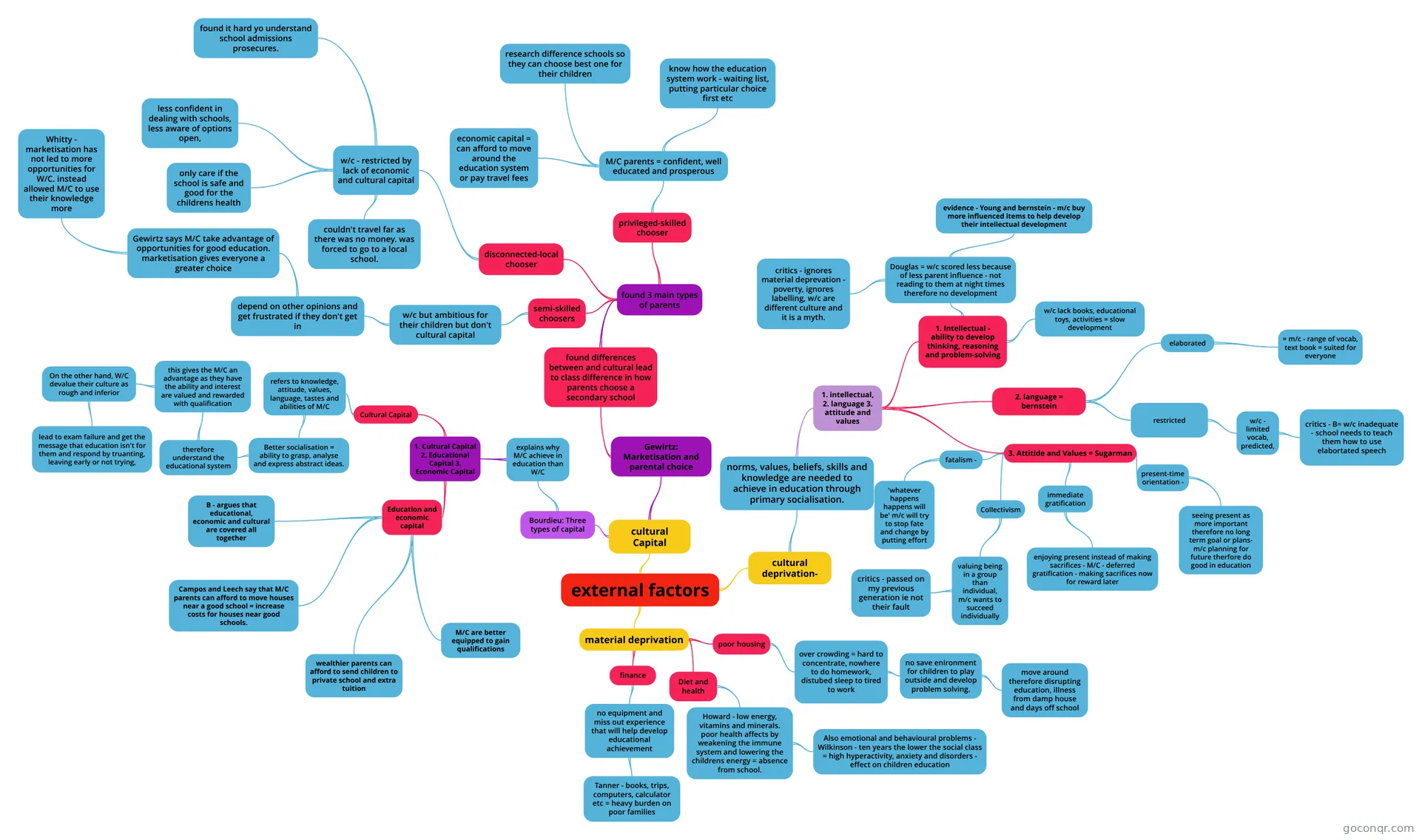
Mind map: external factors in education
Conteúdo do mapa
external factors
cultural deprivation-
- norms, values, beliefs, skills and knowledge are needed to achieve in education through primary socialisation.
- 1. intellectual, 2. language 3. attitude and values
- 1. Intellectual - ability to develop thinking, reasoning and problem-solving
- w/c lack books, educational toys, activities = slow development
- Douglas = w/c scored less because of less parent influence - not reading to them at night times therefore no development
- evidence - Young and bernstein - m/c buy more influenced items to help develop their intellectual development
- critics - ignores material deprevation - poverty, ignores labelling, w/c are different culture and it is a myth.
- 2. language = bernstein
- restricted
- w/c - limited vocab, predicted,
- critics - B= w/c inadequate - school needs to teach them how to use elabortated speech
- w/c - limited vocab, predicted,
- elaborated
- = m/c - range of vocab, text book = suited for everyone
- restricted
- 3. Attitide and Values = Sugarman
- fatalism -
- 'whatever happens happens will be' m/c will try to stop fate and change by putting effort
- Collectivism
- valuing being in a group than individual, m/c wants to succeed individually
- critics - passed on my previous generation ie not their fault
- valuing being in a group than individual, m/c wants to succeed individually
- immediate gratification
- enjoying present instead of making sacrifices - M/C - deferred gratification - making sacrifices now for reward later
- present-time orientation -
- seeing present as more important therefore no long term goal or plans- m/c planning for future therfore do good in education
- fatalism -
- 1. Intellectual - ability to develop thinking, reasoning and problem-solving
- 1. intellectual, 2. language 3. attitude and values
- norms, values, beliefs, skills and knowledge are needed to achieve in education through primary socialisation.
material deprivation
- poor housing
- over crowding = hard to concentrate, nowhere to do homework, distubed sleep to tired to work
- no save enironment for children to play outside and develop problem solving.
- move around therefore disrupting education, illness from damp house and days off school
- no save enironment for children to play outside and develop problem solving.
- over crowding = hard to concentrate, nowhere to do homework, distubed sleep to tired to work
- Diet and health
- Howard - low energy, vitamins and minerals. poor health affects by weakening the immune system and lowering the childrens energy = absence from school.
- Also emotional and behavioural problems - Wilkinson - ten years the lower the social class = high hyperactivity, anxiety and disorders - effect on children education
- Howard - low energy, vitamins and minerals. poor health affects by weakening the immune system and lowering the childrens energy = absence from school.
- finance
- no equipment and miss out experience that will help develop educational achievement
- Tanner - books, trips, computers, calculator etc = heavy burden on poor families
- no equipment and miss out experience that will help develop educational achievement
- poor housing
cultural Capital
- Bourdieu: Three types of capital
- explains why M/C achieve in education than W/C
- 1. Cultural Capital 2. Educational Capital 3. Economic Capital
- Cultural Capital
- refers to knowledge, attitude, values, language, tastes and abilities of M/C
- Better socialisation = ability to grasp, analyse and express abstract ideas.
- therefore understand the educational system
- this gives the M/C an advantage as they have the ability and interest are valued and rewarded with qualification
- On the other hand, W/C devalue their culture as rough and inferior
- lead to exam failure and get the message that education isn't for them and respond by truanting, leaving early or not trying,
- On the other hand, W/C devalue their culture as rough and inferior
- this gives the M/C an advantage as they have the ability and interest are valued and rewarded with qualification
- therefore understand the educational system
- Better socialisation = ability to grasp, analyse and express abstract ideas.
- refers to knowledge, attitude, values, language, tastes and abilities of M/C
- Education and economic capital
- B - argues that educational, economic and cultural are covered all together
- M/C are better equipped to gain qualifications
- wealthier parents can afford to send children to private school and extra tuition
- Campos and Leech say that M/C parents can afford to move houses near a good school = increase costs for houses near good schools.
- Cultural Capital
- 1. Cultural Capital 2. Educational Capital 3. Economic Capital
- explains why M/C achieve in education than W/C
- Gewirtz: Marketisation and parental choice
- found differences between and cultural lead to class difference in how parents choose a secondary school
- found 3 main types of parents
- privileged-skilled chooser
- M/C parents = confident, well educated and prosperous
- know how the education system work - waiting list, putting particular choice first etc
- research difference schools so they can choose best one for their children
- economic capital = can afford to move around the education system or pay travel fees
- M/C parents = confident, well educated and prosperous
- disconnected-local chooser
- w/c - restricted by lack of economic and cultural capital
- found it hard yo understand school admissions prosecures.
- less confident in dealing with schools, less aware of options open,
- only care if the school is safe and good for the childrens health
- couldn't travel far as there was no money. was forced to go to a local school.
- w/c - restricted by lack of economic and cultural capital
- semi-skilled choosers
- w/c but ambitious for their children but don't cultural capital
- depend on other opinions and get frustrated if they don't get in
- Gewirtz says M/C take advantage of opportunities for good education. marketisation gives everyone a greater choice
- Whitty - marketisation has not led to more opportunities for W/C. instead allowed M/C to use their knowledge more
- Gewirtz says M/C take advantage of opportunities for good education. marketisation gives everyone a greater choice
- depend on other opinions and get frustrated if they don't get in
- w/c but ambitious for their children but don't cultural capital
- privileged-skilled chooser
- found 3 main types of parents
- found differences between and cultural lead to class difference in how parents choose a secondary school
- Bourdieu: Three types of capital
Informações
- Descrição
- external overview for external
- Criado por
- Sanjidah Ahmed7909
- Visualizações
- 21
- Tags
- Avaliação