
Mapa mental
Meat
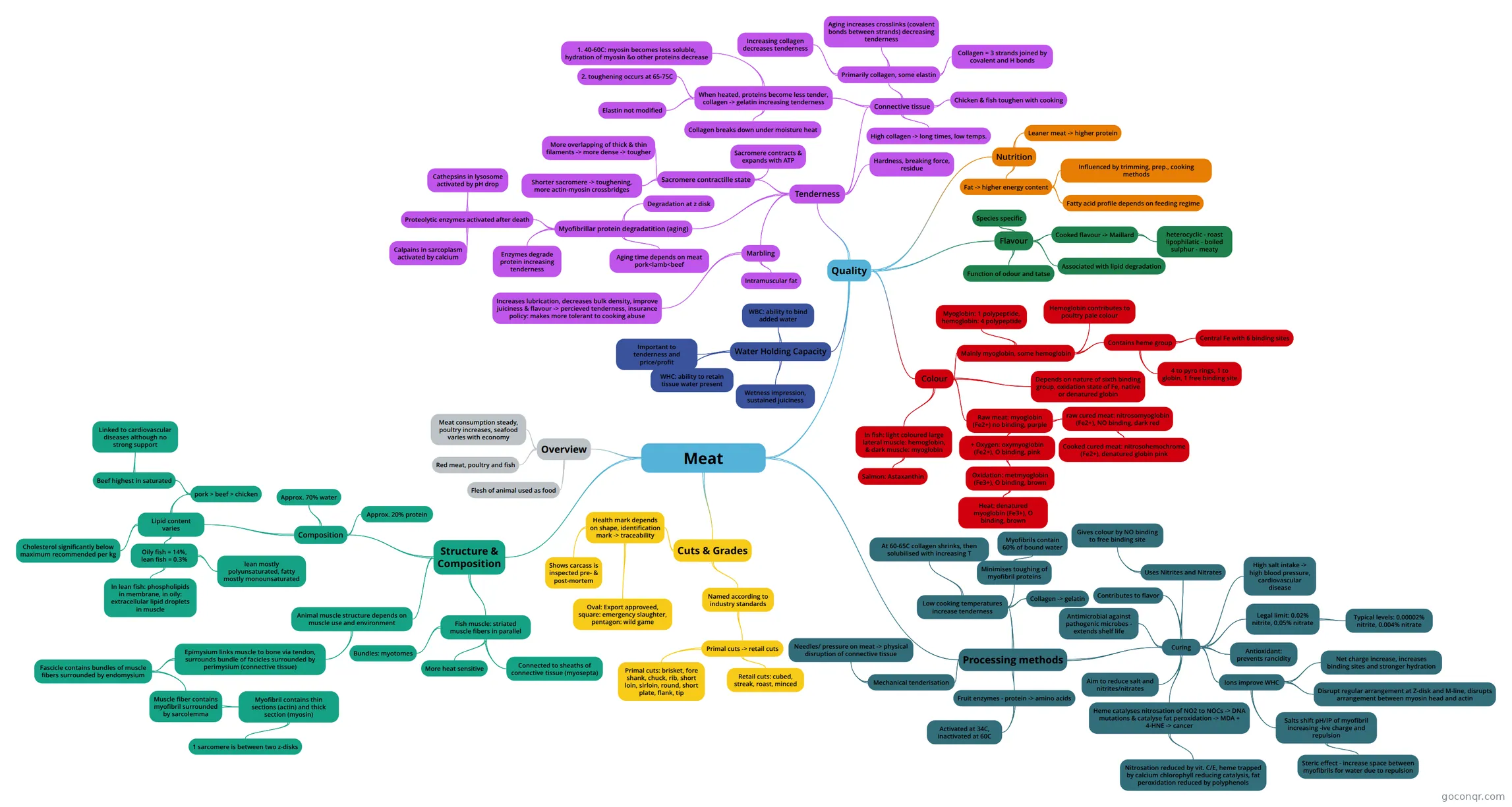
Mind map: Meat: Overview, Structure & Composition, Cuts & Grades, Quality, Processing Methods
Conteúdo do mapa
Meat
Overview
- Red meat, poultry and fish
- Flesh of animal used as food
- Meat consumption steady, poultry increases, seafood varies with economy
Structure & Composition
- Animal muscle structure depends on muscle use and environment
- Epimysium links muscle to bone via tendon, surrounds bundle of facicles surrounded by perimysium (connective tissue)
- Fascicle contains bundles of muscle fibers surrounded by endomysium
- Muscle fiber contains myofibril surrounded by sarcolemma
- Myofibril contains thin sections (actin) and thick section (myosin)
- 1 sarcomere is between two z-disks
- Myofibril contains thin sections (actin) and thick section (myosin)
- Muscle fiber contains myofibril surrounded by sarcolemma
- Fascicle contains bundles of muscle fibers surrounded by endomysium
- Epimysium links muscle to bone via tendon, surrounds bundle of facicles surrounded by perimysium (connective tissue)
- Fish muscle: striated muscle fibers in parallel
- Connected to sheaths of connective tissue (myosepta)
- Bundles: myotomes
- More heat sensitive
- Composition
- Approx. 20% protein
- Approx. 70% water
- Lipid content varies
- pork > beef > chicken
- Beef highest in saturated
- Linked to cardiovascular diseases although no strong support
- Beef highest in saturated
- Oily fish = 14%, lean fish = 0.3%
- lean mostly polyunsaturated, fatty mostly monounsaturated
- In lean fish: phospholipids in membrane, in oily: extracellular lipid droplets in muscle
- Cholesterol significantly below maximum recommended per kg
- pork > beef > chicken
- Animal muscle structure depends on muscle use and environment
Cuts & Grades
- Health mark depends on shape, identification mark -> traceability
- Shows carcass is inspected pre- & post-mortem
- Oval: Export approveed, square: emergency slaughter, pentagon: wild game
- Named according to industry standards
- Primal cuts -> retail cuts
- Primal cuts: brisket, fore shank, chuck, rib, short loin, sirloin, round, short plate, flank, tip
- Retail cuts: cubed, streak, roast, minced
- Primal cuts -> retail cuts
- Health mark depends on shape, identification mark -> traceability
Quality
- Colour
- Mainly myoglobin, some hemoglobin
- Contains heme group
- Central Fe with 6 binding sites
- 4 to pyro rings, 1 to globin, 1 free binding site
- Myoglobin: 1 polypeptide, hemoglobin: 4 polypeptide
- Hemoglobin contributes to poultry pale colour
- Contains heme group
- Depends on nature of sixth binding group, oxidation state of Fe, native or denatured globin
- Raw meat: myoglobin (Fe2+) no binding, purple
- + Oxygen: oxymyoglobin (Fe2+), O binding, pink
- Oxidation: metmyoglobin (Fe3+), O binding, brown
- Heat: denatured myoglobin (Fe3+), O binding, brown
- Oxidation: metmyoglobin (Fe3+), O binding, brown
- raw cured meat: nitrosomyoglobin (Fe2+), NO binding, dark red
- Cooked cured meat: nitrosohemochrome (Fe2+), denatured globin pink
- + Oxygen: oxymyoglobin (Fe2+), O binding, pink
- In fish: light coloured large lateral muscle: hemoglobin, & dark muscle: myoglobin
- Salmon: Astaxanthin
- Mainly myoglobin, some hemoglobin
- Flavour
- Function of odour and tatse
- Species specific
- Associated with lipid degradation
- Cooked flavour -> Maillard
- heterocyclic - roast lipophilatic - boiled sulphur - meaty
- Tenderness
- Hardness, breaking force, residue
- Connective tissue
- Primarily collagen, some elastin
- Collagen = 3 strands joined by covalent and H bonds
- Increasing collagen decreases tenderness
- Aging increases crosslinks (covalent bonds between strands) decreasing tenderness
- When heated, proteins become less tender, collagen -> gelatin increasing tenderness
- 1. 40-60C: myosin becomes less soluble, hydration of myosin &o other proteins decrease
- 2. toughening occurs at 65-75C
- Collagen breaks down under moisture heat
- Elastin not modified
- High collagen -> long times, low temps.
- Chicken & fish toughen with cooking
- Primarily collagen, some elastin
- Sacromere contractille state
- Shorter sacromere -> toughening, more actin-myosin crossbridges
- More overlapping of thick & thin filaments -> more dense -> tougher
- Sacromere contracts & expands with ATP
- Myofibrillar protein degradatition (aging)
- Proteolytic enzymes activated after death
- Cathepsins in lysosome activated by pH drop
- Calpains in sarcoplasm activated by calcium
- Enzymes degrade protein increasing tenderness
- Degradation at z disk
- Aging time depends on meat pork<lamb<beef
- Proteolytic enzymes activated after death
- Marbling
- Intramuscular fat
- Increases lubrication, decreases bulk density, improve juiciness & flavour -> percieved tenderness, insurance policy: makes more tolerant to cooking abuse
- Water Holding Capacity
- Wetness impression, sustained juiciness
- WHC: ability to retain tissue water present
- WBC: ability to bind added water
- Important to tenderness and price/profit
- Nutrition
- Leaner meat -> higher protein
- Fat -> higher energy content
- Fatty acid profile depends on feeding regime
- Influenced by trimming, prep., cooking methods
- Colour
Processing methods
- Curing
- Uses Nitrites and Nitrates
- Gives colour by NO binding to free binding site
- Contributes to flavor
- Antioxidant: prevents rancidity
- Antimicrobial against pathogenic microbes - extends shelf life
- Legal limit: 0.02% nitrite, 0.05% nitrate
- Typical levels: 0.00002% nitrite, 0.004% nitrate
- Ions improve WHC
- Net charge increase, increases binding sites and stronger hydration
- Salts shift pH/IP of myofibril increasing -ive charge and repulsion
- Steric effect - increase space between myofibrils for water due to repulsion
- Disrupt regular arrangement at Z-disk and M-line, disrupts arrangement between myosin head and actin
- High salt intake -> high blood pressure, cardiovascular disease
- Heme catalyses nitrosation of NO2 to NOCs -> DNA mutations & catalyse fat peroxidation -> MDA + 4-HNE -> cancer
- Nitrosation reduced by vit. C/E, heme trapped by calcium chlorophyll reducing catalysis, fat peroxidation reduced by polyphenols
- Aim to reduce salt and nitrites/nitrates
- Uses Nitrites and Nitrates
- Mechanical tenderisation
- Needles/ pressure on meat -> physical disruption of connective tissue
- Fruit enzymes - protein -> amino acids
- Activated at 34C, inactivated at 60C
- Low cooking temperatures increase tenderness
- At 60-65C collagen shrinks, then solubilised with increasing T
- Collagen -> gelatin
- Minimises toughing of myofibril proteins
- Myofibrils contain 60% of bound water
- Curing
Informações
- Descrição
- Mapa Mental sobre Meat, criado por alex gilbert em 08-01-2021.
- Criado por
- alex gilbert
- Visualizações
- 1
- Avaliação
Mais sobre Meat Types and Composition