
Mapa mental
Business Studies (BUSS2)
Conteúdo do mapa
Business Studies (BUSS2)
USING BUDGETS
- BUDGET DEFINITION: An agreed plan establishing the expected revenue and expenditure of an organisation.
- INCOME BUDGET: Shows the planned inflows to the organisation over a period of time.
- EXPENDITURE BUDGET: Shows the planned outflows of the organisation over period of time.
- PROFIT BUDGET: Shows the planned profit of the business over a period of time.
- GOOD BUDGETING
- Consistent with the aims of the organisation
- Based on the opinions of as many people as possible.
- Challenging but realistic targets
- VARIANCE ANALYSIS: This is the process where the actual figures are compared to those that were budgeted for.
- ADVERSE VARIANCE: When a business has done worse than expected.
- Actual costs were higher than budgeted for
- Actual revenue was lower than budgeted for
- FAVOURABLE VARIANCE: When a business has done better than expected.
- Actual costs were lower than budgeted for
- Actual revenue was higher than budgeted for
- ADVERSE VARIANCE: When a business has done worse than expected.
- BUDGET DEFINITION: An agreed plan establishing the expected revenue and expenditure of an organisation.
IMPROVING CASH FLOW
- CASH FLOW DEFINITION: The flow of money in and out of a business.
- RECAP ON CASH FLOW: Cash flow forecast is a prediction. Cash flow statement is the actual. Used by managers, owners & lenders.
- SOLUTIONS
- Increase sales revenue
- Reduce costs
- CAUSES OF CASH FLOW PROBLEMS
- Seasonality
- Poor financial planning
- Poor debtor management
- Poor creditor management
- Overheads unmanageable
MEASURING & INCREASING PROFIT
- RECAP:
- Profit = Revenue - Costs
- Gross Profit = Revenue - Cost of Sales
- Net Profit = Revenue - All Costs
- NET PROFIT MARGIN: The amount of profit that an organisation is making expressed as a %.
- CALCULATED: Net Profit / Turnover x100
- The greater the profit margin, the better the organisation is performing.
- Need to pick out from the income statement the figures require to conduct this.
- GROSS PROFIT MARGIN: The amount of profit an organisation is making on each item sold, expressed as a %
- CALCULATED: Gross Profit / Turnover x 100
- The greater the gross profit magin, the better the orgainisation is performing
- This profit margin should always be greater than the net profit margin
- RETURN ON CAPITAL: This is the % return on capital invested. Typically this could be used to measure the return your getting from your investment in the business.
- CALCULATED: Net Profit / Capital Invested x 100
- IMPROVING PROFITABILITY
- iNCREASE SELLING PRICE
- Reduce demand
- Depends on price elasticity
- REDUCE COSTS
- Reduce quality
- Damage reputation
- Reduce added value
- iNCREASE SELLING PRICE
- RECAP:
OPERATIONAL TARGETS: QUALITY
- QUALITY DEFINITION: A quality product is one that meets the customers expectations and would be fit for purpose.
- QUALITY CONTROL (QC): This is the process of inspecting the product at the end of the production process. Typically completed using a sample of products.
- QUALITY ASSURANCE (QA): This is the system that ensures that quality standards are being met throughout the production process. Typically completed using a sample of products.
- QC OR QA?
- Quality control tends to be cheaper in the short term, due to reduced training requirements & reduced employee responsibility.
- Quality control can lead to more wastage.
- Quality assurance can increase motivation.
- Quality assurance can actually identify specific problems in the production process.
- QC OR QA?
- QUALITY CONTROL (QC): This is the process of inspecting the product at the end of the production process. Typically completed using a sample of products.
- QUALITY DEFINITION: A quality product is one that meets the customers expectations and would be fit for purpose.
EFFECTIVE OPERATIONS: CUSTOMER SERVICE
- CUSTOMER SERVICE DEFINITION: This is the service given to customers before, during and after purchase to a standard that meets the customers expectations.
- EXAMPLES OF CUSTOMER SERVICE
- Offering advice pre sales
- Ensuring the item about to be purchased meets the customer needs
- Help lines to answer questions after purchase
- Dealing with customer issues fairly and successfully
- HOW DO BUSINESSES GO ABOUT MEETING CUSTOMER EXPECTATIONS?
- MARKET RESEARCH: Surveys, questionnaires focus groups.
- TRAINING: Staff know what makes good customer service
- QUALITY, ASSURANCE & CONTROL: Ensuring staff get it right the first time.
- MONITORING CUSTOMER SERVICE: It's important for an organisation to monitor its levels of customer service.
- Typically they will use:
- Satisfaction surveys
- Focus groups
- Tracking surveys
- Online/mobile surveys
- Typically they will use:
- IMPROVING CUSTOMER SERVICE
- Improve quality of products/service
- Value customers
- Speed of service
- Friendliness of service
- Efficient dealing with complaints
- Staff trained and competent
WORKING WITH SUPPLIERS
- SUPPLIERS
- These are organisations who provide your business with a product or service.
- Typically you want to establish a good relationship with your suppliers.
- Suppliers can be critical to the overall success of your organisation.
- FACTORS TO CONSIDER WHEN CHOOSING A SUPPLIER
- Quality of materials/service supplied
- Flexibility
- Reliability
- Value for money
- Technological investment
- Payment terms
- GOOD SUPPLIERS: The benefits of a good supplier should be
- IMPROVED CUSTOMER SERVICE: Delivery on time, good quality of product/service
- LOWER COSTS: Good discounts from economies of scale
- FLEXIBLE: Able to deal with changes in demand
- SUPPLIERS
TECHNOLOGY IN OPERATIONS
- ROBOTICS
- PRODUCTION OF PRODUCTS (CAM)
- ADVANTAGES: Increased production speed, Improved quality, Don't get bored, Don't take breaks
- DISADVANTAGES: Expensive to purchase, Not flexible, Could demotivate existing employees
- PRODUCTION OF PRODUCTS (CAM)
- AUTOMATION STOCK CONTROL
- JUST IN TIME (JIT)
- ADVANTAGES: Reduced wastage, Reduced storage space, Improved cash flow, More accurate forecasting
- DISADVANTAGES: Expensive to setup, Dependant on good supplier relationship, Doesn't take into account external factors
- JUST IN TIME (JIT)
- COMMUNICATION TECHNOLOGY
- INTERNET/EMAIL
- ADVANTAGES: Reduced wastage, Increased efficiency, Improved communication channels, Increased opportunities for outsourcing
- DISADVANTAGES: Training required for employees, Cost of investing in equipment, Increased considerations in the management of its use
- INTERNET/EMAIL
- COMPUTER AIDED DESIGN (CAD)
- DISADVANTAGES: Training required for employees, Cost of investing in software, Software could be used by rivals
- ADVANTAGES: More efficient, Enables competitive advantage, Reduces lead time between design and production, Reduced need for physical prototypes
- BENEFITS OF TECHNOLOGY
- Reduced unit costs
- Improved communication
- Quicker operations processes
- Improved quality
- Reduced wastage
- ROBOTICS
ORGANISATIONAL STRUCTURE:
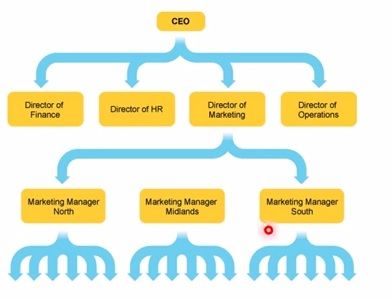
- DEFINITION: The ways jobs, responsibilities and power is organised within a business
- LAYERS OF HIERARCHY: Levels of management
- CHAIN OF COMMAND: Lines of authority in the organisation
- SPAN OF CONTROL: Number of subordinates who a manager directly controls
- HIERARCHAL: Tall & flat, Traditional methods, provide promotion opportunites
- MATRIX: Based around projects, People from each functional area working as a team
- ENTREPRENEURIAL: Central control from owner, Quick decisions with small team around them
- WORKFORCE ROLES
- SUPERVISORS: Employees with control for one or more subordinate
- TEAM LEADERS: Employees responsible for leading a team of employees
- MANAGERS: Employees who are responsible for the operation of a specific area of the business
- DIRECTORS: Appointed persons by the share-holders to run the organisations
- DEFINITION: The ways jobs, responsibilities and power is organised within a business
EFFECTIVENESS OF WORKFORCE
- LABOUR TURNOVER: Number of leavers per year / Average of number of employees for year x 100
- LABOUR PRODUCTIVITY: Total value of output / Total number of employees
RECRUITMENT, TRAINING & SELECTION
- RECRUITMENT PROCESS
- Identify the vacancy
- Write a job description / personal specification
- Advertise position
- Receive and process applications
- TYPES OF RECRUITMENT
- INTERNAL (notice board, promotion)
- EXTERNAL (job adverts, agencies)
- SELECTION PROCESS
- Interview
- Presentations
- Assessment centres
- Psychometric tests
- TRAINING
- On the job
- Off the job
- Induction
- RECRUITMENT PROCESS
MOTIVATION
- WHAT MOTIVATES EMPLOYEES IN A WORKPLACE?
- Pay
- Responsibility
- Praise
- Empowerment
- Rewards
- FREDRIK TAYLOR
- Workers enjoy work but go to work to earn money
- Theory based all around payment
- Believes that money does motivate and piecework is an effective method to use
- Workers trained to do one job well
- ELTON MAYO
- Believed workers are motivated by having special needs met
- Conducted a study known as the ''hawthorne effect''
- CONCLUSIONS: Managers & Employees communicating motivates, Managers taking an interest motivates, Working in teams motivates
- ABRAHAM MASLOW
- Devised a hierarchy of needs
- Each level has to be fulfilled before the next motivates
- Physiological needs (food, water, shelter)
- Safety needs (security, protection)
- Social needs (Sense of belonging)
- Self esteem (praise, recognition)
- Self actualisation (achieve dreams)
- FREDERICK HERZBERG
- Believes some factors motivate, some demotivate.
- Motivators: Job enlargement, Job enrichment, Empowerment
- Demotivators: Anything else
- Believes some factors motivate, some demotivate.
- WHAT MOTIVATES EMPLOYEES IN A WORKPLACE?
EFFECTIVE MARKETING
- The purpose of marketing is to meet the customers needs & wants
- NICHE MARKET: Small specialised market
- MASS MARKET: Larger more general market
- The purpose of marketing is to meet the customers needs & wants
Imagens e arquivos do mapa
Informações
- Descrição
- A guide to business studies UNIT 2 covers everything apart from marketing mix (there was no room to include it)
- Criado por
- jakeyboihc
- Visualizações
- 40
- Tags
- Avaliação