
30089346
Descrição

Mapa Mental por Rodrigo Sebastián De León Mendoza, atualizado more than 1 year ago

|
Criado por Rodrigo Sebastián De León Mendoza
quase 5 anos atrás
|
|
Proteins
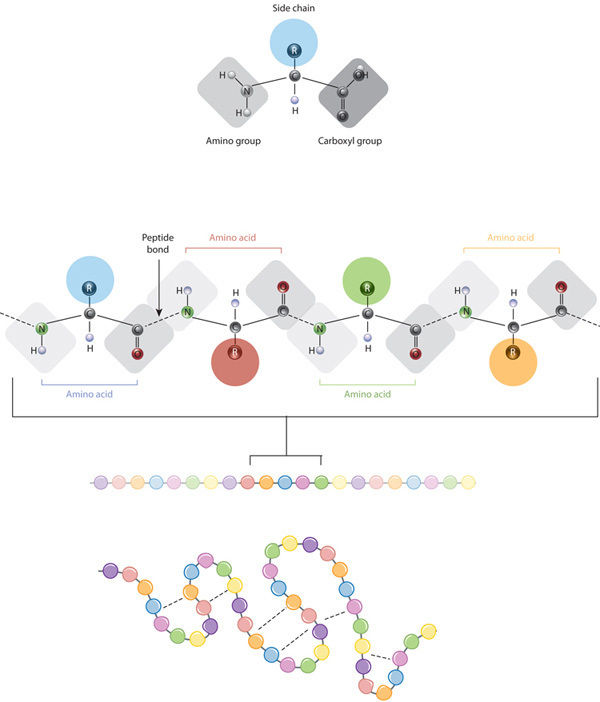
- Proteins consists of one or more chains of amino acids
- All amino acids have the same fundamental structure.
- A central carbon bonded to a hydrogen atom, a
nitrogen-containing amino group a carboxylic
group, and in "R" group that varies among
different amino acids
- A central carbon bonded to a hydrogen atom, a
nitrogen-containing amino group a carboxylic
group, and in "R" group that varies among
different amino acids
- Amino acids are commonly
found in the protein organisms
- They are polymers of amino acids joined.
- All amino acids have the same fundamental structure.
- They can have up to four levels of structure that
determine its function
- Interactions among amino acid R groups cause twists, folds and interconnections
which gives proteins their 3D dimensional structure
- They are up to four organized levels of protein structure.
- Primary structure is the sequence of
amino acids in a protein
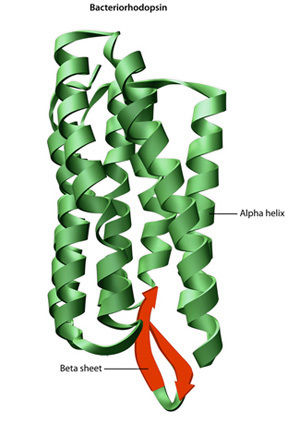
- Secondary Structures are maintained by
hydrogen bonds between the polar
structures of amino acids
- Quaternary Structure refers to the structure of a protein
macromolecule formed by interactions between multiple polypeptide
chains. Each polypeptide chain is referred to as a subunit. Proteins
with quaternary structure may consist of more than one of the
same type of protein subunit. They may also be composed of
different subunits.
- The tertiary structure is
primarily due to interactions
between the R groups of the
amino acids that make up
the protein.
- There are several types of bonds and forces that hold a
protein in its tertiary structure.
- Hydrogen bonding in the polypeptide chain and
between amino acid "R" groups helps to stabilize
protein structure by holding the protein in the
shape established by the hydrophobic
interactions.
- Hydrophobic interactions greatly contribute to the folding and
shaping of a protein. The "R" group of the amino acid is either
hydrophobic or hydrophilic. The amino acids with hydrophilic "R"
groups will seek contact with their aqueous environment, while
amino acids with hydrophobic "R" groups will seek to avoid water
and position themselves towards the center of the protein.
- Due to protein folding, ionic bonding can occur between
the positively and negatively charged "R" groups that
come in close contact with one another.
- Folding can also result in covalent bonding between the
"R" groups of cysteine amino acids. This type of bonding
forms what is called a disulfide bridge. Interactions
called van der Waals forces also assist in the
stabilization of protein structure. These interactions
pertain to the attractive and repulsive forces that occur
between molecules that become polarized. These forces
contribute to the bonding that occurs between molecules.
- Hydrogen bonding in the polypeptide chain and
between amino acid "R" groups helps to stabilize
protein structure by holding the protein in the
shape established by the hydrophobic
interactions.
- There are several types of bonds and forces that hold a
protein in its tertiary structure.
- Primary structure is the sequence of
amino acids in a protein
- They are up to four organized levels of protein structure.
- Interactions among amino acid R groups cause twists, folds and interconnections
which gives proteins their 3D dimensional structure
- The function of protein are related to their three-dimensional structures
- When a protein is denatured, the importance of a higher level protein
structure is obvius as its 3D structure is altered while leaving the
primarly structure intact
- The exact position and number of amino acids bearing specific
R groups determine both the structure and the biological
function of a protein
- When a protein is denatured, the importance of a higher level protein
structure is obvius as its 3D structure is altered while leaving the
primarly structure intact
- Amino Acids are joined by dehydration synthesis.
- Amino Acids are added, one by one, until polypeptide
chain is all completed
- Amino Acids are added, one by one, until polypeptide
chain is all completed
Anexos de mídia
Quer criar seus próprios Mapas Mentais gratuitos com a GoConqr? Saiba mais.