
Mapa mental
Lithosphere
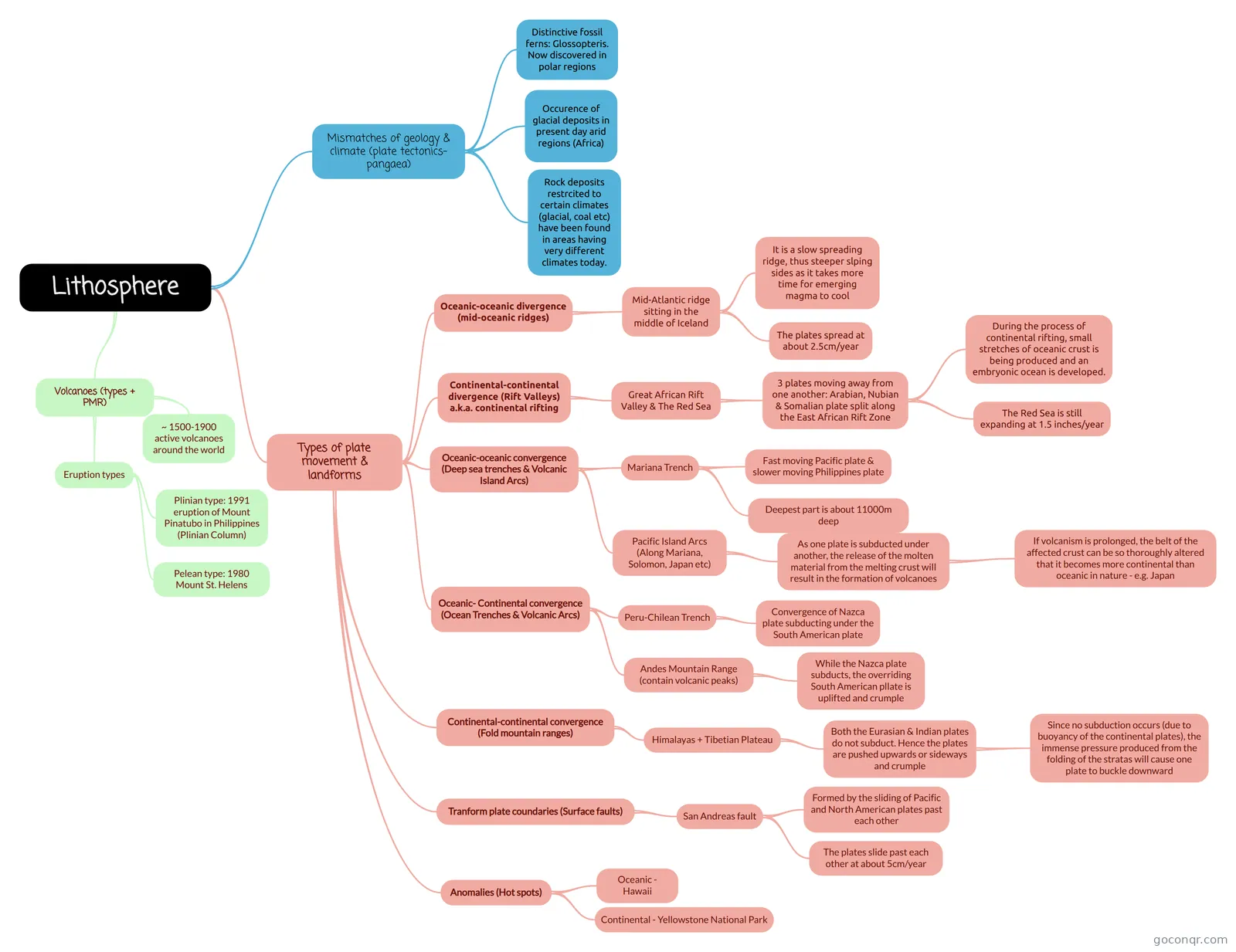
Mind map: Lithosphere
Conteúdo do mapa
Lithosphere
Mismatches of geology & climate (plate tectonics- pangaea)
- Distinctive fossil ferns: Glossopteris. Now discovered in polar regions
- Occurence of glacial deposits in present day arid regions (Africa)
- Rock deposits restrcited to certain climates (glacial, coal etc) have been found in areas having very different climates today.
Types of plate movement & landforms
- Oceanic-oceanic divergence (mid-oceanic ridges)
- Mid-Atlantic ridge sitting in the middle of Iceland
- It is a slow spreading ridge, thus steeper slping sides as it takes more time for emerging magma to cool
- North Atlantic: North American & Eurasian plates South Atlantic: South American & African plates
- The plates spread at about 2.5cm/year
- It is a slow spreading ridge, thus steeper slping sides as it takes more time for emerging magma to cool
- Mid-Atlantic ridge sitting in the middle of Iceland
- Continental-continental divergence (Rift Valleys) a.k.a. continental rifting
- Great African Rift Valley & The Red Sea
- 3 plates moving away from one another: Arabian, Nubian & Somalian plate split along the East African Rift Zone
- During the process of continental rifting, small stretches of oceanic crust is being produced and an embryonic ocean is developed.
- This occurs as the plates continue to diverge and basaltic magma rises through the lines of crustal weakness to form new oceanic crust.
- The Red Sea is still expanding at 1.5 inches/year
- During the process of continental rifting, small stretches of oceanic crust is being produced and an embryonic ocean is developed.
- 3 plates moving away from one another: Arabian, Nubian & Somalian plate split along the East African Rift Zone
- Great African Rift Valley & The Red Sea
- Oceanic-oceanic convergence (Deep sea trenches & Volcanic Island Arcs)
- Mariana Trench
- Fast moving Pacific plate & slower moving Philippines plate
- Deepest part is about 11000m deep
- Pacific Island Arcs (Along Mariana, Solomon, Japan etc)
- Parallel to the Oceanic trench
- As one plate is subducted under another, the release of the molten material from the melting crust will result in the formation of volcanoes
- If volcanism is prolonged, the belt of the affected crust can be so thoroughly altered that it becomes more continental than oceanic in nature - e.g. Japan
- Mariana Trench
- Oceanic- Continental convergence (Ocean Trenches & Volcanic Arcs)
- Peru-Chilean Trench
- Convergence of Nazca plate subducting under the South American plate
- Andes Mountain Range (contain volcanic peaks)
- While the Nazca plate subducts, the overriding South American pllate is uplifted and crumple
- Peru-Chilean Trench
- Continental-continental convergence (Fold mountain ranges)
- Himalayas + Tibetian Plateau
- Both the Eurasian & Indian plates do not subduct. Hence the plates are pushed upwards or sideways and crumple
- Since no subduction occurs (due to buoyancy of the continental plates), the immense pressure produced from the folding of the stratas will cause one plate to buckle downward
- Both the Eurasian & Indian plates do not subduct. Hence the plates are pushed upwards or sideways and crumple
- Himalayas + Tibetian Plateau
- Tranform plate coundaries (Surface faults)
- San Andreas fault
- Formed by the sliding of Pacific and North American plates past each other
- The plates slide past each other at about 5cm/year
- San Andreas fault
- Anomalies (Hot spots)
- Oceanic - Hawaii
- Continental - Yellowstone National Park
- Oceanic-oceanic divergence (mid-oceanic ridges)
Volcanoes (types + PMR)
- ~ 1500-1900 active volcanoes around the world
- Eruption types
- Plinian type: 1991 eruption of Mount Pinatubo in Philippines (Plinian Column)
- Pelean type: 1980 Mount St. Helens
Informações
- Descrição
- A'levels Geography (Lithosphere) Mapa Mental sobre Lithosphere, criado por kikymm em 01-08-2015.
- Criado por
- kikymm
- Visualizações
- 1
- Avaliação
Mais sobre Earth's Internal Structure