
Mapa mental
Indemnity
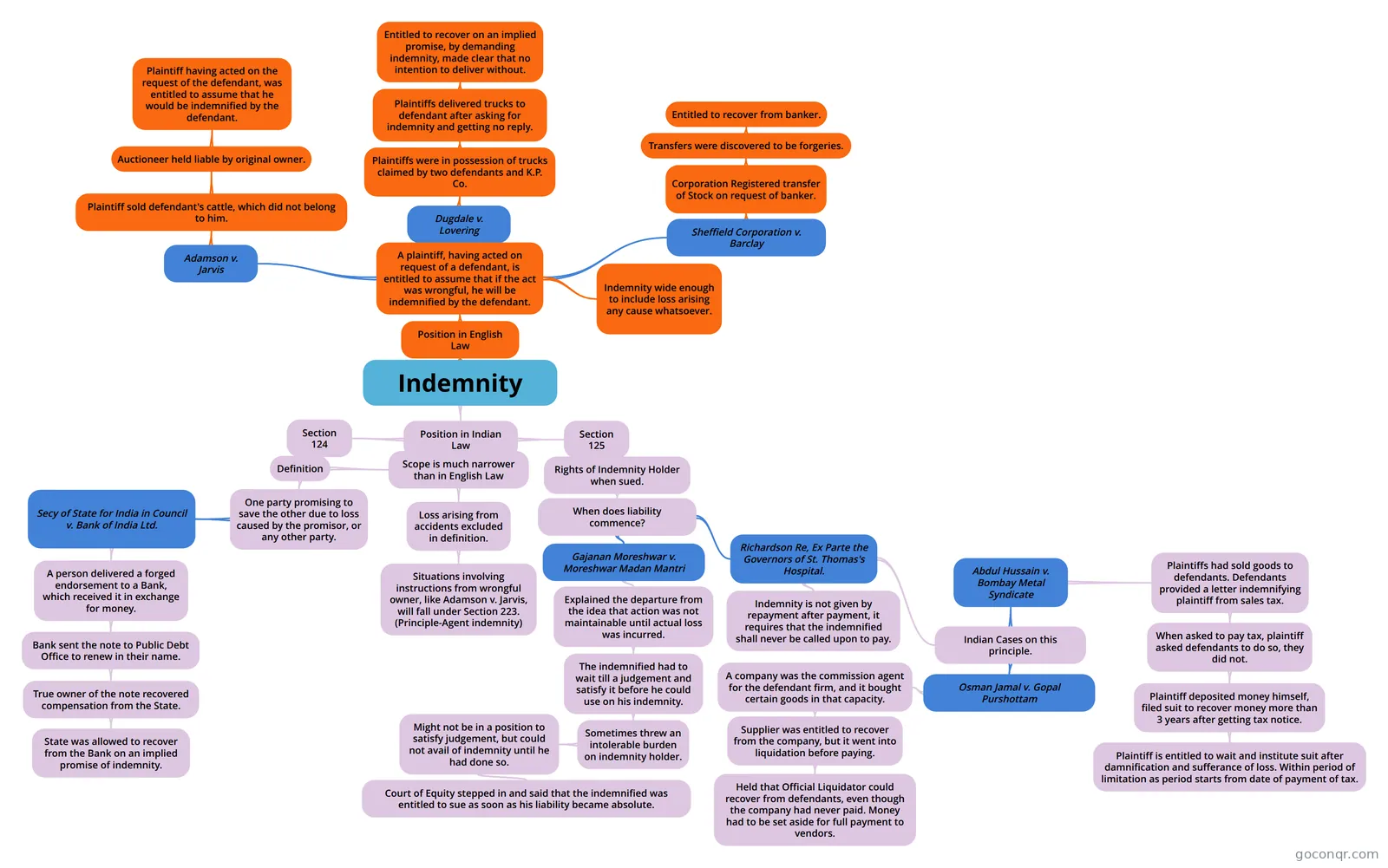
Mind map: Indemnity law
Conteúdo do mapa
Indemnity
Position in English Law
- A plaintiff, having acted on request of a defendant, is entitled to assume that if the act was wrongful, he will be indemnified by the defendant.
- Adamson v. Jarvis
- Plaintiff sold defendant's cattle, which did not belong to him.
- Auctioneer held liable by original owner.
- Plaintiff having acted on the request of the defendant, was entitled to assume that he would be indemnified by the defendant.
- Auctioneer held liable by original owner.
- Plaintiff sold defendant's cattle, which did not belong to him.
- Indemnity wide enough to include loss arising any cause whatsoever.
- Dugdale v. Lovering
- Plaintiffs were in possession of trucks claimed by two defendants and K.P. Co.
- Plaintiffs delivered trucks to defendant after asking for indemnity and getting no reply.
- Entitled to recover on an implied promise, by demanding indemnity, made clear that no intention to deliver without.
- Plaintiffs delivered trucks to defendant after asking for indemnity and getting no reply.
- Plaintiffs were in possession of trucks claimed by two defendants and K.P. Co.
- Sheffield Corporation v. Barclay
- Corporation Registered transfer of Stock on request of banker.
- Transfers were discovered to be forgeries.
- Entitled to recover from banker.
- Transfers were discovered to be forgeries.
- Corporation Registered transfer of Stock on request of banker.
- Adamson v. Jarvis
- A plaintiff, having acted on request of a defendant, is entitled to assume that if the act was wrongful, he will be indemnified by the defendant.
Position in Indian Law
- Section 124
- Definition
- Scope is much narrower than in English Law
- Loss arising from accidents excluded in definition.
- Situations involving instructions from wrongful owner, like Adamson v. Jarvis, will fall under Section 223. (Principle-Agent indemnity)
- Loss arising from accidents excluded in definition.
- One party promising to save the other due to loss caused by the promisor, or any other party.
- Secy of State for India in Council v. Bank of India Ltd.
- A person delivered a forged endorsement to a Bank, which received it in exchange for money.
- Bank sent the note to Public Debt Office to renew in their name.
- True owner of the note recovered compensation from the State.
- State was allowed to recover from the Bank on an implied promise of indemnity.
- True owner of the note recovered compensation from the State.
- Bank sent the note to Public Debt Office to renew in their name.
- A person delivered a forged endorsement to a Bank, which received it in exchange for money.
- Secy of State for India in Council v. Bank of India Ltd.
- Scope is much narrower than in English Law
- Definition
- Section 125
- Rights of Indemnity Holder when sued.
- When does liability commence?
- Gajanan Moreshwar v. Moreshwar Madan Mantri
- Explained the departure from the idea that action was not maintainable until actual loss was incurred.
- The indemnified had to wait till a judgement and satisfy it before he could use on his indemnity.
- Sometimes threw an intolerable burden on indemnity holder.
- Might not be in a position to satisfy judgement, but could not avail of indemnity until he had done so.
- Court of Equity stepped in and said that the indemnified was entitled to sue as soon as his liability became absolute.
- Might not be in a position to satisfy judgement, but could not avail of indemnity until he had done so.
- Sometimes threw an intolerable burden on indemnity holder.
- The indemnified had to wait till a judgement and satisfy it before he could use on his indemnity.
- Explained the departure from the idea that action was not maintainable until actual loss was incurred.
- Richardson Re, Ex Parte the Governors of St. Thomas's Hospital.
- Indemnity is not given by repayment after payment, it requires that the indemnified shall never be called upon to pay.
- Indian Cases on this principle.
- Osman Jamal v. Gopal Purshottam
- A company was the commission agent for the defendant firm, and it bought certain goods in that capacity.
- Supplier was entitled to recover from the company, but it went into liquidation before paying.
- Held that Official Liquidator could recover from defendants, even though the company had never paid. Money had to be set aside for full payment to vendors.
- Supplier was entitled to recover from the company, but it went into liquidation before paying.
- A company was the commission agent for the defendant firm, and it bought certain goods in that capacity.
- Abdul Hussain v. Bombay Metal Syndicate
- Plaintiffs had sold goods to defendants. Defendants provided a letter indemnifying plaintiff from sales tax.
- When asked to pay tax, plaintiff asked defendants to do so, they did not.
- Plaintiff deposited money himself, filed suit to recover money more than 3 years after getting tax notice.
- Plaintiff is entitled to wait and institute suit after damnification and sufferance of loss. Within period of limitation as period starts from date of payment of tax.
- Plaintiff deposited money himself, filed suit to recover money more than 3 years after getting tax notice.
- When asked to pay tax, plaintiff asked defendants to do so, they did not.
- Plaintiffs had sold goods to defendants. Defendants provided a letter indemnifying plaintiff from sales tax.
- Osman Jamal v. Gopal Purshottam
- Gajanan Moreshwar v. Moreshwar Madan Mantri
- When does liability commence?
- Rights of Indemnity Holder when sued.
- Section 124