
Mapa mental
Lymphatic System
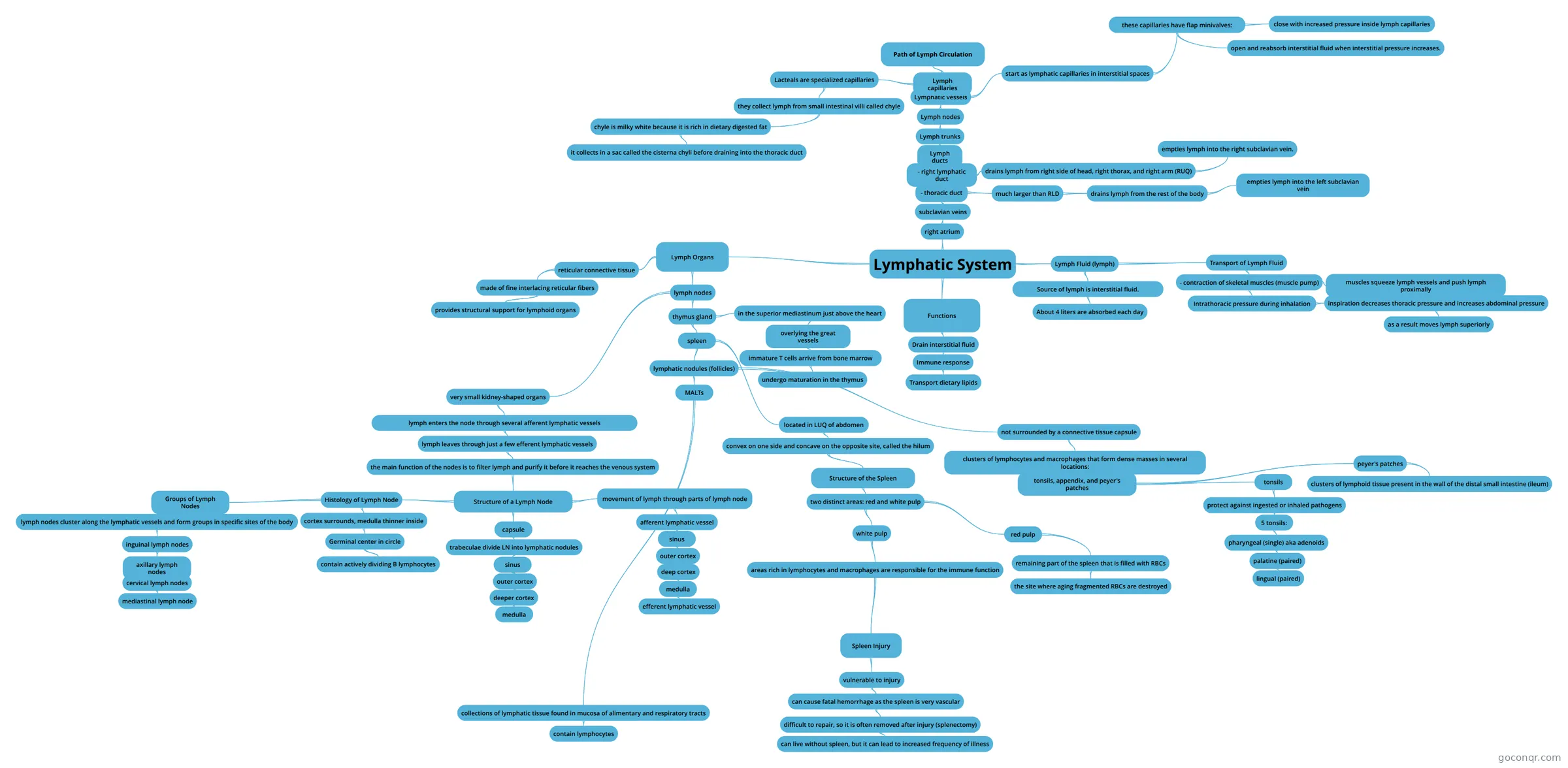
Mind map: Lymphatic system
Conteúdo do mapa
Lymphatic System
Functions
- Drain interstitial fluid
- Immune response
- Transport dietary lipids
- Immune response
- Drain interstitial fluid
Lymph Fluid (lymph)
- Source of lymph is interstitial fluid.
- About 4 liters are absorbed each day
- Transport of Lymph Fluid
- - contraction of skeletal muscles (muscle pump)
- Intrathoracic pressure during inhalation
- inspiration decreases thoracic pressure and increases abdominal pressure
- as a result moves lymph superiorly
- inspiration decreases thoracic pressure and increases abdominal pressure
- muscles squeeze lymph vessels and push lymph proximally
- Intrathoracic pressure during inhalation
- - contraction of skeletal muscles (muscle pump)
- Source of lymph is interstitial fluid.
right atrium
- subclavian veins
- - thoracic duct
- - right lymphatic duct
- Lymph ducts
- Lymph trunks
- Lymph nodes
- Lymphatic vessels
- Lymph capillaries
- Path of Lymph Circulation
- Lacteals are specialized capillaries
- they collect lymph from small intestinal villi called chyle
- chyle is milky white because it is rich in dietary digested fat
- it collects in a sac called the cisterna chyli before draining into the thoracic duct
- chyle is milky white because it is rich in dietary digested fat
- they collect lymph from small intestinal villi called chyle
- start as lymphatic capillaries in interstitial spaces
- these capillaries have flap minivalves:
- open and reabsorb interstitial fluid when interstitial pressure increases.
- close with increased pressure inside lymph capillaries
- these capillaries have flap minivalves:
- Lymph capillaries
- Lymphatic vessels
- Lymph nodes
- Lymph trunks
- drains lymph from right side of head, right thorax, and right arm (RUQ)
- empties lymph into the right subclavian vein.
- Lymph ducts
- much larger than RLD
- drains lymph from the rest of the body
- empties lymph into the left subclavian vein
- drains lymph from the rest of the body
- - right lymphatic duct
- - thoracic duct
- subclavian veins
Lymph Organs
- lymph nodes
- thymus gland
- spleen
- lymphatic nodules (follicles)
- MALTs
- collections of lymphatic tissue found in mucosa of alimentary and respiratory tracts
- contain lymphocytes
- collections of lymphatic tissue found in mucosa of alimentary and respiratory tracts
- not surrounded by a connective tissue capsule
- clusters of lymphocytes and macrophages that form dense masses in several locations:
- tonsils, appendix, and peyer's patches
- tonsils
- protect against ingested or inhaled pathogens
- 5 tonsils:
- pharyngeal (single) aka adenoids
- palatine (paired)
- lingual (paired)
- palatine (paired)
- pharyngeal (single) aka adenoids
- 5 tonsils:
- protect against ingested or inhaled pathogens
- peyer's patches
- clusters of lymphoid tissue present in the wall of the distal small intestine (ileum)
- tonsils
- tonsils, appendix, and peyer's patches
- clusters of lymphocytes and macrophages that form dense masses in several locations:
- MALTs
- located in LUQ of abdomen
- convex on one side and concave on the opposite site, called the hilum
- Structure of the Spleen
- two distinct areas: red and white pulp
- white pulp
- areas rich in lymphocytes and macrophages are responsible for the immune function
- Spleen Injury
- vulnerable to injury
- can cause fatal hemorrhage as the spleen is very vascular
- difficult to repair, so it is often removed after injury (splenectomy)
- can live without spleen, but it can lead to increased frequency of illness
- difficult to repair, so it is often removed after injury (splenectomy)
- can cause fatal hemorrhage as the spleen is very vascular
- vulnerable to injury
- Spleen Injury
- areas rich in lymphocytes and macrophages are responsible for the immune function
- red pulp
- remaining part of the spleen that is filled with RBCs
- the site where aging fragmented RBCs are destroyed
- remaining part of the spleen that is filled with RBCs
- white pulp
- two distinct areas: red and white pulp
- Structure of the Spleen
- convex on one side and concave on the opposite site, called the hilum
- lymphatic nodules (follicles)
- in the superior mediastinum just above the heart
- overlying the great vessels
- immature T cells arrive from bone marrow
- undergo maturation in the thymus
- immature T cells arrive from bone marrow
- overlying the great vessels
- spleen
- very small kidney-shaped organs
- lymph enters the node through several afferent lymphatic vessels
- lymph leaves through just a few efferent lymphatic vessels
- the main function of the nodes is to filter lymph and purify it before it reaches the venous system
- Structure of a Lymph Node
- capsule
- trabeculae divide LN into lymphatic nodules
- sinus
- outer cortex
- deeper cortex
- medulla
- deeper cortex
- outer cortex
- sinus
- trabeculae divide LN into lymphatic nodules
- movement of lymph through parts of lymph node
- afferent lymphatic vessel
- sinus
- outer cortex
- deep cortex
- medulla
- efferent lymphatic vessel
- medulla
- deep cortex
- outer cortex
- sinus
- afferent lymphatic vessel
- Histology of Lymph Node
- cortex surrounds, medulla thinner inside
- Germinal center in circle
- contain actively dividing B lymphocytes
- Germinal center in circle
- Groups of Lymph Nodes
- lymph nodes cluster along the lymphatic vessels and form groups in specific sites of the body
- inguinal lymph nodes
- axillary lymph nodes
- cervical lymph nodes
- mediastinal lymph node
- cervical lymph nodes
- axillary lymph nodes
- inguinal lymph nodes
- lymph nodes cluster along the lymphatic vessels and form groups in specific sites of the body
- cortex surrounds, medulla thinner inside
- capsule
- Structure of a Lymph Node
- the main function of the nodes is to filter lymph and purify it before it reaches the venous system
- lymph leaves through just a few efferent lymphatic vessels
- lymph enters the node through several afferent lymphatic vessels
- thymus gland
- reticular connective tissue
- made of fine interlacing reticular fibers
- provides structural support for lymphoid organs
- made of fine interlacing reticular fibers
- lymph nodes
Informações
- Descrição
- Mapa Mental sobre Lymphatic System, criado por Key R em 15-06-2021.
- Criado por
- Key R
- Visualizações
- 4
- Avaliação
Mais sobre Lymphatic system anatomy and functions