
Mapa mental
Defamation
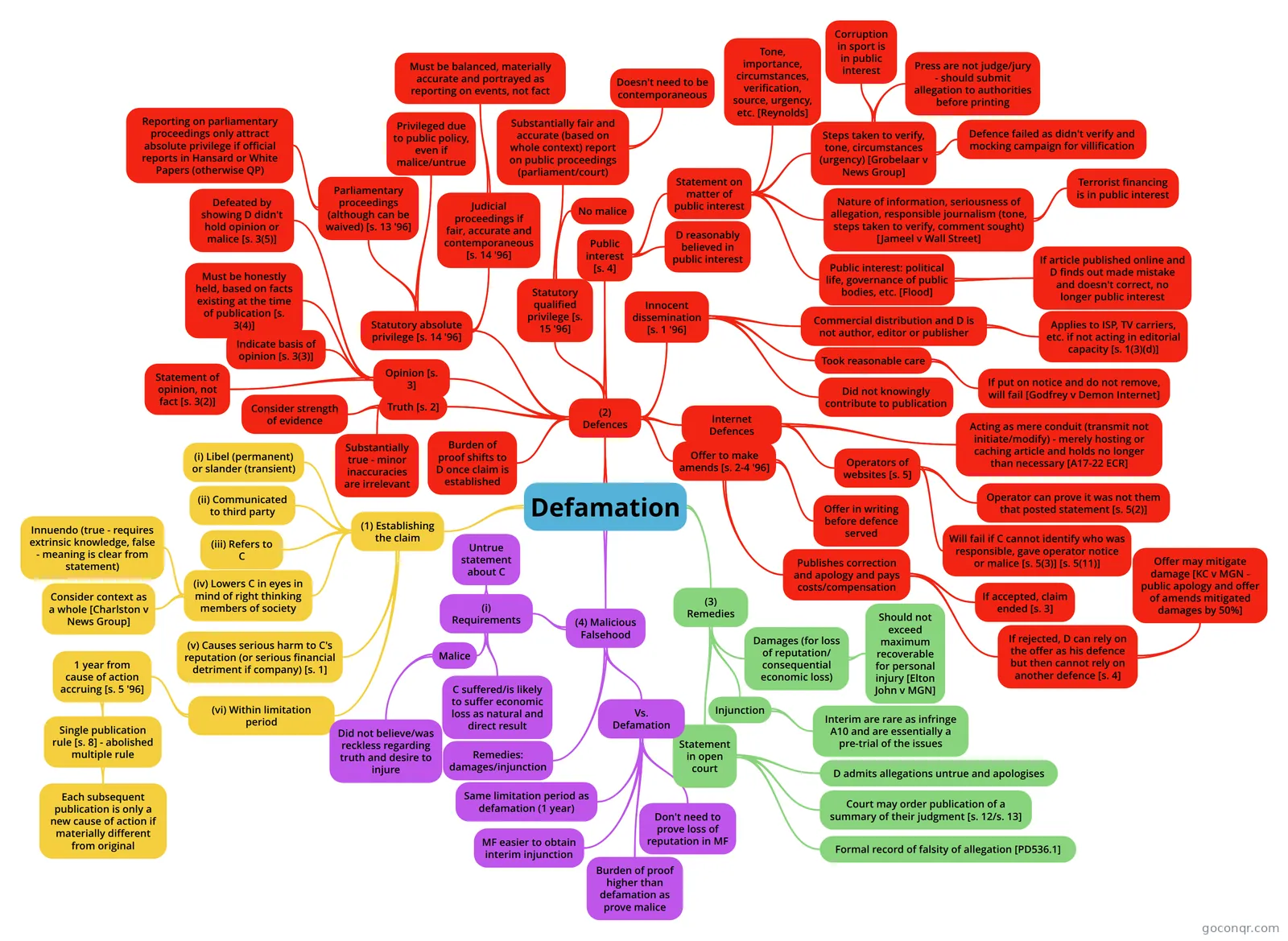
Mind map: Defamation
Conteúdo do mapa
Defamation
(1) Establishing the claim
- (i) Libel (permanent) or slander (transient)
- (ii) Communicated to third party
- (iii) Refers to C
- (iv) Lowers C in eyes in mind of right thinking members of society
- Innuendo (true - requires extrinsic knowledge, false - meaning is clear from statement)
- Consider context as a whole [Charlston v News Group]
- (v) Causes serious harm to C's reputation (or serious financial detriment if company) [s. 1]
- (vi) Within limitation period
- 1 year from cause of action accruing [s. 5 '96]
- Single publication rule [s. 8] - abolished multiple rule
- Each subsequent publication is only a new cause of action if materially different from original
- Single publication rule [s. 8] - abolished multiple rule
- 1 year from cause of action accruing [s. 5 '96]
(2) Defences
- Burden of proof shifts to D once claim is established
- Truth [s. 2]
- Substantially true - minor inaccuracies are irrelevant
- Consider strength of evidence
- Opinion [s. 3]
- Statement of opinion, not fact [s. 3(2)]
- Indicate basis of opinion [s. 3(3)]
- Must be honestly held, based on facts existing at the time of publication [s. 3(4)]
- Defeated by showing D didn't hold opinion or malice [s. 3(5)]
- Statutory absolute privilege [s. 14 '96]
- Privileged due to public policy, even if malice/untrue
- Parliamentary proceedings (although can be waived) [s. 13 '96]
- Reporting on parliamentary proceedings only attract absolute privilege if official reports in Hansard or White Papers (otherwise QP)
- Judicial proceedings if fair, accurate and contemporaneous [s. 14 '96]
- Must be balanced, materially accurate and portrayed as reporting on events, not fact
- Statutory qualified privilege [s. 15 '96]
- Substantially fair and accurate (based on whole context) report on public proceedings (parliament/court)
- Doesn't need to be contemporaneous
- No malice
- Substantially fair and accurate (based on whole context) report on public proceedings (parliament/court)
- Public interest [s. 4]
- Statement on matter of public interest
- Tone, importance, circumstances, verification, source, urgency, etc. [Reynolds]
- Steps taken to verify, tone, circumstances (urgency) [Grobelaar v News Group]
- Corruption in sport is in public interest
- Press are not judge/jury - should submit allegation to authorities before printing
- Defence failed as didn't verify and mocking campaign for villification
- Nature of information, seriousness of allegation, responsible journalism (tone, steps taken to verify, comment sought) [Jameel v Wall Street]
- Terrorist financing is in public interest
- Public interest: political life, governance of public bodies, etc. [Flood]
- If article published online and D finds out made mistake and doesn't correct, no longer public interest
- D reasonably believed in public interest
- Statement on matter of public interest
- Innocent dissemination [s. 1 '96]
- Commercial distribution and D is not author, editor or publisher
- Applies to ISP, TV carriers, etc. if not acting in editorial capacity [s. 1(3)(d)]
- Took reasonable care
- If put on notice and do not remove, will fail [Godfrey v Demon Internet]
- Did not knowingly contribute to publication
- Commercial distribution and D is not author, editor or publisher
- Internet Defences
- Acting as mere conduit (transmit not initiate/modify) - merely hosting or caching article and holds no longer than necessary [A17-22 ECR]
- Operators of websites [s. 5]
- Operator can prove it was not them that posted statement [s. 5(2)]
- Will fail if C cannot identify who was responsible, gave operator notice or malice [s. 5(3)] [s. 5(11)]
- Offer to make amends [s. 2-4 '96]
- Offer in writing before defence served
- Publishes correction and apology and pays costs/compensation
- If accepted, claim ended [s. 3]
- If rejected, D can rely on the offer as his defence but then cannot rely on another defence [s. 4]
- Offer may mitigate damage [KC v MGN - public apology and offer of amends mitigated damages by 50%]
(3) Remedies
- Damages (for loss of reputation/ consequential economic loss)
- Should not exceed maximum recoverable for personal injury [Elton John v MGN]
- Injunction
- Interim are rare as infringe A10 and are essentially a pre-trial of the issues
- Statement in open court
- D admits allegations untrue and apologises
- Formal record of falsity of allegation [PD536.1]
- Court may order publication of a summary of their judgment [s. 12/s. 13]
- Damages (for loss of reputation/ consequential economic loss)
(4) Malicious Falsehood
- (i) Requirements
- Untrue statement about C
- Malice
- Did not believe/was reckless regarding truth and desire to injure
- C suffered/is likely to suffer economic loss as natural and direct result
- Remedies: damages/injunction
- Vs. Defamation
- Burden of proof higher than defamation as prove malice
- Same limitation period as defamation (1 year)
- MF easier to obtain interim injunction
- Don't need to prove loss of reputation in MF
- (i) Requirements
Informações
- Descrição
- LPC MEL Mapa Mental sobre Defamation, criado por jc94055z em 11-08-2015.
- Criado por
- jc94055z
- Visualizações
- 0
- Avaliação