
Mapa mental
Unit 12 Algorithms
Conteúdo do mapa
Unit 12 Algorithms
T1 - Analysis & Design of algorithms
- Problems solved by algorithms
- A good algorithm
- has clear and precisely stated steps that product the correct output for any set of valid inputs
- Should allow for invalid inputs
- Must always terminate at some point
- Should perform the task efficiently, in as few steps as possible
- should be designed in such a way that other people will be able to understand it and modify it if necessary
- A good algorithm
- Execution time VS problem size
- For most problems, the larger the size of the problem or amount of data, the longer the execution time
- Linear function
- A linear function takes the form f(n) = an + b where a and b are constants
- F(n) = 3n, f(n) = n + 5 are examples of linear functions
- F(1) is a constant function - no matter how large n gets, f(1) stays the same size. F(2), f(3) and f(100) are all constant functions.
- The order of magnitude for a linear function is written as O(n)
- Quadratic function
- A quadratic function takes the form f(n) = an^2 + bn + c where a, b and c are constants.
- As n becomes large, the n^2 terms increases very much faster than either of the other terms
- The order of magnitude of a quadratic function is written as O(n^2)
- The dominant term is the one used when comparing algorithms, so the bn and c terms are not considered
- Logarithmic functions
- A logarithmic function takes the form f(n) = alog2n. the logarithm of a number is the power to which the base must be raised to make it equal to a number
- 8 = 2^3, log2,8 = 3, this is an example of a logarithmic function
- F(n) increases very slowly in relation to n. The order of magnitude of a logarithmic function is written as O(log n)
- Logarithmic function
- "Divide and conquer" algorithms work by halving the size of the problem at each pass. A binary tree search algorithm is a good example of this.
- For a balanced tree of 1024 (2^10) items, only20 items need to be examined
- Time complexity increases very slowly as the problem size increases. It is logarithmic, that is, O(log n).
- Big-O notation
- Big-O notation is a measure of the time complexity of an algorithm. It is a useful approximation of the time taken to execute an algorithm for a given number of items in a data set.
- An algorithm of time complexity O(n) increases linearly. 10,000 items will take approximately twice as long as 5000 items to process
- There is no such thing as, for example, O(2n+1). Only the dominant term counts, so it is O(n)
- Permutations
- A permutation of n items is the number of ways the n items can be arranged.
- Repetition allowed; for example, a combination lock with 4 digits 0 to 9
- No repetition allowed; for example, you have 4 different coloured balls in a bag, and you draw them out one at a time
- Problems solved by algorithms
T2 - Searching Algorithms
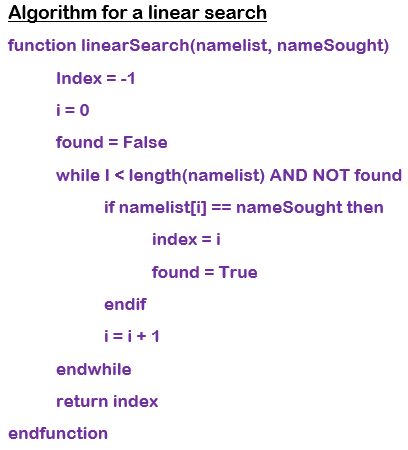
- Linear Search
- if the data is in a random order, the only systematic way to find something would be a linear search
- Algorithm for a linear search
- Big-O for linear search
- There are 2 statements in the loop and 3 at the start. 2n + 3 in worst case. The time complexity is O(n)
- if the data is in a random order, the only systematic way to find something would be a linear search
- Binary search
- The binary search is a very efficient way of searching a sorted list.
- Examine the middle item in the list
- If this is the one you are searching for, return the index
- Eliminate half the list, depending on whether the item being sought is greater than or less than the middle item
- Repeat until the item is found or is proved top be not in the list
- Eliminate half the list, depending on whether the item being sought is greater than or less than the middle item
- If this is the one you are searching for, return the index
- Divide & Conquer
- In a binary search, the size of the list is approximately halved each item an item is examined
- In a list of 2^n items, the maximum number of items you will need to look at will be n + 1
- Linear Search
T3 - Bubble & Insertion Sort
- Choosing a sort algorithm
- If there only a small number of items to sort, a bubble sort may be perfectly adequate
- Some sort of algorithms take a lot of memory and that may be a problem with a large dataset
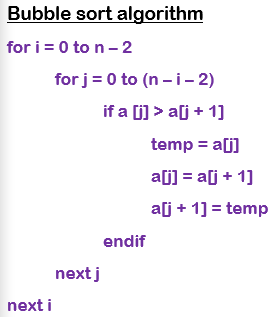
- Bubble sort
- A bubble sort is a useful sort when there are only a small number of items to be sorted
- To sort an array of n items, n-1 passes are made through the array, with each item being compared with the adjacent item and swapped if necessary
- Big-O for a bubble sort
- The three statements in the inner loop are performed n(n-1 + n-2 + n-3 + ...... + 1)
- This is approximately 3 x 1/2 n^2 statements. Ignoring the constant, the time complexity is O(n^2)
- The three statements in the inner loop are performed n(n-1 + n-2 + n-3 + ...... + 1)
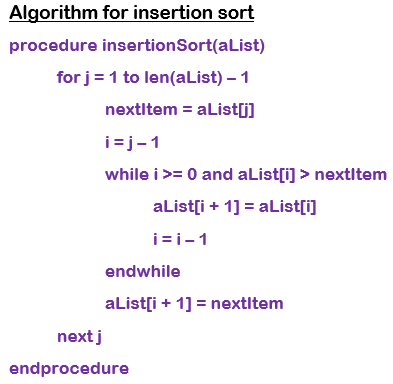
- Insertion sort
- The insertion sort is an efficient algorithm for sorting a small number of elements. It works in the same way you might sort a deck of playing cards
- Start with all cards face down. Pick up each card in turn and insert it into the correct place in the deck.
- Time complexity of insertion sort
- The insertion sort algorithm has 2 nested loops, the outer loop is performed n-1 times, the inner loop, which moves the items along to make room for the current item, is performed a maximum of n-1 times, the Big-O time complexity is O(n^2)
- Choosing a sort algorithm
T4 - Merge & Quick sort
- Merge sort
- This is much more efficient than the bubble sort
- Big-O for the merge sort
- This is another example of a 'divide and conquer' algorithm which halves the size of each list to be merged
- First the list is split into halves, log2n times. Each of these log2n splits requires n operations to merge the data into a single list
- So the time complexity is O(n log2n)
- Quick sort
- This is another 'Divide and Conquer' algorithm. It is much faster than any of the other sorts.
- The algorithm works by finding a split point, which divides the lists into two sub-lists, one containing items less than the value at the split point, and the right half containing items greater than the value at the split point
- Merge sort
T5 - Graph traversal algorithms
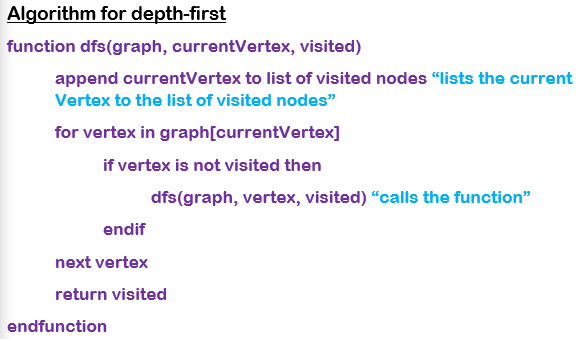
- Depth-first traversal
- With depth-first, you go as far as you can down a path before backtracking and going down the next path
- The algorithm uses a stack to keep track of the last node visited, and a list to hold the names of nodes that have been visited
- Applications of a depth-first traversal
- Job scheduling, where some jobs have to be completed before others can begin
- Depth-first traversal
Imagens e arquivos do mapa
Informações
- Descrição
- A level Computing Mapa Mental sobre Unit 12 Algorithms, criado por Dane Owen em 29-11-2021.
- Criado por
- Dane Owen
- Visualizações
- 0
- Avaliação