
Mapa mental
Globalisation
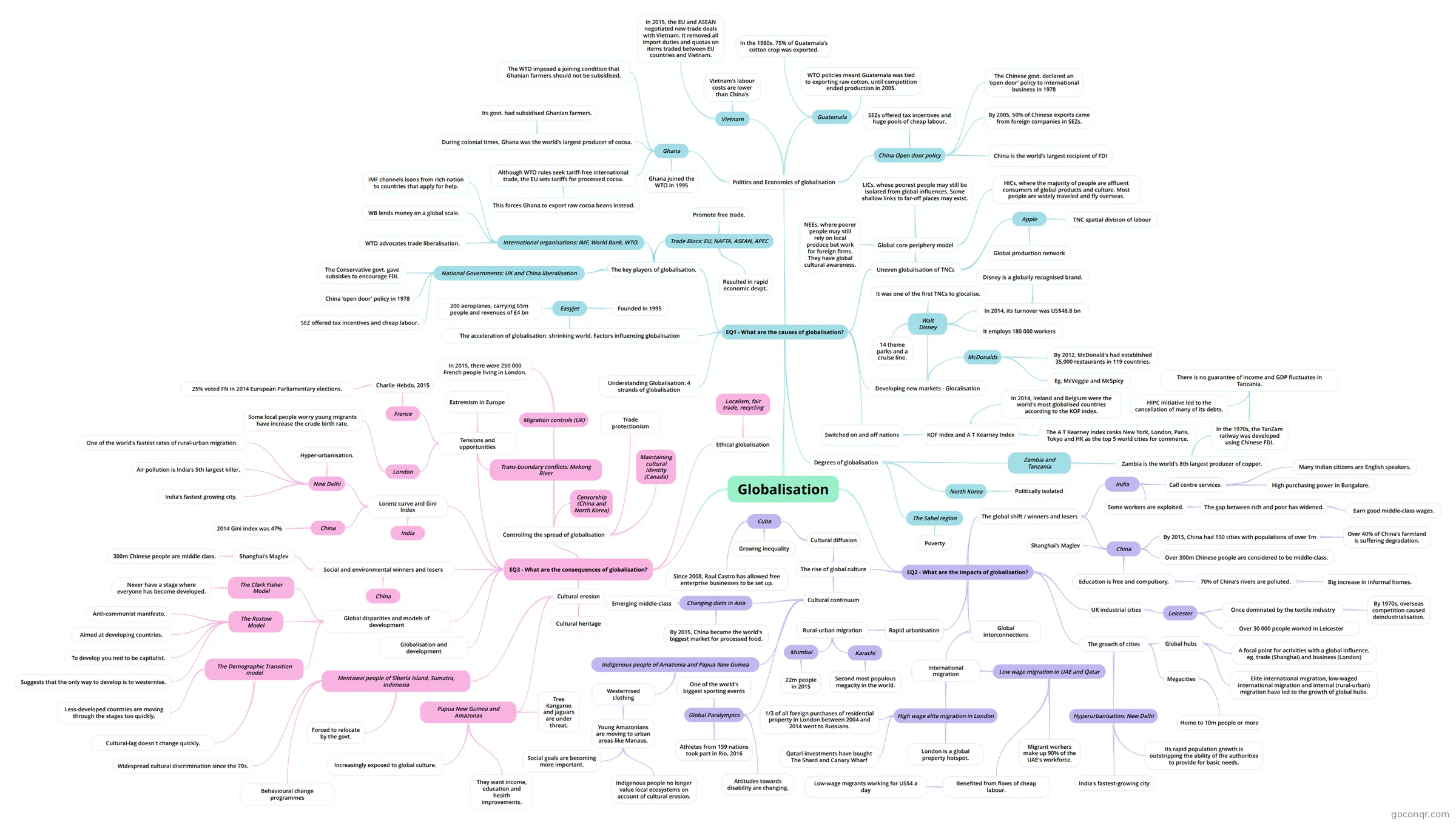
Mind map: Globalisation
Conteúdo do mapa
Globalisation
EQ1 - What are the causes of globalisation?
- Understanding Globalisation: 4 strands of globalisation
- The acceleration of globalisation: shrinking world. Factors influencing globalisation
- Easyjet
- 200 aeroplanes, carrying 65m people and revenues of £4 bn
- Founded in 1995
- Easyjet
- The key players of globalisation.
- International organisations: IMF, World Bank, WTO.
- IMF channels loans from rich nation to countries that apply for help.
- WB lends money on a global scale.
- WTO advocates trade liberalisation.
- National Governments: UK and China liberalisation
- The Conservative govt. gave subsidies to encourage FDI.
- China 'open door' policy in 1978
- SEZ offered tax incentives and cheap labour.
- Trade Blocs: EU, NAFTA, ASEAN, APEC
- Promote free trade.
- Resulted in rapid economic devpt.
- International organisations: IMF, World Bank, WTO.
- Politics and Economics of globalisation
- Ghana
- During colonial times, Ghana was the world's largest producer of cocoa.
- Its govt. had subsidised Ghanian farmers.
- Although WTO rules seek tariff-free international trade, the EU sets tariffs for processed cocoa.
- This forces Ghana to export raw cocoa beans instead.
- Ghana joined the WTO in 1995
- The WTO imposed a joining condition that Ghanian farmers should not be subsidised.
- During colonial times, Ghana was the world's largest producer of cocoa.
- Vietnam
- In 2015, the EU and ASEAN negotiated new trade deals with Vietnam. It removed all import duties and quotas on items traded between EU countries and Vietnam.
- Vietnam's labour costs are lower than China's
- Guatemala
- In the 1980s, 75% of Guatemala's cotton crop was exported.
- WTO policies meant Guatemala was tied to exporting raw cotton, until competition ended production in 2005.
- China Open door policy
- The Chinese govt. declared an 'open door' policy to international business in 1978
- SEZs offered tax incentives and huge pools of cheap labour.
- By 2005, 50% of Chinese exports came from foreign companies in SEZs.
- China is the world's largest recipient of FDI
- Ghana
- Uneven globalisation of TNCs
- Global core periphery model
- LICs, whose poorest people may still be isolated from global influences. Some shallow links to far-off places may exist.
- NEEs, where poorer people may still rely on local produce but work for foreign firms. They have global cultural awareness.
- HICs, where the majority of people are affluent consumers of global products and culture. Most people are widely traveled and fly overseas.
- Apple
- TNC spatial division of labour
- Global production network
- Global core periphery model
- Developing new markets - Glocalisation
- Walt Disney
- It was one of the first TNCs to glocalise.
- 14 theme parks and a cruise line.
- In 2014, its turnover was US$48.8 bn
- Disney is a globally recognised brand.
- It employs 180 000 workers
- McDonalds
- By 2012, McDonald's had established 35,000 restaurants in 119 countries.
- Eg. McVeggie and McSpicy
- Walt Disney
- Switched on and off nations
- KOF index and A T Kearney Index
- In 2014, Ireland and Belgium were the world's most globalised countries according to the KOF index.
- The A T Kearney Index ranks New York, London, Paris, Tokyo and HK as the top 5 world cities for commerce.
- KOF index and A T Kearney Index
- Degrees of globalisation
- Zambia and Tanzania
- Zambia is the world's 8th largest producer of copper.
- In the 1970s, the TanZam railway was developed using Chinese FDI.
- There is no guarantee of income and GDP fluctuates in Tanzania.
- HIPC initiative led to the cancellation of many of its debts.
- There is no guarantee of income and GDP fluctuates in Tanzania.
- In the 1970s, the TanZam railway was developed using Chinese FDI.
- Zambia is the world's 8th largest producer of copper.
- North Korea
- Politically isolated
- The Sahel region
- Poverty
- Zambia and Tanzania
EQ2 - What are the impacts of globalisation?
- The global shift / winners and losers
- India
- Call centre services.
- Many Indian citizens are English speakers.
- High purchasing power in Bangalore.
- Some workers are exploited.
- The gap between rich and poor has widened.
- Earn good middle-class wages.
- The gap between rich and poor has widened.
- Call centre services.
- China
- By 2015, China had 150 cities with populations of over 1m
- Over 40% of China's farmland is suffering degradation.
- Shanghai's Maglev
- Over 300m Chinese people are considered to be middle-class.
- Education is free and compulsory.
- 70% of China's rivers are polluted.
- Big increase in informal homes.
- 70% of China's rivers are polluted.
- By 2015, China had 150 cities with populations of over 1m
- India
- UK industrial cities
- Leicester
- Once dominated by the textile industry
- By 1970s, overseas competition caused deindustrialisation.
- Over 30 000 people worked in Leicester
- Once dominated by the textile industry
- Leicester
- The growth of cities
- Megacities
- Home to 10m people or more
- Global hubs
- A focal point for activities with a global influence, eg. trade (Shanghai) and business (London)
- Elite international migration, low-waged international migration and internal (rural-urban) migration have led to the growth of global hubs.
- Hyperurbanisation: New Delhi
- Its rapid population growth is outstripping the ability of the authorities to provide for basic needs.
- India's fastest-growing city
- Megacities
- Global interconnections
- International migration
- Low wage migration in UAE and Qatar
- Benefited from flows of cheap labour.
- Low-wage migrants working for US$4 a day
- Migrant workers make up 90% of the UAE's workforce.
- Benefited from flows of cheap labour.
- High wage elite migration in London
- London is a global property hotspot.
- Qatari investments have bought The Shard and Canary Wharf
- 1/3 of all foreign purchases of residential property in London between 2004 and 2014 went to Russians.
- Low wage migration in UAE and Qatar
- International migration
- Rapid urbanisation
- Rural-urban migration
- Mumbai
- 22m people in 2015
- Karachi
- Second most populous megacity in the world.
- Mumbai
- Rural-urban migration
- The rise of global culture
- Cultural diffusion
- Cuba
- Since 2008, Raul Castro has allowed free enterprise businesses to be set up.
- Growing inequality
- Cuba
- Cultural continuum
- Changing diets in Asia
- By 2015, China became the world's biggest market for processed food.
- Emerging middle-class
- Indigenous people of Amazonia and Papua New Guinea
- Westernised clothing
- Young Amazonians are moving to urban areas like Manaus.
- Social goals are becoming more important.
- Indigenous people no longer value local ecosystems on account of cultural erosion.
- Young Amazonians are moving to urban areas like Manaus.
- Westernised clothing
- Global Paralympics
- One of the world's biggest sporting events
- Athletes from 159 nations took part in Rio, 2016
- Attitudes towards disability are changing.
- Changing diets in Asia
- Cultural diffusion
- The global shift / winners and losers
EQ3 - What are the consequences of globalisation?
- Cultural erosion
- Cultural heritage
- Mentawai people of Siberia island, Sumatra, Indonesia
- Widespread cultural discrimination since the 70s.
- Behavioural change programmes
- Forced to relocate by the govt.
- Papua New Guinea and Amazonas
- They want income, education and health improvements.
- Tree Kangaroo and jaguars are under threat.
- Increasingly exposed to global culture.
- Globalisation and development
- Global disparities and models of development
- The Clark Fisher Model
- Never have a stage where everyone has become developed.
- The Rostow Model
- Suggests that the only way to develop is to westernise.
- To develop you ned to be capitalist.
- Aimed at developing countries.
- Anti-communist manifesto.
- The Demographic Transition model
- Less-developed countries are moving through the stages too quickly.
- Cultural-lag doesn't change quickly.
- The Clark Fisher Model
- Social and environmental winners and losers
- China
- Shanghai's Maglev
- 300m Chinese people are middle class.
- Lorenz curve and Gini Index
- India
- China
- 2014 Gini index was 47%
- New Delhi
- India's fastest growing city.
- Air pollution is India's 5th largest killer.
- One of the world's fastest rates of rural-urban migration.
- Hyper-urbanisation.
- Tensions and opportunities
- London
- Some local people worry young migrants have increase the crude birth rate.
- France
- Charlie Hebdo, 2015
- 25% voted FN in 2014 European Parliamentary elections.
- Charlie Hebdo, 2015
- Extremism in Europe
- Trans-boundary conflicts: Mekong River
- London
- Controlling the spread of globalisation
- Censorship (China and North Korea)
- Migration controls (UK)
- In 2015, there were 250 000 French people living in London.
- Trade protectionism
- Maintaining cultural identity (Canada)
- Ethical globalisation
- Localism, fair trade, recycling
- Cultural erosion
Informações
- Descrição
- A level Geography Mapa Mental sobre Globalisation, criado por Zoe Barclay em 17-12-2021.
- Criado por
- Zoe Barclay
- Visualizações
- 5
- Avaliação