
Mapa mental
POWER
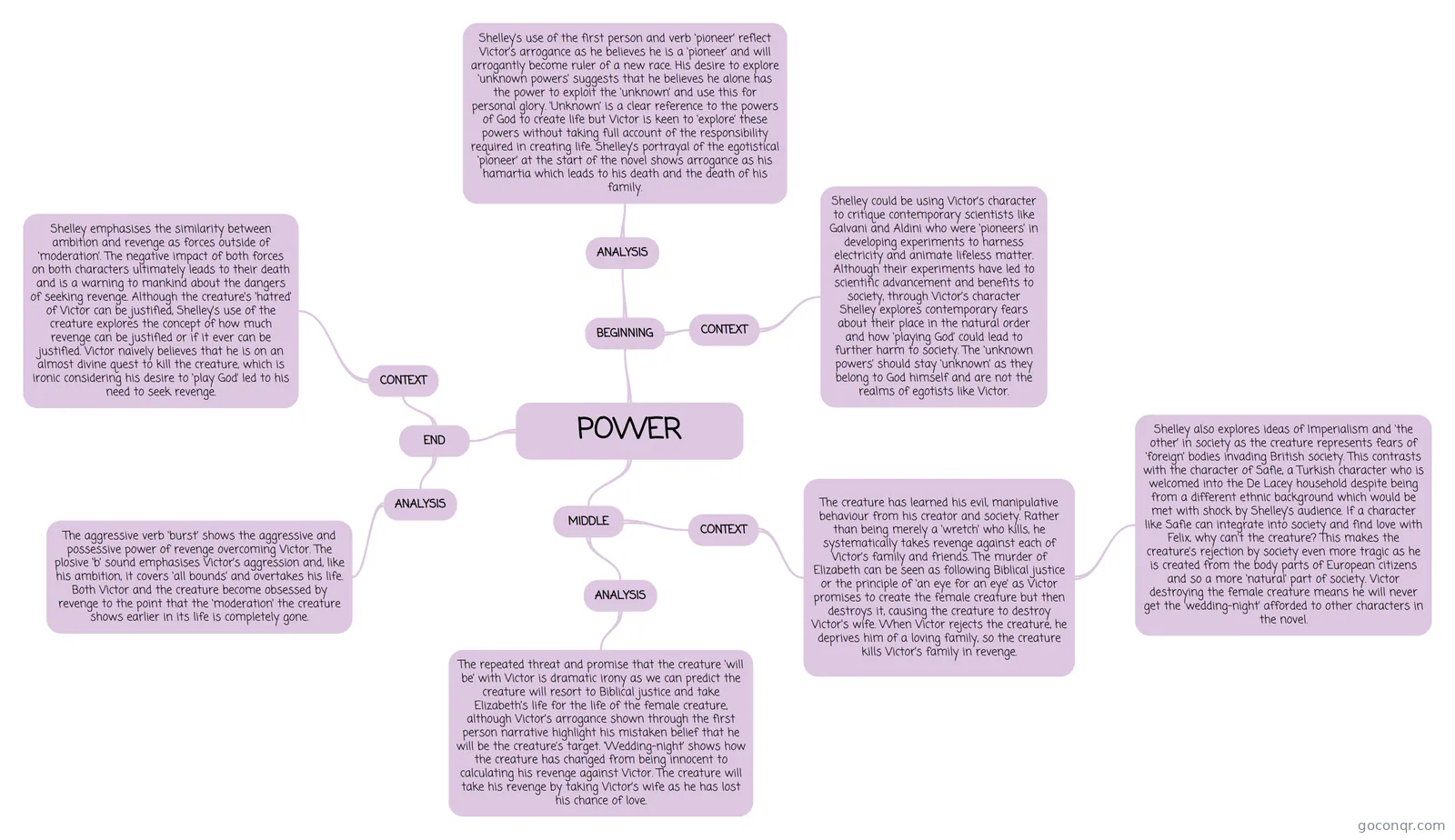
Mind map: Power mind map
Conteúdo do mapa
POWER
BEGINNING
- ANALYSIS
- Shelley’s use of the first person and verb ‘pioneer’ reflect Victor’s arrogance as he believes he is a ‘pioneer’ and will arrogantly become ruler of a new race. His desire to explore ‘unknown powers’ suggests that he believes he alone has the power to exploit the ‘unknown’ and use this for personal glory. ‘Unknown’ is a clear reference to the powers of God to create life but Victor is keen to ‘explore’ these powers without taking full account of the responsibility required in creating life. Shelley’s portrayal of the egotistical ‘pioneer’ at the start of the novel shows arrogance as his hamartia which leads to his death and the death of his family.
- CONTEXT
- Shelley could be using Victor’s character to critique contemporary scientists like Galvani and Aldini who were ‘pioneers’ in developing experiments to harness electricity and animate lifeless matter. Although their experiments have led to scientific advancement and benefits to society, through Victor’s character Shelley explores contemporary fears about their place in the natural order and how ‘playing God’ could lead to further harm to society. The ‘unknown powers’ should stay ‘unknown’ as they belong to God himself and are not the realms of egotists like Victor.
- ANALYSIS
MIDDLE
- ANALYSIS
- The repeated threat and promise that the creature ‘will be’ with Victor is dramatic irony as we can predict the creature will resort to Biblical justice and take Elizabeth’s life for the life of the female creature, although Victor’s arrogance shown through the first person narrative highlight his mistaken belief that he will be the creature’s target. ‘Wedding-night’ shows how the creature has changed from being innocent to calculating his revenge against Victor. The creature will take his revenge by taking Victor’s wife as he has lost his chance of love.
- CONTEXT
- The creature has learned his evil, manipulative behaviour from his creator and society. Rather than being merely a ‘wretch’ who kills, he systematically takes revenge against each of Victor’s family and friends. The murder of Elizabeth can be seen as following Biblical justice or the principle of ‘an eye for an eye’ as Victor promises to create the female creature but then destroys it, causing the creature to destroy Victor's wife. When Victor rejects the creature, he deprives him of a loving family, so the creature kills Victor’s family in revenge.
- Shelley also explores ideas of Imperialism and ‘the other’ in society as the creature represents fears of ‘foreign’ bodies invading British society. This contrasts with the character of Safie, a Turkish character who is welcomed into the De Lacey household despite being from a different ethnic background which would be met with shock by Shelley’s audience. If a character like Safie can integrate into society and find love with Felix, why can't the creature? This makes the creature’s rejection by society even more tragic as he is created from the body parts of European citizens and so a more ‘natural’ part of society. Victor destroying the female creature means he will never get the ‘wedding-night’ afforded to other characters in the novel.
- The creature has learned his evil, manipulative behaviour from his creator and society. Rather than being merely a ‘wretch’ who kills, he systematically takes revenge against each of Victor’s family and friends. The murder of Elizabeth can be seen as following Biblical justice or the principle of ‘an eye for an eye’ as Victor promises to create the female creature but then destroys it, causing the creature to destroy Victor's wife. When Victor rejects the creature, he deprives him of a loving family, so the creature kills Victor’s family in revenge.
- ANALYSIS
END
- ANALYSIS
- The aggressive verb ‘burst’ shows the aggressive and possessive power of revenge overcoming Victor. The plosive ‘b’ sound emphasises Victor’s aggression and, like his ambition, it covers ‘all bounds’ and overtakes his life. Both Victor and the creature become obsessed by revenge to the point that the ‘moderation’ the creature shows earlier in its life is completely gone.
- CONTEXT
- Shelley emphasises the similarity between ambition and revenge as forces outside of ‘moderation’. The negative impact of both forces on both characters ultimately leads to their death and is a warning to mankind about the dangers of seeking revenge. Although the creature’s ‘hatred’ of Victor can be justified, Shelley’s use of the creature explores the concept of how much revenge can be justified or if it ever can be justified. Victor naively believes that he is on an almost divine quest to kill the creature, which is ironic considering his desire to ‘play God’ led to his need to seek revenge.
- ANALYSIS
Informações
- Descrição
- Mapa Mental sobre POWER, criado por Sarah Mawson em 31-05-2022.
- Criado por
- Sarah Mawson
- Visualizações
- 2
- Avaliação