
Mapa mental
Business Structures
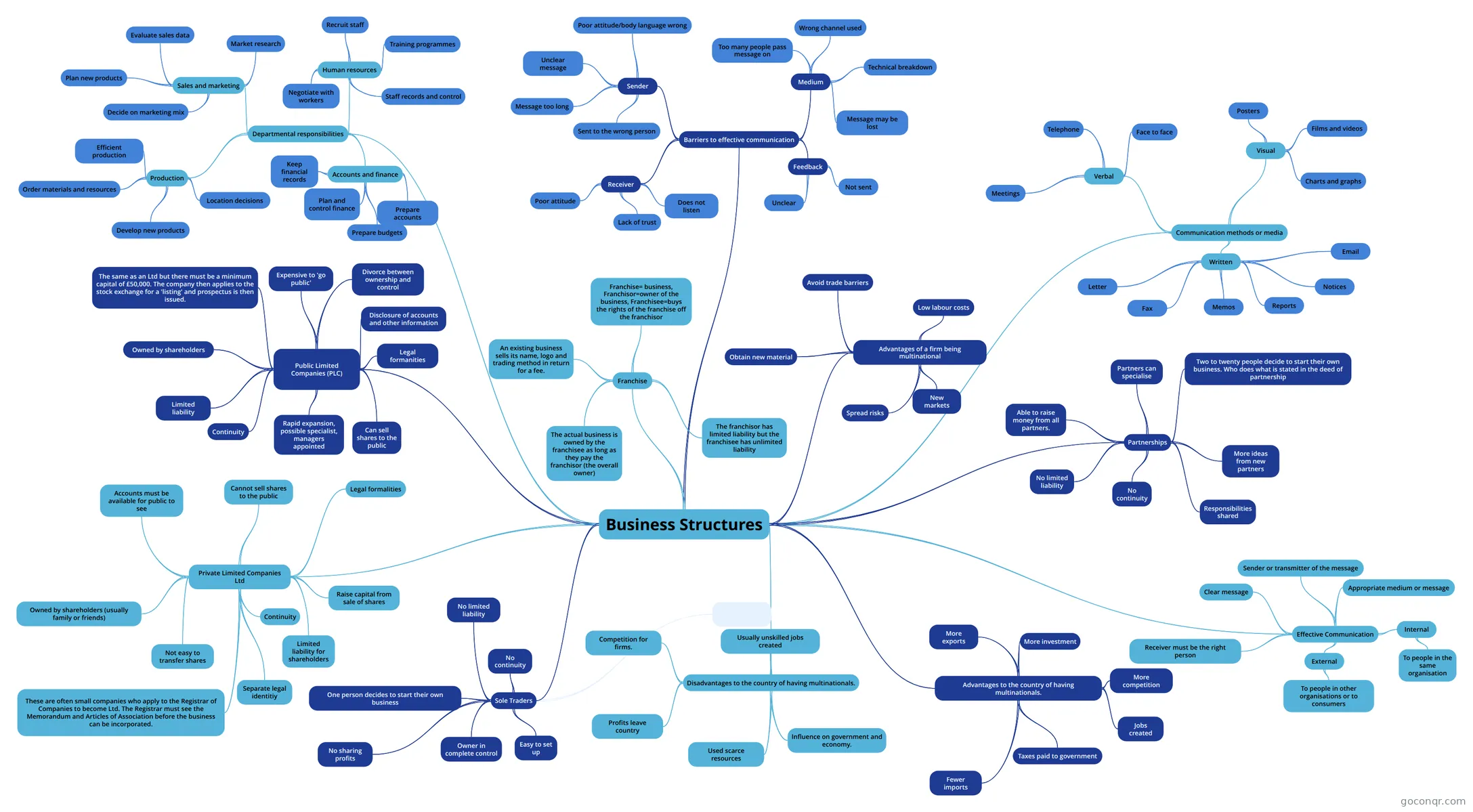
Mind map: Business structures
Conteúdo do mapa
Business Structures
Sole Traders
- Owner in complete control
- No sharing profits
- Incentives to work hard
- Easy to set up
- No limited liability
- No continuity
- One person decides to start their own business
Partnerships
- No limited liability
- Able to raise money from all partners.
- Responsibilities shared
- More ideas from new partners
- Partners can specialise
- No continuity
- Two to twenty people decide to start their own business. Who does what is stated in the deed of partnership
Private Limited Companies Ltd
- Raise capital from sale of shares
- Limited liability for shareholders
- Separate legal identitiy
- Continuity
- Not easy to transfer shares
- Accounts must be available for public to see
- Cannot sell shares to the public
- Legal formalities
- These are often small companies who apply to the Registrar of Companies to become Ltd. The Registrar must see the Memorandum and Articles of Association before the business can be incorporated.
- Owned by shareholders (usually family or friends)
Public Limited Companies (PLC)
- Can sell shares to the public
- Rapid expansion, possible specialist, managers appointed
- Continuity
- Limited liability
- Expensive to 'go public'
- Divorce between ownership and control
- Disclosure of accounts and other information
- Legal formanities
- The same as an Ltd but there must be a minimum capital of £50,000. The company then applies to the stock exchange for a 'listing' and prospectus is then issued.
- Owned by shareholders
Franchise
- An existing business sells its name, logo and trading method in return for a fee.
- The actual business is owned by the franchisee as long as they pay the franchisor (the overall owner)
- The franchisor has limited liability but the franchisee has unlimited liability
- Franchise= business, Franchisor=owner of the business, Franchisee=buys the rights of the franchise off the franchisor
Advantages of a firm being multinational
- New markets
- Spread risks
- Obtain new material
- Avoid trade barriers
- Low labour costs
Advantages to the country of having multinationals.
- More exports
- More investment
- More competition
- Jobs created
- Fewer imports
- Taxes paid to government
Disadvantages to the country of having multinationals.
- Profits leave country
- Competition for firms.
- Influence on government and economy.
- Used scarce resources
- Usually unskilled jobs created
Effective Communication
- Clear message
- Sender or transmitter of the message
- Appropriate medium or message
- Receiver must be the right person
- Internal
- To people in the same organisation
- External
- To people in other organisations or to consumers
Communication methods or media
- Written
- Letter
- Fax
- Memos
- Reports
- Notices
- Verbal
- Meetings
- Telephone
- Face to face
- Visual
- Posters
- Films and videos
- Charts and graphs
- Written
Barriers to effective communication
- Sender
- Sent to the wrong person
- Message too long
- Unclear message
- Poor attitude/body language wrong
- Medium
- Message may be lost
- Technical breakdown
- Wrong channel used
- Too many people pass message on
- Receiver
- Does not listen
- Poor attitude
- Lack of trust
- Feedback
- Unclear
- Not sent
- Sender
Departmental responsibilities
- Human resources
- Recruit staff
- Training programmes
- Staff records and control
- Negotiate with workers
- Accounts and finance
- Prepare accounts
- Prepare budgets
- Plan and control finance
- Keep financial records
- Sales and marketing
- Market research
- Evaluate sales data
- Plan new products
- Decide on marketing mix
- Production
- Location decisions
- Efficient production
- Order materials and resources
- Develop new products
- Human resources
Informações
- Descrição
- unit one business structures gcse mindmap
- Criado por
- lauren roberts5302
- Visualizações
- 53
- Tags
- Avaliação