
Mapa mental
natural hazards
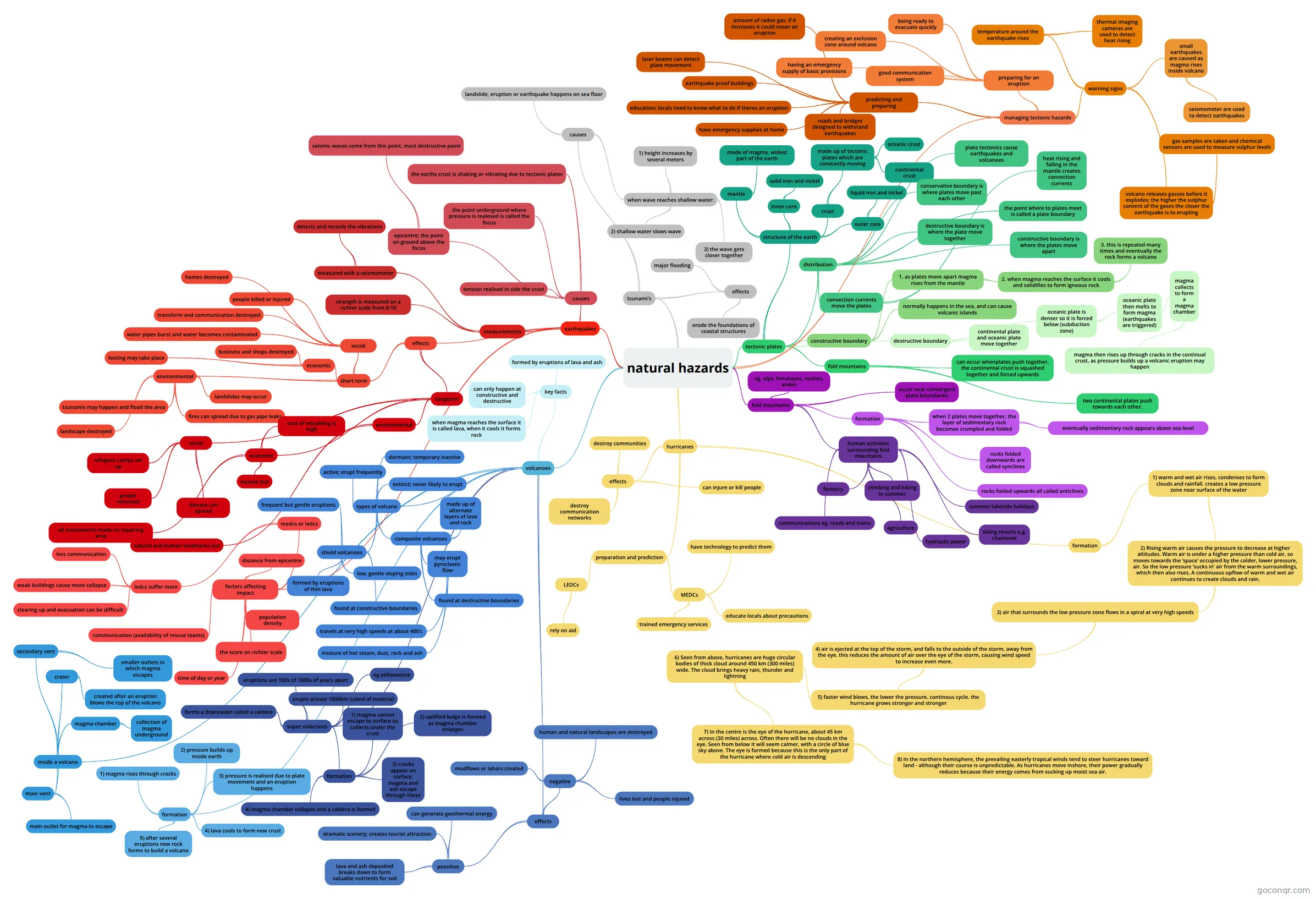
Mind map: natural hazards
Conteúdo do mapa
natural hazards
tectonic plates
- structure of the earth
- inner core
- solid iron and nickel
- outer core
- liquid iron and nickel
- mantle
- made of magma, widest part of the earth
- crust
- made up of tectonic plates which are constantly moving
- continental crust
- oceanic crust
- made up of tectonic plates which are constantly moving
- inner core
- distribution
- convection currents move the plates
- heat rising and falling in the mantle creates convection currents
- the point where to plates meet is called a plate boundary
- plate tectonics cause earthquakes and volcanoes
- constructive boundary is where the plates move apart
- destructive boundary is where the plate move together
- conservative boundary is where plates move past each other
- convection currents move the plates
- constructive boundary
- 1. as plates move apart magma rises from the mantle
- 2. when magma reaches the surface it cools and solidifies to form igneous rock
- 3. this is repeated many times and eventually the rock forms a volcano
- 2. when magma reaches the surface it cools and solidifies to form igneous rock
- normally happens in the sea, and can cause volcanic islands
- 1. as plates move apart magma rises from the mantle
- destructive boundary
- continental plate and oceanic plate move together
- oceanic plate is denser so it is forced below (subduction zone)
- oceanic plate then melts to form magma (earthquakes are triggered)
- magma collects to form a magma chamber
- magma then rises up through cracks in the continual crust, as pressure builds up a volcanic eruption may happen
- magma collects to form a magma chamber
- oceanic plate then melts to form magma (earthquakes are triggered)
- fold mountains
- can occur whenplates push together, the continental crust is squashed together and forced upwards
- two continental plates push towards each other.
- structure of the earth
fold mountains
- occur near convergent plate boundaries
- eg. alps, himalayas, rockies, andes
- formation
- when 2 plates move together, the layer of sedimentary rock becomes crumpled and folded
- eventually sedimentary rock appears above sea level
- rocks folded upwards all called anticlines
- rocks folded downwards are called synclines
- when 2 plates move together, the layer of sedimentary rock becomes crumpled and folded
- human activities surrounding fold mountains
- skiing resorts e.g. chamonix
- climbing and hiking in summer
- summer lakeside holidays
- agriculture
- forestry
- communications eg. roads and trains
- hydraulic power
hurricanes
- formation
- 1) warm and wet air rises, condenses to form clouds and rainfall. creates a low pressure zone near surface of the water
- 2) Rising warm air causes the pressure to decrease at higher altitudes. Warm air is under a higher pressure than cold air, so moves towards the ‘space’ occupied by the colder, lower pressure, air. So the low pressure ‘sucks in’ air from the warm surroundings, which then also rises. A continuous upflow of warm and wet air continues to create clouds and rain.
- 3) air that surrounds the low pressure zone flows in a spiral at very high speeds
- 4) air is ejected at the top of the storm, and falls to the outside of the storm, away from the eye. this reduces the amount of air over the eye of the storm, causing wind speed to increase even more.
- 5) faster wind blows, the lower the pressure. continous cycle. the hurricane grows stronger and stronger
- 6) Seen from above, hurricanes are huge circular bodies of thick cloud around 450 km (300 miles) wide. The cloud brings heavy rain, thunder and lightning
- 7) In the centre is the eye of the hurricane, about 45 km across (30 miles) across. Often there will be no clouds in the eye. Seen from below it will seem calmer, with a circle of blue sky above. The eye is formed because this is the only part of the hurricane where cold air is descending
- 8) In the northern hemisphere, the prevailing easterly tropical winds tend to steer hurricanes toward land - although their course is unpredictable. As hurricanes move inshore, their power gradually reduces because their energy comes from sucking up moist sea air.
- 7) In the centre is the eye of the hurricane, about 45 km across (30 miles) across. Often there will be no clouds in the eye. Seen from below it will seem calmer, with a circle of blue sky above. The eye is formed because this is the only part of the hurricane where cold air is descending
- 6) Seen from above, hurricanes are huge circular bodies of thick cloud around 450 km (300 miles) wide. The cloud brings heavy rain, thunder and lightning
- 5) faster wind blows, the lower the pressure. continous cycle. the hurricane grows stronger and stronger
- 4) air is ejected at the top of the storm, and falls to the outside of the storm, away from the eye. this reduces the amount of air over the eye of the storm, causing wind speed to increase even more.
- 3) air that surrounds the low pressure zone flows in a spiral at very high speeds
- 2) Rising warm air causes the pressure to decrease at higher altitudes. Warm air is under a higher pressure than cold air, so moves towards the ‘space’ occupied by the colder, lower pressure, air. So the low pressure ‘sucks in’ air from the warm surroundings, which then also rises. A continuous upflow of warm and wet air continues to create clouds and rain.
- 1) warm and wet air rises, condenses to form clouds and rainfall. creates a low pressure zone near surface of the water
- preparation and prediction
- MEDCs
- have technology to predict them
- educate locals about precautions
- trained emergency services
- LEDCs
- rely on aid
- MEDCs
- effects
- destroy communities
- destroy communication networks
- can injure or kill people
- formation
volcanoes
- key facts
- formed by eruptions of lava and ash
- when magma reaches the surface it is called lava, when it cools it forms rock
- can only happen at constructive and destructive
- formation
- 1) magma rises through cracks
- 2) pressure builds up inside earth
- 3) pressure is realised due to plate movement and an eruption happens
- 4) lava cools to form new crust
- 5) after several eruptions new rock forms to build a volcano
- inside a volcano
- magma chamber
- collection of magma underground
- main vent
- main outlet for magma to escape
- secondary vent
- smaller outlets in which magma escapes
- crater
- created after an eruption blows the top of the volcano
- magma chamber
- types of volcano
- active; erupt frequently
- dormant; temporary inactive
- extinct; never likely to erupt
- shield volcanoes
- low, gentle sloping sides
- formed by eruptions of thin lava
- frequent but gentle eruptions
- found at constructive boundaries
- composite volcanoes
- made up of alternate layers of lava and rock
- found at destructive boundaries
- may erupt pyroclastic flow
- mixture of hot steam, dust, rock and ash
- travels at very high speeds at about 400'c
- super volacnoes
- erupts atleast 1000km cubed of material
- forms a depression called a caldera
- eruptions are 100s of 1000s of years apart
- formation
- 1) magma cannot escape to surface so collects under the crust
- 2) uplifted bulge is formed as magma chamber enlarges
- 3) cracks appear on surface, magma and ash escape through these
- 4) magma chamber collapse and a caldera is formed
- eg yellowstone
- effects
- possitive
- dramatic scenery; creates tourist attraction
- lava and ash deposited breaks down to form valuable nutrients for soil
- can generate geothermal energy
- negative
- lives lost and people injured
- mudflows or lahars created
- human and natural landscapes are destroyed
- possitive
- key facts
earthquakes
- causes
- the earths crust is shaking or vibrating due to tectonic plates
- tension realised in side the crust
- the point underground where pressure is realesed is called the focus
- epicentre; the point on ground above the focus
- seismic waves come from this point, most destructive point
- measurements
- measured with a seismometer
- detects and records the vibrations
- strength is measured on a richter scale from 0-10
- measured with a seismometer
- effects
- short term
- social
- water pipes burst and water becomes contaminated
- transform and communication destroyed
- homes destroyed
- people killed or injured
- economic
- business and shops destroyed
- looting may take place
- environmental
- landscape destroyed
- fires can spread due to gas pipe leaks
- landslides may occur
- tsunamis may happen and flood the area
- social
- longterm
- social
- refugees camps set up
- disease can spread
- people rehomed
- economic
- cost of rebuilding is high
- income lost
- all investments made on repairing area
- environmental
- natural and human landmarks lost
- social
- short term
- factors affecting impact
- distance from epicentre
- the score on richter scale
- medcs or ledcs
- ledcs suffer more
- less communication
- weak buildings cause more collapse
- clearing up and evacuation can be difficult
- ledcs suffer more
- population density
- communication (availability of rescue teams)
- time of day or year
- causes
tsunami's
- causes
- landslide, eruption or earthquake happens on sea floor
- when wave reaches shallow water:
- 1) height increases by several meters
- 2) shallow water slows wave
- 3) the wave gets closer together
- effects
- major flooding
- erode the foundations of coastal structures
- causes
managing tectonic hazards
- warning signs
- small earthquakes are caused as magma rises inside volcano
- seismometer are used to detect earthquakes
- temperature around the earthquake rises
- thermal imaging cameras are used to detect heat rising
- volcano releases gasses before it explodes; the higher the sulphur content of the gases the closer the earthquake is to erupting
- gas samples are taken and chemical sensors are used to measure sulphur levels
- small earthquakes are caused as magma rises inside volcano
- preparing for an eruption
- creating an exclusion zone around volcano
- being ready to evacuate quickly
- having an emergency supply of basic provisions
- good communication system
- predicting and preparing
- laser beams can detect plate movement
- amount of radon gas; if it increases it could mean an eruption
- education; locals need to know what to do if theres an eruption
- earthquake proof buildings
- have emergency supplies at home
- roads and bridges designed to withstand earthquakes
- warning signs
Informações
- Descrição
- Mapa Mental sobre natural hazards, criado por tara.hammersley9571 em 26-01-2016.
- Criado por
- tara.hammersley9571
- Visualizações
- 1
- Avaliação