
Mapa mental
Computing Topic 5 Databases
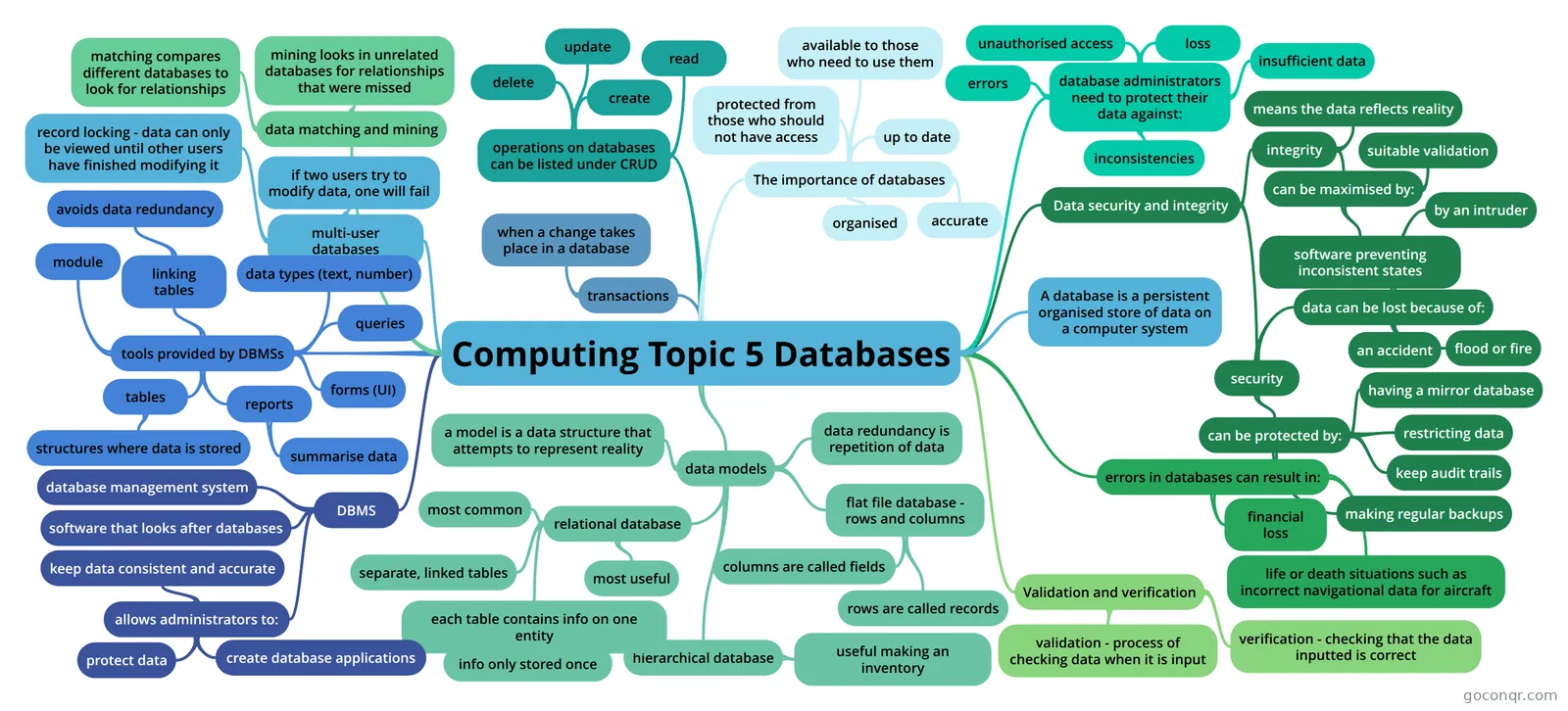
Mind map: Computing databases
Conteúdo do mapa
Computing Topic 5 Databases
A database is a persistent organised store of data on a computer system
The importance of databases
- accurate
- up to date
- organised
- protected from those who should not have access
- available to those who need to use them
database administrators need to protect their data against:
- errors
- loss
- unauthorised access
- inconsistencies
- insufficient data
errors in databases can result in:
- financial loss
- life or death situations such as incorrect navigational data for aircraft
Data security and integrity
- security
- data can be lost because of:
- an accident
- flood or fire
- by an intruder
- can be protected by:
- making regular backups
- restricting data
- having a mirror database
- keep audit trails
- data can be lost because of:
- integrity
- means the data reflects reality
- can be maximised by:
- suitable validation
- software preventing inconsistent states
- security
Validation and verification
- validation - process of checking data when it is input
- verification - checking that the data inputted is correct
operations on databases can be listed under CRUD
- create
- read
- update
- delete
data matching and mining
- matching compares different databases to look for relationships
- mining looks in unrelated databases for relationships that were missed
data models
- a model is a data structure that attempts to represent reality
- flat file database - rows and columns
- rows are called records
- columns are called fields
- data redundancy is repetition of data
- hierarchical database
- useful making an inventory
- relational database
- most useful
- most common
- separate, linked tables
- each table contains info on one entity
- info only stored once
DBMS
- database management system
- software that looks after databases
- allows administrators to:
- create database applications
- protect data
- keep data consistent and accurate
transactions
- when a change takes place in a database
multi-user databases
- if two users try to modify data, one will fail
- record locking - data can only be viewed until other users have finished modifying it
tools provided by DBMSs
- tables
- structures where data is stored
- linking tables
- avoids data redundancy
- data types (text, number)
- forms (UI)
- reports
- summarise data
- queries
- module
- tables
Informações
- Descrição
- Mapa Mental sobre Computing Topic 5 Databases, criado por Will Darby em 11-02-2016.
- Criado por
- Will Darby
- Visualizações
- 66
- Tags
- Avaliação