
Mapa mental
Barriers to Entry/Exit
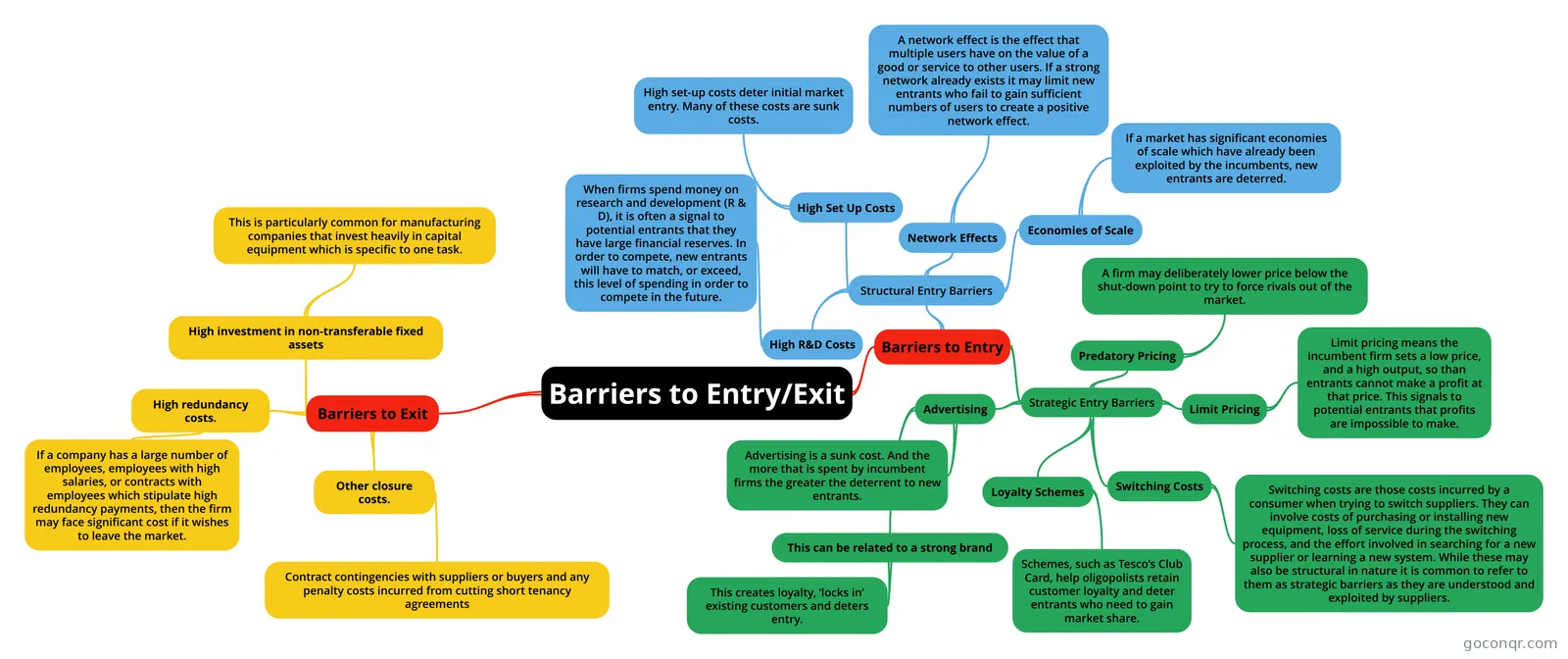
Mind map: Barriers to entry and exit
Conteúdo do mapa
Barriers to Entry/Exit
Barriers to Entry
- Structural Entry Barriers
- Economies of Scale
- If a market has significant economies of scale which have already been exploited by the incumbents, new entrants are deterred.
- Network Effects
- A network effect is the effect that multiple users have on the value of a good or service to other users. If a strong network already exists it may limit new entrants who fail to gain sufficient numbers of users to create a positive network effect.
- High Set Up Costs
- High set-up costs deter initial market entry. Many of these costs are sunk costs.
- High R&D Costs
- When firms spend money on research and development (R & D), it is often a signal to potential entrants that they have large financial reserves. In order to compete, new entrants will have to match, or exceed, this level of spending in order to compete in the future.
- Economies of Scale
- Strategic Entry Barriers
- Predatory Pricing
- A firm may deliberately lower price below the shut-down point to try to force rivals out of the market.
- Limit Pricing
- Limit pricing means the incumbent firm sets a low price, and a high output, so than entrants cannot make a profit at that price. This signals to potential entrants that profits are impossible to make.
- Switching Costs
- Switching costs are those costs incurred by a consumer when trying to switch suppliers. They can involve costs of purchasing or installing new equipment, loss of service during the switching process, and the effort involved in searching for a new supplier or learning a new system. While these may also be structural in nature it is common to refer to them as strategic barriers as they are understood and exploited by suppliers.
- Advertising
- Advertising is a sunk cost. And the more that is spent by incumbent firms the greater the deterrent to new entrants.
- This can be related to a strong brand
- This creates loyalty, ‘locks in’ existing customers and deters entry.
- Loyalty Schemes
- Schemes, such as Tesco’s Club Card, help oligopolists retain customer loyalty and deter entrants who need to gain market share.
- Predatory Pricing
- Structural Entry Barriers
Barriers to Exit
- High investment in non-transferable fixed assets
- This is particularly common for manufacturing companies that invest heavily in capital equipment which is specific to one task.
- High redundancy costs.
- If a company has a large number of employees, employees with high salaries, or contracts with employees which stipulate high redundancy payments, then the firm may face significant cost if it wishes to leave the market.
- Other closure costs.
- Contract contingencies with suppliers or buyers and any penalty costs incurred from cutting short tenancy agreements
- High investment in non-transferable fixed assets
Informações
- Descrição
- A-Level Economics (Microeconomics) Mapa Mental sobre Barriers to Entry/Exit, criado por Abi Penman em 05-04-2016.
- Criado por
- Abi Penman
- Visualizações
- 1
- Avaliação