
Mapa mental
THE INSTITUTES
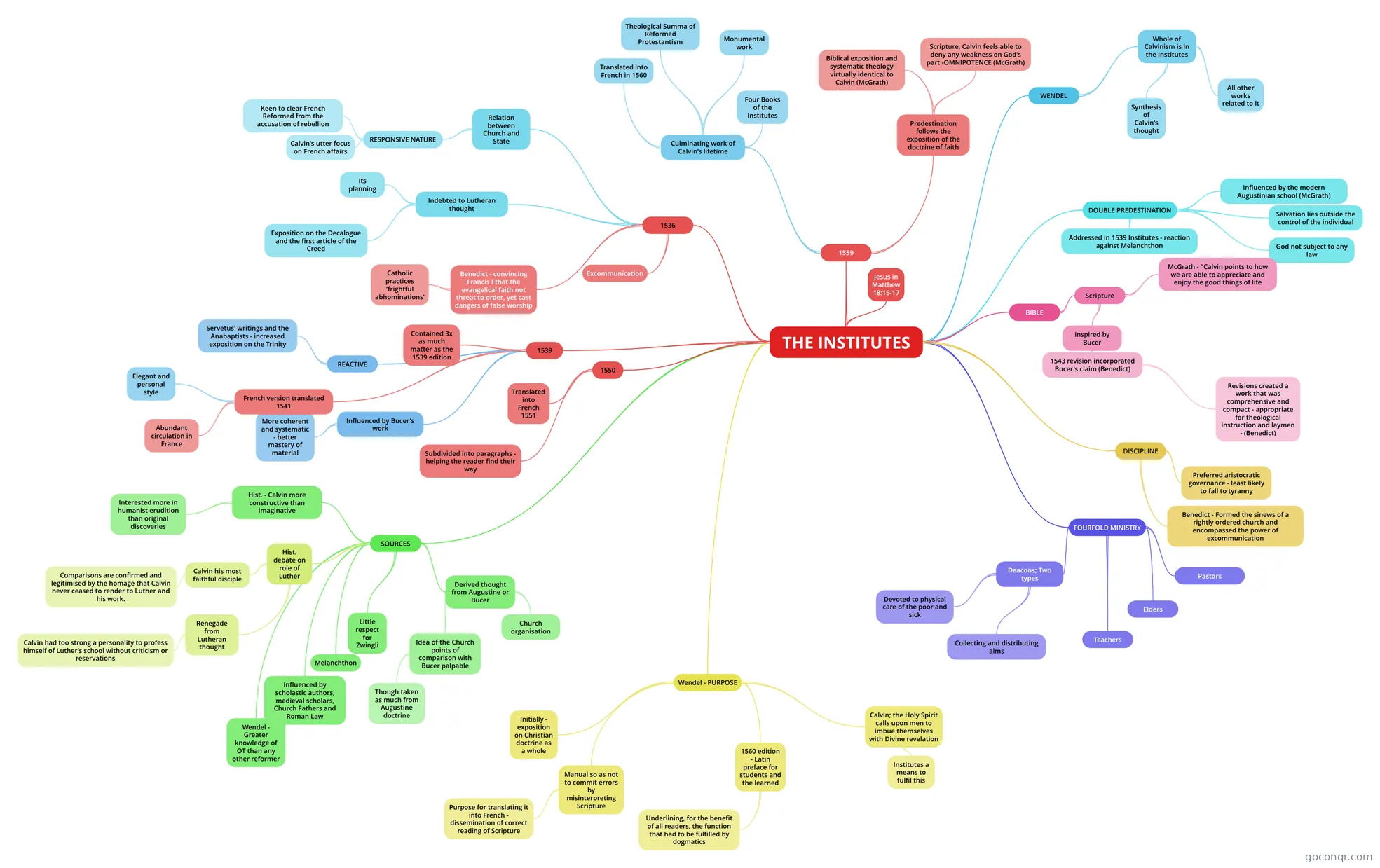
Mind map: Calvin's Institutes
Conteúdo do mapa
THE INSTITUTES
1536
- Benedict - convincing Francis I that the evangelical faith not threat to order, yet cast dangers of false worship
- Catholic practices 'frightful abhominations'
- Excommunication
- Instituted to bar the evidently unbelieving and unworthy
- Relation between Church and State
- Influenced by the Gospel
- RESPONSIVE NATURE
- Official condemnation of the Affair of the Placards of 1534
- Protest against the attitude of the French Crown with regard to the Reform
- Calvin's utter focus on French affairs
- Keen to clear French Reformed from the accusation of rebellion
- Indebted to Lutheran thought
- Its planning
- Exposition on the Decalogue and the first article of the Creed
- Benedict - convincing Francis I that the evangelical faith not threat to order, yet cast dangers of false worship
Jesus in Matthew 18:15-17
- Blueprint for shunning sinners who refused to amend their ways after first private, then collective admonitions failed to move them.
DISCIPLINE
- Benedict - Formed the sinews of a rightly ordered church and encompassed the power of excommunication
- The Consistory served a different need to state's suppression of criminal behaviour
- Preferred aristocratic governance - least likely to fall to tyranny
- Benedict - Formed the sinews of a rightly ordered church and encompassed the power of excommunication
BIBLE
- clear model for church discipline
- Scripture
- Spelled out the basic offices found in any properly ordered Christian church.
- Inspired by Bucer
- 'On True Pastoral Care' of 1538 on the NT - "pastors and preachers as the servants who meet the needs of the poor on behalf of the common church".
- Bucer - 'Holy Spirit's ordinance...each church have a number of elders who are all pastors and bishops; overseers who provide pastoral care and carry out the pastoral office
- 1543 revision incorporated Bucer's claim (Benedict)
- Various forms of ministry had a clear biblical sanction and gave greater precision to the lists on ministers in Bucer's work.
- Revisions created a work that was comprehensive and compact - appropriate for theological instruction and laymen - (Benedict)
- McGrath - "Calvin points to how we are able to appreciate and enjoy the good things of life
- Celebrate and acknowledge their author, giving him thanks - Calvin's sentiment
FOURFOLD MINISTRY
- Calvin strengthened ministerial authority by claiming divine ordination for it, and gave those recognising the need to escape pollutive Rome a positive alternative model of a true Christian church
- Pastors
- Proclaiming the Gospel and administering the sacraments BIBLE - 'bishops', 'presbyters', 'pastors', 'ministers',
- Like Bucer, Calvin (Benedict) deduced that the Roman Catholic hierarchy that distinguished bishops from parish ministers was illegitimate
- Some ministers could have an oversight role, but all should preach and minister to a congregation at the same time
- Ministers of the Word
- Teachers
- Experts in scriptural interpretation, but LACKED authority to apply Scripture
- Elders
- Censured morals
- Deacons; Two types
- Responsible for the relief of the poor
- Collecting and distributing alms
- Devoted to physical care of the poor and sick
- Included widows - deaconesses as well as deacons. Inspired by Paul in Timothy 5:9-10
DOUBLE PREDESTINATION
- Humanity as humble and cast down, to learn to tremble at his judgment and esteem his mercy - ELECTION
- Addressed in 1539 Institutes - reaction against Melanchthon
- Influenced by the modern Augustinian school (McGrath)
- Taught a doctrine of absolute double predestination - God allocates some to eternal life and others to eternal condemnation, without any reference to merits or demerits. Fate rests upon the will of God
- Salvation lies outside the control of the individual
- Calvin; forced to reckon with the mystery of the inexplicable
- God not subject to any law
- God is outside the law, and that his will is the foundation of existing conceptions of morality
- Predestination rests in the inscrutable judgements of God
- Ancillary doctrine; explaining a puzzling aspect of the consequences of the proclamation of the gospel of grace - McGrath
1559
- Predestination follows the exposition of the doctrine of faith
- Predestination in its proper context - mystery of divine revelation - yet revealed in a specific context and specific manner
- Jesus the 'mirror' of election- an object lesson for the upright in faith
- Scripture, Calvin feels able to deny any weakness on God's part -OMNIPOTENCE (McGrath)
- Biblical exposition and systematic theology virtually identical to Calvin (McGrath)
- Culminating work of Calvin's lifetime
- Translated into French in 1560
- Four Books of the Institutes
- Monumental work
- Its success was immense and it was never discredited afterwards.
- Theological Summa of Reformed Protestantism
- Predestination follows the exposition of the doctrine of faith
WENDEL
- Whole of Calvinism is in the Institutes
- All other works related to it
- Synthesis of Calvin's thought
- Whole of Calvinism is in the Institutes
1539
- Contained 3x as much matter as the 1539 edition
- REACTIVE
- Servetus' writings and the Anabaptists - increased exposition on the Trinity
- Influenced by Bucer's work
- More coherent and systematic - better mastery of material
- French version translated 1541
- Elegant and personal style
- Abundant circulation in France
- established itself at once as the basic manual of dogmatic in the reformed churches.
1550
- Translated into French 1551
- Subdivided into paragraphs - helping the reader find their way
SOURCES
- Hist. - Calvin more constructive than imaginative
- Interested more in humanist erudition than original discoveries
- Hist. debate on role of Luther
- Calvin his most faithful disciple
- Comparisons are confirmed and legitimised by the homage that Calvin never ceased to render to Luther and his work.
- Renegade from Lutheran thought
- Calvin had too strong a personality to profess himself of Luther’s school without criticism or reservations
- Calvin his most faithful disciple
- Derived thought from Augustine or Bucer
- Idea of the Church points of comparison with Bucer palpable
- Unified in two aspects (visible and invisible)
- Though taken as much from Augustine doctrine
- Church organisation
- Wendel - Bucer's most important contribution
- Ecclesiastical organisations are of Divine right because they are dictated by the Holy Spirit
- Idea of the Church points of comparison with Bucer palpable
- Wendel - Greater knowledge of OT than any other reformer
- Influenced by scholastic authors, medieval scholars, Church Fathers and Roman Law
- Melanchthon
- His expositions on tables of the Law, upon faith, hope and charity influenced Calvin's thought
- Little respect for Zwingli
- Saw him as a second-rate theologian - didn't understand Zurcich's support-base for him
- Hist. - Calvin more constructive than imaginative
Wendel - PURPOSE
- Initially - exposition on Christian doctrine as a whole
- Sort of Catechism - an elementary manual
- Calvin; the Holy Spirit calls upon men to imbue themselves with Divine revelation
- By the reading of Holy Scripture
- Institutes a means to fulfil this
- Manual so as not to commit errors by misinterpreting Scripture
- Purpose for translating it into French - dissemination of correct reading of Scripture
- 1560 edition - Latin preface for students and the learned
- Fundamental aim of work made apparent
- Underlining, for the benefit of all readers, the function that had to be fulfilled by dogmatics
- Initially - exposition on Christian doctrine as a whole
Informações
- Descrição
- Calvinism Mapa Mental sobre THE INSTITUTES, criado por tompoad em 25-04-2013.
- Criado por
- tompoad
- Visualizações
- 106
- Tags
- Avaliação