
Mind map
CALVIN'S GENEVA pre-1555
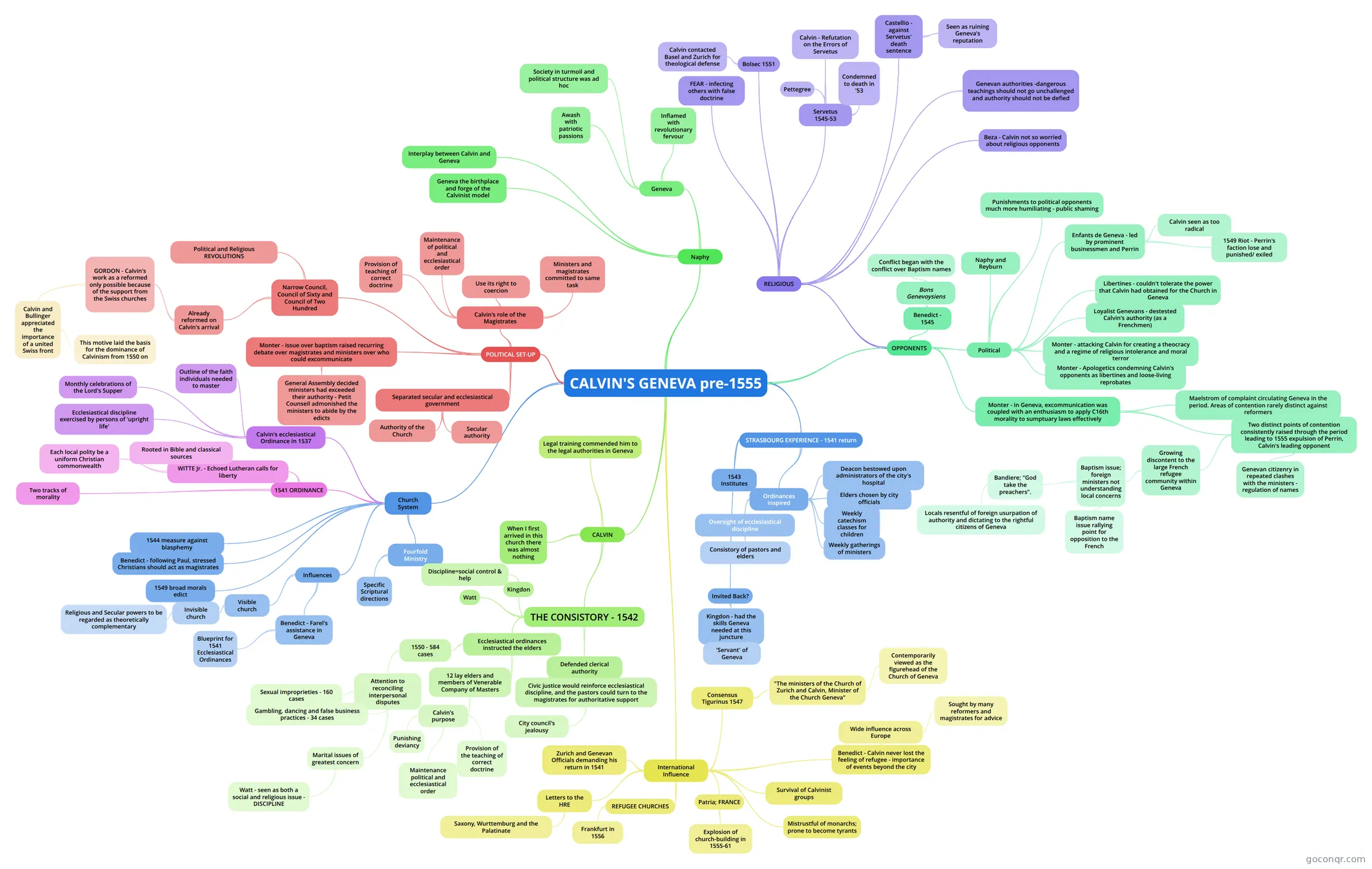
Mind map: Calvin's Geneva pre-1555
Map content
CALVIN'S GENEVA pre-1555
POLITICAL SET-UP
- Monter - issue over baptism raised recurring debate over magistrates and ministers over who could excommunicate
- General Assembly decided ministers had exceeded their authority - Petit Counseil admonished the ministers to abide by the edicts
- Separated secular and ecclesiastical government
- Authority of the Church
- Extended over matters spiritual - charge was to combat sin, to aid believers in the process of their personal sanctification, and to guard the church against dishonour
- Secular authority
- watched over outward forms of behaviour - theft, rape, murder, riots etc...
- Obliged to follow both tablets of the Ten Commandments - obligated to punish idolatry, sacrilege and blasphemy
- Duty of seeing that ecclesiastical discipline was upheld and the ministers of the word were not mocked.
- Authority of the Church
- Calvin's role of the Magistrates
- Maintenance of political and ecclesiastical order
- Provision of teaching of correct doctrine
- Use its right to coercion
- Ministers and magistrates committed to same task
- Complementary responsibilities - agents and servants of God
- Church discipline a matter of public concern, within the legitimate authority of the magistracy
- Narrow Council, Council of Sixty and Council of Two Hundred
- Already reformed on Calvin's arrival
- GORDON - Calvin's work as a reformed only possible because of the support from the Swiss churches
- Calvin and Bullinger appreciated the importance of a united Swiss front
- This motive laid the basis for the dominance of Calvinism from 1550 on
- Calvin and Bullinger appreciated the importance of a united Swiss front
- GORDON - Calvin's work as a reformed only possible because of the support from the Swiss churches
- Political and Religious REVOLUTIONS
- Already reformed on Calvin's arrival
- Monter - issue over baptism raised recurring debate over magistrates and ministers over who could excommunicate
OPPONENTS
- Political
- Monter - attacking Calvin for creating a theocracy and a regime of religious intolerance and moral terror
- Monter - Apologetics condemning Calvin's opponents as libertines and loose-living reprobates
- Libertines - couldn't tolerate the power that Calvin had obtained for the Church in Geneva
- Specifically the Consistory's power of excommunication
- Loyalist Genevans - destested Calvin's authority (as a Frenchmen)
- Enfants de Geneva - led by prominent businessmen and Perrin
- Calvin seen as too radical
- Imposing a new tyranny - believed inhabitants had the right to appeal consistory excommunications - Small Council
- 1549 Riot - Perrin's faction lose and punished/ exiled
- Calvin seen as too radical
- Naphy and Reyburn
- Calvin's fear of political opponents is reflected in the very harsh way he treats them
- Punishments to political opponents much more humiliating - public shaming
- Monter - in Geneva, excommunication was coupled with an enthusiasm to apply C16th morality to sumptuary laws effectively
- Maelstrom of complaint circulating Geneva in the period. Areas of contention rarely distinct against reformers
- Two distinct points of contention consistently raised through the period leading to 1555 expulsion of Perrin, Calvin's leading opponent
- Growing discontent to the large French refugee community within Geneva
- their size and influence, of which the ministers were the visible influence
- Baptism issue; foreign ministers not understanding local concerns
- and local people under greater stress from increased foreign influence
- Bandiere; "God take the preachers".
- "The Devil can take all the foreigners..the foreigners want to rule over us".
- Locals resentful of foreign usurpation of authority and dictating to the rightful citizens of Geneva
- Baptism name issue rallying point for opposition to the French
- coincided with increased anti-French attacks
- their growing economic, social and political influence
- Genevan citizenry in repeated clashes with the ministers - regulation of names
- Growing discontent to the large French refugee community within Geneva
- Benedict - 1545
- When anti-Guillermins exiled in 1541 were welcomed back in 1545 to fill the population void left by intermittent bouts of the plague, anti-Calvin sentiment grew
- Bons Genevoysiens
- Resisted Calvin's ministerial efforts to regulate behaviour and to exercise ecclesiastical discipline without magisterial oversight.
- Definitive triumph only after a decade of struggle
- Conflict began with the conflict over Baptism names
- RELIGIOUS
- FEAR - infecting others with false doctrine
- Bolsec 1551
- Continuously attacked Calvin over the issue of pre-destination and argued that it was a false picture of God as a tyrant eternally damning people
- Calvin contacted Basel and Zurich for theological defense
- Bolsec punished for acting too audaciously and banished from the city
- Servetus 1545-53
- Wrote to Calvin with a revised version of Calvin's 'Institutes' - how Servetus viewed the correct doctrine
- Condemned to death in '53
- Melanchthon greatly approved, wrote to Calvin "done a great service to the Reformed faith'
- Calvin - Refutation on the Errors of Servetus
- Defended capital punishment against heretics
- Pettegree
- More than any event, left a stain on Calvin's historical reputation
- Castellio - against Servetus' death sentence
- Religious freedom and freedom of conscience the most important - purity of life more important than doctrinal orthodoxy
- Seen as ruining Geneva's reputation
- 'That perfect school of Christ' Knox in 1559. Castellio saw Calvin as tyrannical and exerting too much power -
- Genevan authorities -dangerous teachings should not go unchallenged and authority should not be defied
- Beza - Calvin not so worried about religious opponents
- His supreme knowledge of Scripture meant he could defend his own doctrine in the face of any difference in opinion
- Political
CALVIN
- Legal training commended him to the legal authorities in Geneva
- Benedict - Advised on matters of legal procedure and help in drafting the ecclesiastical ordinances - legal exegesis avoided allegorical interpretation
- THE CONSISTORY - 1542
- Ecclesiastical ordinances instructed the elders
- Attend to those expressing contrary religious doctrines, negligent over church attendance and those engaged in vice or crime
- 1550 - 584 cases
- 86 involved suspected magic or Catholic practice, failure to attend sermons and inadequate knowledge of the catechism
- Attention to reconciling interpersonal disputes
- 238 cases
- Family cases and domestic assaults
- Sexual improprieties - 160 cases
- Gambling, dancing and false business practices - 34 cases
- Marital issues of greatest concern
- Watt - seen as both a social and religious issue - DISCIPLINE
- 12 lay elders and members of Venerable Company of Masters
- Met weekly on a thursday - to maintain ecclesiastical discipline
- Early matters - marital problems; pastoral and legal problem
- Calvin's purpose
- Guarantor of the discipline which Calvin's experience in Strasbourg had led him to recognise as essential to the survival of Reformed Christendom
- Punishing deviancy
- Those posing a threat to the established religious order of Geneva
- Maintenance political and ecclesiastical order
- Provision of the teaching of correct doctrine
- Defended clerical authority
- Civic justice would reinforce ecclesiastical discipline, and the pastors could turn to the magistrates for authoritative support
- City council's jealousy
- 'To take place in a manner that the ministers have no civil jurisdiction, not use anything but the spiritual sword of the word of God'
- Civil power to remain unimpeded - McGrath
- City council's jealousy
- Civic justice would reinforce ecclesiastical discipline, and the pastors could turn to the magistrates for authoritative support
- Watt
- 'the means by which morality and discipline were imposed upon the rank and file of Geneva’
- Kingdon
- religious ignorance problems were because not fully informed about the Reformation and still using Catholic practices
- Discipline=social control & help
- Ecclesiastical ordinances instructed the elders
- When I first arrived in this church there was almost nothing
- On his deathbed - "they were preaching, and that is all" - a very basic level of reformation in his eyes
- Legal training commended him to the legal authorities in Geneva
Church System
- Church as a divinely founded body - endowed with 'spiritual power'
- Influences
- Lay church members and ministers - Included in draft ordinances for Schwabisch Hall, Basel, Constance, Ulm and Strasbourg - magistrates of long-standing free cities all proved unwilling to give church bodies the final say in excommunication
- Visible church
- Community of the Christian faithful, a visible group
- Object of present experience
- Invisible church
- Fellowship of the saints and the company of the elect - an invisible entity
- Object of faith and hope
- Religious and Secular powers to be regarded as theoretically complementary
- Benedict - Farel's assistance in Geneva
- A radically new order of service, arrangements for education in the faith as new defined, and provisions for discipline of those who misbehaved.
- Blueprint for 1541 Ecclesiastical Ordinances
- Calvin's ecclesiastical Ordinance in 1537
- Council accepted most of these measures, though communion restricted to four-yearly celebrations
- Pastors - 'Instruction and Confession of Faith Used in the Church of Geneva' incorporated these Ordinances
- Monthly celebrations of the Lord's Supper
- Outline of the faith individuals needed to master
- Ecclesiastical discipline exercised by persons of 'upright life'
- Gave ministers the power to bar unrepentant sinners from the table - Benedict
- Fourfold Ministry
- Specific Scriptural directions
- The right order of ministry in the visible church, so a specific form of ecclesiastical order became an item of doctrine - ecclesiastical administration (McGrath)
- Cyprian of Carthage - "you cannot have God as your father unless you have the church as your mother" & "Outside the church there is no hope of remission of sins nor any salvation"
- Specific Scriptural directions
- Benedict - following Paul, stressed Christians should act as magistrates
- Against Anabaptists, who stated true Christians should have nothing to do with government
- Government was divinely ordained; to resist the lawful leader was to resist God
- 1544 measure against blasphemy
- Prohibition of dirty songs and forbade loitering in the streets during the sunday sermons
- 1549 broad morals edict
- new penalties for confirmed blasphemers, prohibited speaking ill of God's word or the city magistrates
- 1541 ORDINANCE
- WITTE Jr. - Echoed Lutheran calls for liberty
- Liberty of political officials from ecclesiastical power and privilege; of the individual conscience from canon law and clerical control; local clergy from papacy; of Prot. churches from state & church oppression
- Rooted in Bible and classical sources
- Each local polity be a uniform Christian commonwealth
- Two tracks of morality
- Morality of Duty - demanded of ALL persons
- Morality of Aspiration demanded of believers in reflection of their faith
- WITTE Jr. - Echoed Lutheran calls for liberty
STRASBOURG EXPERIENCE - 1541 return
- Conditions in Geneva deteriorated: remaining Protestant preachers in Geneva were not capable of providing effective leadership
- 1543 Institutes
- Ordinances inspired
- Elders chosen by city officials
- from members of various councils that made up the city government
- Benedict - Genevan ordinances linked the consistory more closely to the city government than other Reformed church orders
- Deacon bestowed upon administrators of the city's hospital
- Weekly gatherings of ministers
- Biblical passages to be discussed 'to preserve purity and agreement of doctrine' and quarterly sessions of fraternal correction
- Weekly catechism classes for children
- No child admitted to communion until he/she could recite the catechism
- Oversight of ecclesiastical discipline
- Consistory of pastors and elders
- Elders chosen by city officials
- Invited Back?
- Kingdon - had the skills Geneva needed at this juncture
- Training as both a lawyer and a theologian - apt for dealing with the various councils of Geneva and generating the needed- reform
- A first set of laws provided a kind of constitution for the Reformed Church of Geneva.
- A second set of laws provided a kind of constitution for the Genevan state
- 'Servant' of Geneva
- Kingdon - had the skills Geneva needed at this juncture
International Influence
- Zurich and Genevan Officials demanding his return in 1541
- Stressed the town's location and trade connections made it a place from which he could exercise wide influence
- Benedict - Calvin never lost the feeling of refugee - importance of events beyond the city
- Wide influence across Europe
- Sought by many reformers and magistrates for advice
- Wide influence across Europe
- Letters to the HRE
- Saxony, Wurttemburg and the Palatinate
- Princes to strive for a godly reformation
- Saxony, Wurttemburg and the Palatinate
- REFUGEE CHURCHES
- Frankfurt in 1556
- to mediate a dispute with the French churches there
- Frankfurt in 1556
- Patria; FRANCE
- Explosion of church-building in 1555-61
- Calvin inundated with letters imploring him to send ministers to reap the harvest, seeking his counsel about matters of doctrine, worship and discipline
- Explosion of church-building in 1555-61
- Survival of Calvinist groups
- Dependent on a strong, well-disciplined church, capable of weathering the hostility of its milieu
- Mistrustful of monarchs; prone to become tyrants
- Tyrannical kings of the OT
- Consensus Tigurinus 1547
- Zurich agreement with Zwingli and Calvin
- "The ministers of the Church of Zurich and Calvin, Minister of the Church Geneva"
- Contemporarily viewed as the figurehead of the Church of Geneva
- Clear clerical role, and the power he was deemed to exert
- Contemporarily viewed as the figurehead of the Church of Geneva
- Zurich and Genevan Officials demanding his return in 1541
Naphy
- Geneva the birthplace and forge of the Calvinist model
- Interplay between Calvin and Geneva
- Which gave Calvinism many of its distinctive and idiosyncratic (individual) characteristics
- Geneva
- Awash with patriotic passions
- Inflamed with revolutionary fervour
- Society in turmoil and political structure was ad hoc
Information
- Description
- Calvinism Mind Map on CALVIN'S GENEVA pre-1555, created by tompoad on 25/04/2013.
- Created by
- tompoad
- Views
- 102
- Tags
- Rating