
Mapa mental
Pharmacokinetics
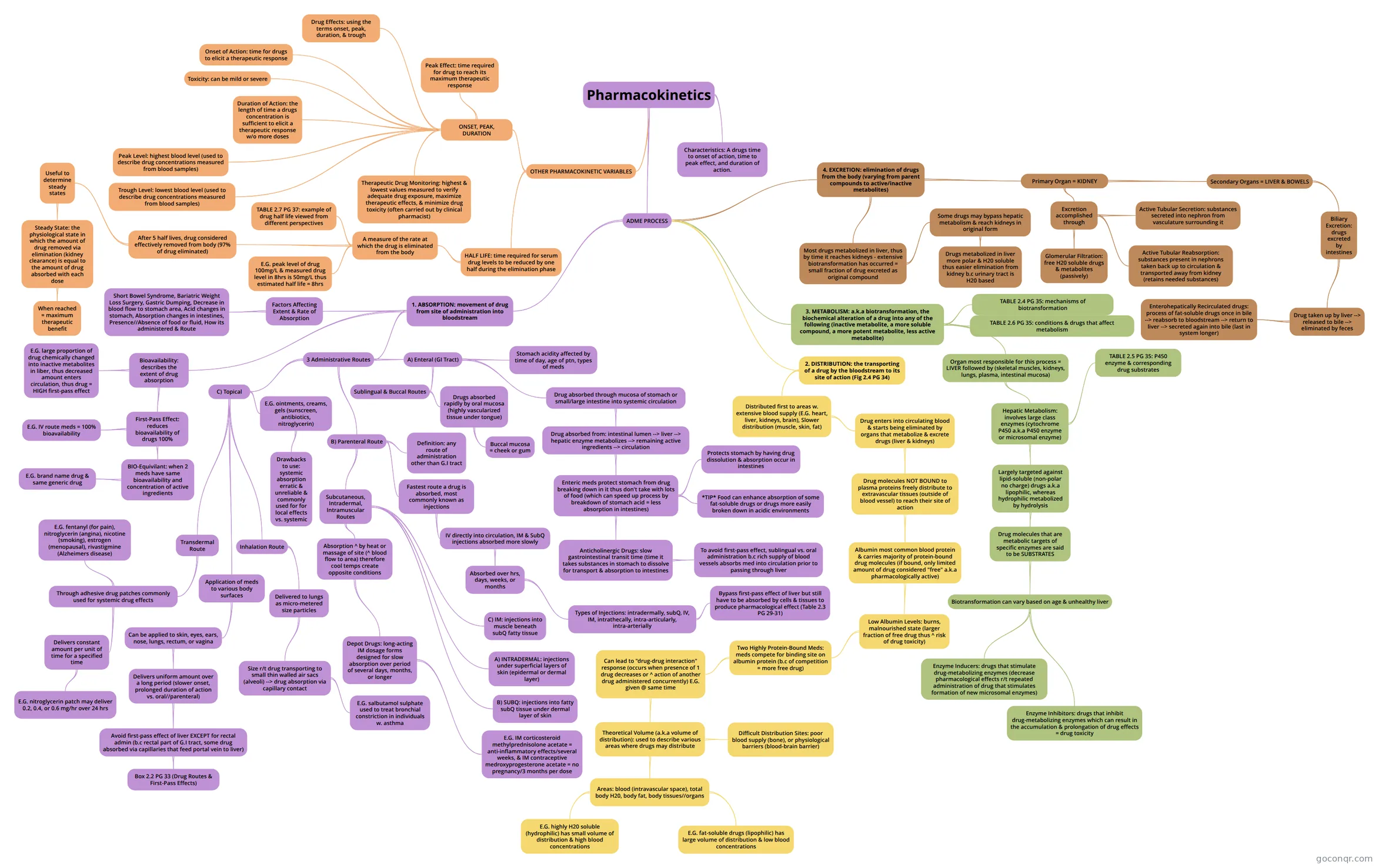
Mind map: Pharmacokinetics
Conteúdo do mapa
Pharmacokinetics
Characteristics: A drugs time to onset of action, time to peak effect, and duration of action.
ADME PROCESS
- 1. ABSORPTION: movement of drug from site of administration into bloodstream
- Bioavailability: describes the extent of drug absorption
- E.G. large proportion of drug chemically changed into inactive metabolites in liber, thus decreased amount enters circulation, thus drug = HIGH first-pass effect
- First-Pass Effect: reduces bioavailability of drugs 100%
- E.G. IV route meds = 100% bioavailability
- BIO-Equivilant: when 2 meds have same bioavailability and concentration of active ingredients
- E.G. brand name drug & same generic drug
- Factors Affecting Extent & Rate of Absorption
- Short Bowel Syndrome, Bariatric Weight Loss Surgery, Gastric Dumping, Decrease in blood flow to stomach area, Acid changes in stomach, Absorption changes in intestines, Presence//Absence of food or fluid, How its administered & Route
- 3 Administrative Routes
- A) Enteral (GI Tract)
- Drug absorbed through mucosa of stomach or small/large intestine into systemic circulation
- Drug absorbed from: intestinal lumen --> liver --> hepatic enzyme metabolizes --> remaining active ingredients --> circulation
- Enteric meds protect stomach from drug breaking down in it thus don't take with lots of food (which can speed up process by breakdown of stomach acid = less absorption in intestines)
- Anticholinergic Drugs: slow gastrointestinal transit time (time it takes substances in stomach to dissolve for transport & absorption to intestines
- To avoid first-pass effect, sublingual vs. oral administration b.c rich supply of blood vessels absorbs med into circulation prior to passing through liver
- *TIP* Food can enhance absorption of some fat-soluble drugs or drugs more easily broken down in acidic environments
- Protects stomach by having drug dissolution & absorption occur in intestines
- Anticholinergic Drugs: slow gastrointestinal transit time (time it takes substances in stomach to dissolve for transport & absorption to intestines
- Enteric meds protect stomach from drug breaking down in it thus don't take with lots of food (which can speed up process by breakdown of stomach acid = less absorption in intestines)
- Drug absorbed from: intestinal lumen --> liver --> hepatic enzyme metabolizes --> remaining active ingredients --> circulation
- Sublingual & Buccal Routes
- Drugs absorbed rapidly by oral mucosa (highly vascularized tissue under tongue)
- Buccal mucosa = cheek or gum
- Drugs absorbed rapidly by oral mucosa (highly vascularized tissue under tongue)
- Stomach acidity affected by time of day, age of ptn, types of meds
- Drug absorbed through mucosa of stomach or small/large intestine into systemic circulation
- C) Topical
- Transdermal Route
- Through adhesive drug patches commonly used for systemic drug effects
- E.G. fentanyl (for pain), nitroglycerin (angina), nicotine (smoking), estrogen (menopausal), rivastigmine (Alzheimers disease)
- Delivers constant amount per unit of time for a specified time
- E.G. nitroglycerin patch may deliver 0.2, 0.4, or 0.6 mg/hr over 24 hrs
- Through adhesive drug patches commonly used for systemic drug effects
- Inhalation Route
- Delivered to lungs as micro-metered size particles
- Size r/t drug transporting to small thin walled air sacs (alveoli) --> drug absorption via capillary contact
- E.G. salbutamol sulphate used to treat bronchial constriction in individuals w. asthma
- Size r/t drug transporting to small thin walled air sacs (alveoli) --> drug absorption via capillary contact
- Delivered to lungs as micro-metered size particles
- Application of meds to various body surfaces
- Can be applied to skin, eyes, ears, nose, lungs, rectum, or vagina
- Delivers uniform amount over a long period (slower onset, prolonged duration of action vs. oral//parenteral)
- Avoid first-pass effect of liver EXCEPT for rectal admin (b.c rectal part of G.I tract, some drug absorbed via capillaries that feed portal vein to liver)
- Box 2.2 PG 33 (Drug Routes & First-Pass Effects)
- Avoid first-pass effect of liver EXCEPT for rectal admin (b.c rectal part of G.I tract, some drug absorbed via capillaries that feed portal vein to liver)
- Delivers uniform amount over a long period (slower onset, prolonged duration of action vs. oral//parenteral)
- Can be applied to skin, eyes, ears, nose, lungs, rectum, or vagina
- E.G. ointments, creams, gels (sunscreen, antibiotics, nitroglycerin)
- Drawbacks to use: systemic absorption erratic & unreliable & commonly used for for local effects vs. systemic
- Transdermal Route
- B) Parenteral Route
- Fastest route a drug is absorbed, most commonly known as injections
- IV directly into circulation, IM & SubQ injections absorbed more slowly
- Absorbed over hrs, days, weeks, or months
- Types of Injections: intradermally, subQ, IV, IM, intrathecally, intra-articularly, intra-arterially
- Bypass first-pass effect of liver but still have to be absorbed by cells & tissues to produce pharmacological effect (Table 2.3 PG 29-31)
- Types of Injections: intradermally, subQ, IV, IM, intrathecally, intra-articularly, intra-arterially
- Absorbed over hrs, days, weeks, or months
- IV directly into circulation, IM & SubQ injections absorbed more slowly
- Subcutaneous, Intradermal, Intramuscular Routes
- B) SUBQ: injections into fatty subQ tissue under dermal layer of skin
- A) INTRADERMAL: injections under superficial layers of skin (epidermal or dermal layer)
- C) IM: injections into muscle beneath subQ fatty tissue
- Absorption ^ by heat or massage of site (^ blood flow to area) therefore cool temps create opposite conditions
- Depot Drugs: long-acting IM dosage forms designed for slow absorption over period of several days, months, or longer
- E.G. IM corticosteroid methylprednisolone acetate = anti-inflammatory effects/several weeks, & IM contraceptive medroxyprogesterone acetate = no pregnancy/3 months per dose
- Depot Drugs: long-acting IM dosage forms designed for slow absorption over period of several days, months, or longer
- Definition: any route of administration other than G.I tract
- Fastest route a drug is absorbed, most commonly known as injections
- A) Enteral (GI Tract)
- Bioavailability: describes the extent of drug absorption
- 2. DISTRIBUTION: the transporting of a drug by the bloodstream to its site of action (Fig 2.4 PG 34)
- Distributed first to areas w. extensive blood supply (E.G. heart, liver, kidneys, brain), Slower distribution (muscle, skin, fat)
- Drug enters into circulating blood & starts being eliminated by organs that metabolize & excrete drugs (liver & kidneys)
- Drug molecules NOT BOUND to plasma proteins freely distribute to extravascular tissues (outside of blood vessel) to reach their site of action
- Albumin most common blood protein & carries majority of protein-bound drug molecules (if bound, only limited amount of drug considered "free" a.k.a pharmacologically active)
- Low Albumin Levels: burns, malnourished state (larger fraction of free drug thus ^ risk of drug toxicity)
- Two Highly Protein-Bound Meds: meds compete for binding site on albumin protein (b.c of competition = more free drug)
- Can lead to "drug-drug interaction" response (occurs when presence of 1 drug decreases or ^ action of another drug administered concurrently) E.G. given @ same time
- Theoretical Volume (a.k.a volume of distribution): used to describe various areas where drugs may distribute
- Areas: blood (intravascular space), total body H20, body fat, body tissues//organs
- E.G. highly H20 soluble (hydrophilic) has small volume of distribution & high blood concentrations
- E.G. fat-soluble drugs (lipophilic) has large volume of distribution & low blood concentrations
- Difficult Distribution Sites: poor blood supply (bone), or physiological barriers (blood-brain barrier)
- Areas: blood (intravascular space), total body H20, body fat, body tissues//organs
- Theoretical Volume (a.k.a volume of distribution): used to describe various areas where drugs may distribute
- Can lead to "drug-drug interaction" response (occurs when presence of 1 drug decreases or ^ action of another drug administered concurrently) E.G. given @ same time
- Two Highly Protein-Bound Meds: meds compete for binding site on albumin protein (b.c of competition = more free drug)
- Low Albumin Levels: burns, malnourished state (larger fraction of free drug thus ^ risk of drug toxicity)
- Albumin most common blood protein & carries majority of protein-bound drug molecules (if bound, only limited amount of drug considered "free" a.k.a pharmacologically active)
- Drug molecules NOT BOUND to plasma proteins freely distribute to extravascular tissues (outside of blood vessel) to reach their site of action
- Drug enters into circulating blood & starts being eliminated by organs that metabolize & excrete drugs (liver & kidneys)
- Distributed first to areas w. extensive blood supply (E.G. heart, liver, kidneys, brain), Slower distribution (muscle, skin, fat)
- 3. METABOLISM: a.k.a biotransformation, the biochemical alteration of a drug into any of the following (inactive metabolite, a more soluble compound, a more potent metabolite, less active metabolite)
- TABLE 2.6 PG 35: conditions & drugs that affect metabolism
- Organ most responsible for this process = LIVER followed by (skeletal muscles, kidneys, lungs, plasma, intestinal mucosa)
- Hepatic Metabolism: involves large class enzymes (cytochrome P450 a.k.a P450 enzyme or microsomal enzyme)
- Largely targeted against lipid-soluble (non-polar no charge) drugs a.k.a lipophilic, whereas hydrophilic metabolized by hydrolysis
- Drug molecules that are metabolic targets of specific enzymes are said to be SUBSTRATES
- Biotransformation can vary based on age & unhealthy liver
- Enzyme Inhibitors: drugs that inhibit drug-metabolizing enzymes which can result in the accumulation & prolongation of drug effects = drug toxicity
- Enzyme Inducers: drugs that stimulate drug-metabolizing enzymes (decrease pharmacological effects r/t repeated administration of drug that stimulates formation of new microsomal enzymes)
- Biotransformation can vary based on age & unhealthy liver
- Drug molecules that are metabolic targets of specific enzymes are said to be SUBSTRATES
- TABLE 2.5 PG 35: P450 enzyme & corresponding drug substrates
- Largely targeted against lipid-soluble (non-polar no charge) drugs a.k.a lipophilic, whereas hydrophilic metabolized by hydrolysis
- Hepatic Metabolism: involves large class enzymes (cytochrome P450 a.k.a P450 enzyme or microsomal enzyme)
- TABLE 2.4 PG 35: mechanisms of biotransformation
- 4. EXCRETION: elimination of drugs from the body (varying from parent compounds to active/inactive metabolites)
- Primary Organ = KIDNEY
- Secondary Organs = LIVER & BOWELS
- Biliary Excretion: drugs excreted by intestines
- Drug taken up by liver --> released to bile --> eliminated by feces
- Enterohepatically Recirculated drugs: process of fat-soluble drugs once in bile --> reabsorb to bloodstream --> return to liver --> secreted again into bile (last in system longer)
- Drug taken up by liver --> released to bile --> eliminated by feces
- Biliary Excretion: drugs excreted by intestines
- Excretion accomplished through
- Glomerular Filtration: free H20 soluble drugs & metabolites (passively)
- Active Tubular Reabsorption: substances present in nephrons taken back up to circulation & transported away from kidney (retains needed substances)
- Active Tubular Secretion: substances secreted into nephron from vasculature surrounding it
- Secondary Organs = LIVER & BOWELS
- Most drugs metabolized in liver, thus by time it reaches kidneys - extensive biotransformation has occurred = small fraction of drug excreted as original compound
- Some drugs may bypass hepatic metabolism & reach kidneys in original form
- Drugs metabolized in liver more polar & H20 soluble thus easier elimination from kidney b.c urinary tract is H20 based
- Some drugs may bypass hepatic metabolism & reach kidneys in original form
- Primary Organ = KIDNEY
- 1. ABSORPTION: movement of drug from site of administration into bloodstream
OTHER PHARMACOKINETIC VARIABLES
- HALF LIFE: time required for serum drug levels to be reduced by one half during the elimination phase
- A measure of the rate at which the drug is eliminated from the body
- TABLE 2.7 PG 37: example of drug half life viewed from different perspectives
- E.G. peak level of drug 100mg/L & measured drug level in 8hrs is 50mg/L thus estimated half life = 8hrs
- After 5 half lives, drug considered effectively removed from body (97% of drug eliminated)
- Useful to determine steady states
- Steady State: the physiological state in which the amount of drug removed via elimination (kidney clearance) is equal to the amount of drug absorbed with each dose
- When reached = maximum therapeutic benefit
- Steady State: the physiological state in which the amount of drug removed via elimination (kidney clearance) is equal to the amount of drug absorbed with each dose
- Useful to determine steady states
- A measure of the rate at which the drug is eliminated from the body
- ONSET, PEAK, DURATION
- Drug Effects: using the terms onset, peak, duration, & trough
- Onset of Action: time for drugs to elicit a therapeutic response
- Duration of Action: the length of time a drugs concentration is sufficient to elicit a therapeutic response w/o more doses
- Peak Level: highest blood level (used to describe drug concentrations measured from blood samples)
- Trough Level: lowest blood level (used to describe drug concentrations measured from blood samples)
- Toxicity: can be mild or severe
- Therapeutic Drug Monitoring: highest & lowest values measured to verify adequate drug exposure, maximize therapeutic effects, & minimize drug toxicity (often carried out by clinical pharmacist)
- Peak Effect: time required for drug to reach its maximum therapeutic response
- HALF LIFE: time required for serum drug levels to be reduced by one half during the elimination phase
Informações
- Descrição
- Mapa Mental sobre Pharmacokinetics, criado por Marina Acquaroli em 11-09-2016.
- Criado por
- Marina Acquaroli
- Visualizações
- 0
- Avaliação