
Mapa mental
Virtue Ethics
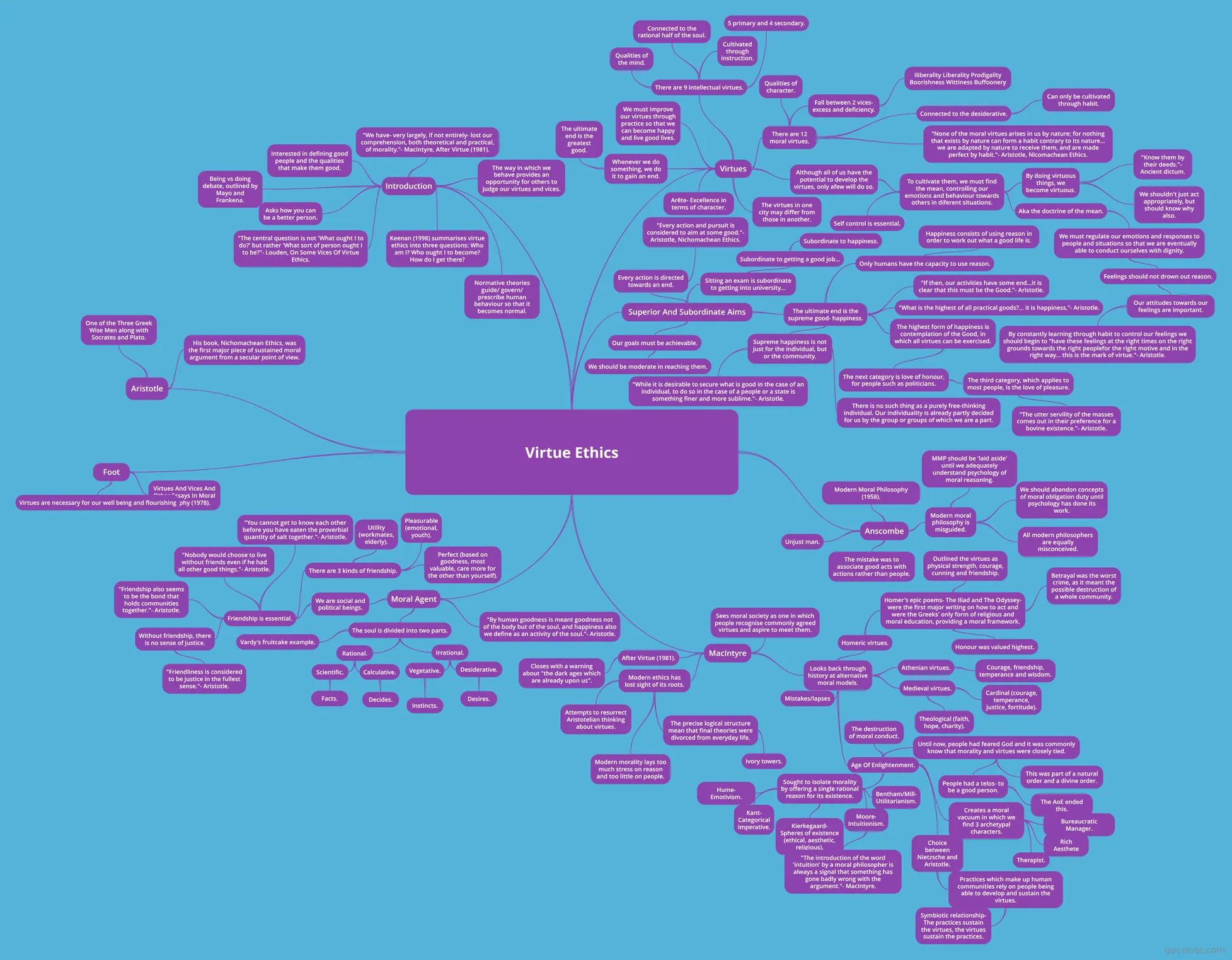
Mind map: Virtue ethics
Conteúdo do mapa
Virtue Ethics
Aristotle
- One of the Three Greek Wise Men along with Socrates and Plato.
- His book, Nichomachean Ethics, was the first major piece of sustained moral argument from a secular point of view.
Introduction
- Asks how you can be a better person.
- Interested in defining good people and the qualities that make them good.
- "We have- very largely, if not entirely- lost our comprehension, both theoretical and practical, of morality."- MacIntyre, After Virtue (1981).
- The way in which we behave provides an opportunity for others to judge our virtues and vices.
- Keenan (1998) summarises virtue ethics into three questions: Who am I? Who ought I to become? How do I get there?
- Normative theories guide/ govern/ prescribe human behaviour so that it becomes normal.
- Being vs doing debate, outlined by Mayo and Frankena.
- "The central question is not 'What ought I to do?' but rather 'What sort of person ought I to be?"- Louden, On Some Vices Of Virtue Ethics.
Virtues
- Whenever we do something, we do it to gain an end.
- The ultimate end is the greatest good.
- We must improve our virtues through practice so that we can become happy and live good lives.
- There are 12 moral virtues.
- Qualities of character.
- Fall between 2 vices- excess and deficiency.
- Iliberality Liberality Prodigality Boorishness Wittiness Buffoonery
- "None of the moral virtues arises in us by nature; for nothing that exists by nature can form a habit contrary to its nature... we are adapted by nature to receive them, and are made perfect by habit."- Aristotle, Nicomachean Ethics.
- Connected to the desiderative.
- Can only be cultivated through habit.
- Although all of us have the potential to develop the virtues, only afew will do so.
- To cultivate them, we must find the mean, controlling our emotions and behaviour towards others in diferent situations.
- Self control is essential.
- By doing virtuous things, we become virtuous.
- We shouldn't just act appropriately, but should know why also.
- "Know them by their deeds."- Ancient dictum.
- Aka the doctrine of the mean.
- We must regulate our emotions and responses to people and situations so that we are eventually able to conduct ourselves with dignity.
- Feelings should not drown out reason.
- Our attitudes towards our feelings are important.
- By constantly learning through habit to control our feelings we should begin to "have these feelings at the right times on the right grounds towards the right peoplefor the right motive and in the right way... this is the mark of virtue."- Aristotle.
- Our attitudes towards our feelings are important.
- Feelings should not drown out reason.
- We must regulate our emotions and responses to people and situations so that we are eventually able to conduct ourselves with dignity.
- To cultivate them, we must find the mean, controlling our emotions and behaviour towards others in diferent situations.
- The virtues in one city may differ from those in another.
- Arête- Excellence in terms of character.
- There are 9 intellectual virtues.
- Qualities of the mind.
- Connected to the rational half of the soul.
- Cultivated through instruction.
- 5 primary and 4 secondary.
- Whenever we do something, we do it to gain an end.
Superior And Subordinate Aims
- Every action is directed towards an end.
- "Every action and pursuit is considered to aim at some good."- Aristotle, Nichomachean Ethics.
- Sitting an exam is subordinate to getting into university...
- Subordinate to getting a good job...
- Subordinate to happiness.
- Subordinate to getting a good job...
- The ultimate end is the supreme good- happiness.
- Supreme happiness is not just for the individual, but or the community.
- "While it is desirable to secure what is good in the case of an individual, to do so in the case of a people or a state is something finer and more sublime."- Aristotle.
- There is no such thing as a purely free-thinking individual. Our individuality is already partly decided for us by the group or groups of which we are a part.
- The highest form of happiness is contemplation of the Good, in which all virtues can be exercised.
- The next category is love of honour, for people such as politicians.
- The third category, which applies to most people, is the love of pleasure.
- "The utter servility of the masses comes out in their preference for a bovine existence."- Aristotle.
- The third category, which applies to most people, is the love of pleasure.
- The next category is love of honour, for people such as politicians.
- "If then, our activities have some end...it is clear that this must be the Good."- Aristotle.
- "What is the highest of all practical goods?... it is happiness,"- Aristotle.
- Only humans have the capacity to use reason.
- Happiness consists of using reason in order to work out what a good life is.
- Supreme happiness is not just for the individual, but or the community.
- Our goals must be achievable.
- We should be moderate in reaching them.
- Every action is directed towards an end.
Anscombe
- Modern moral philosophy is misguided.
- MMP should be 'laid aside' until we adequately understand psychology of moral reasoning.
- We should abandon concepts of moral obligation duty until psychology has done its work.
- All modern philosophers are equally misconceived.
- The mistake was to associate good acts with actions rather than people.
- Modern Moral Philosophy (1958).
- Unjust man.
- Modern moral philosophy is misguided.
MacIntyre
- Modern ethics has lost sight of its roots.
- Attempts to resurrect Aristotelian thinking about virtues.
- Modern morality lays too much stress on reason and too little on people.
- The precise logical structure mean that final theories were divorced from everyday life.
- Ivory towers.
- Sees moral society as one in which people recognise commonly agreed virtues and aspire to meet them.
- After Virtue (1981).
- Closes with a warning about "the dark ages which are already upon us".
- Looks back through history at alternative moral models.
- Homeric virtues.
- Homer's epic poems- The Iliad and The Odyssey- were the first major writing on how to act and were the Greeks' only form of religious and moral education, providing a moral framework.
- Outlined the virtues as physical strength, courage, cunning and friendship.
- Betrayal was the worst crime, as it meant the possible destruction of a whole community.
- Honour was valued highest.
- Homer's epic poems- The Iliad and The Odyssey- were the first major writing on how to act and were the Greeks' only form of religious and moral education, providing a moral framework.
- Athenian virtues.
- Courage, friendship, temperance and wisdom.
- Medieval virtues.
- Cardinal (courage, temperance, justice, fortitude).
- Theological (faith, hope, charity).
- Age Of Enlightenment.
- The destruction of moral conduct.
- Until now, people had feared God and it was commonly know that morality and virtues were closely tied.
- This was part of a natural order and a divine order.
- People had a telos- to be a good person.
- The AoE ended this.
- Sought to isolate morality by offering a single rational reason for its existence.
- Hume- Emotivism.
- Kant- Categorical Imperative.
- Kierkegaard- Spheres of existence (ethical, aesthetic, religious).
- Bentham/Mill- Utilitarianism.
- Moore- Intuitionism.
- "The introduction of the word 'intuition' by a moral philosopher is always a signal that something has gone badly wrong with the argument."- MacIntyre.
- Creates a moral vacuum in which we find 3 archetypal characters.
- Bureaucratic Manager.
- Rich Aesthete
- Therapist.
- Choice between Nietzsche and Aristotle.
- Practices which make up human communities rely on people being able to develop and sustain the virtues.
- Symbiotic relationship- The practices sustain the virtues, the virtues sustain the practices.
- Practices which make up human communities rely on people being able to develop and sustain the virtues.
- Mistakes/lapses
- Homeric virtues.
- Modern ethics has lost sight of its roots.
Moral Agent
- "By human goodness is meant goodness not of the body but of the soul, and happiness also we define as an activity of the soul."- Aristotle.
- The soul is divided into two parts.
- Rational.
- Scientific.
- Facts.
- Calculative.
- Decides.
- Scientific.
- Irrational.
- Vegetative.
- Instincts.
- Desiderative.
- Desires.
- Vegetative.
- Vardy's fruitcake example.
- Rational.
- We are social and political beings.
- Friendship is essential.
- "Nobody would choose to live without friends even if he had all other good things."- Aristotle.
- "Friendship also seems to be the bond that holds communities together."- Aristotle.
- Without friendship, there is no sense of justice.
- "Friendliness is considered to be justice in the fullest sense."- Aristotle.
- There are 3 kinds of friendship.
- Utility (workmates, elderly).
- Pleasurable (emotional, youth).
- Perfect (based on goodness, most valuable, care more for the other than yourself).
- "You cannot get to know each other before you have eaten the proverbial quantity of salt together."- Aristotle.
- Friendship is essential.
Foot
- Virtues And Vices And Other Essays In Moral Philosophy (1978).
- Virtues are necessary for our well being and flourishing
Informações
- Descrição
- Mapa Mental sobre Virtue Ethics, criado por Olivia Crossley em 09-01-2017.
- Criado por
- Olivia Crossley
- Visualizações
- 0
- Avaliação