
Mapa mental
Evolution
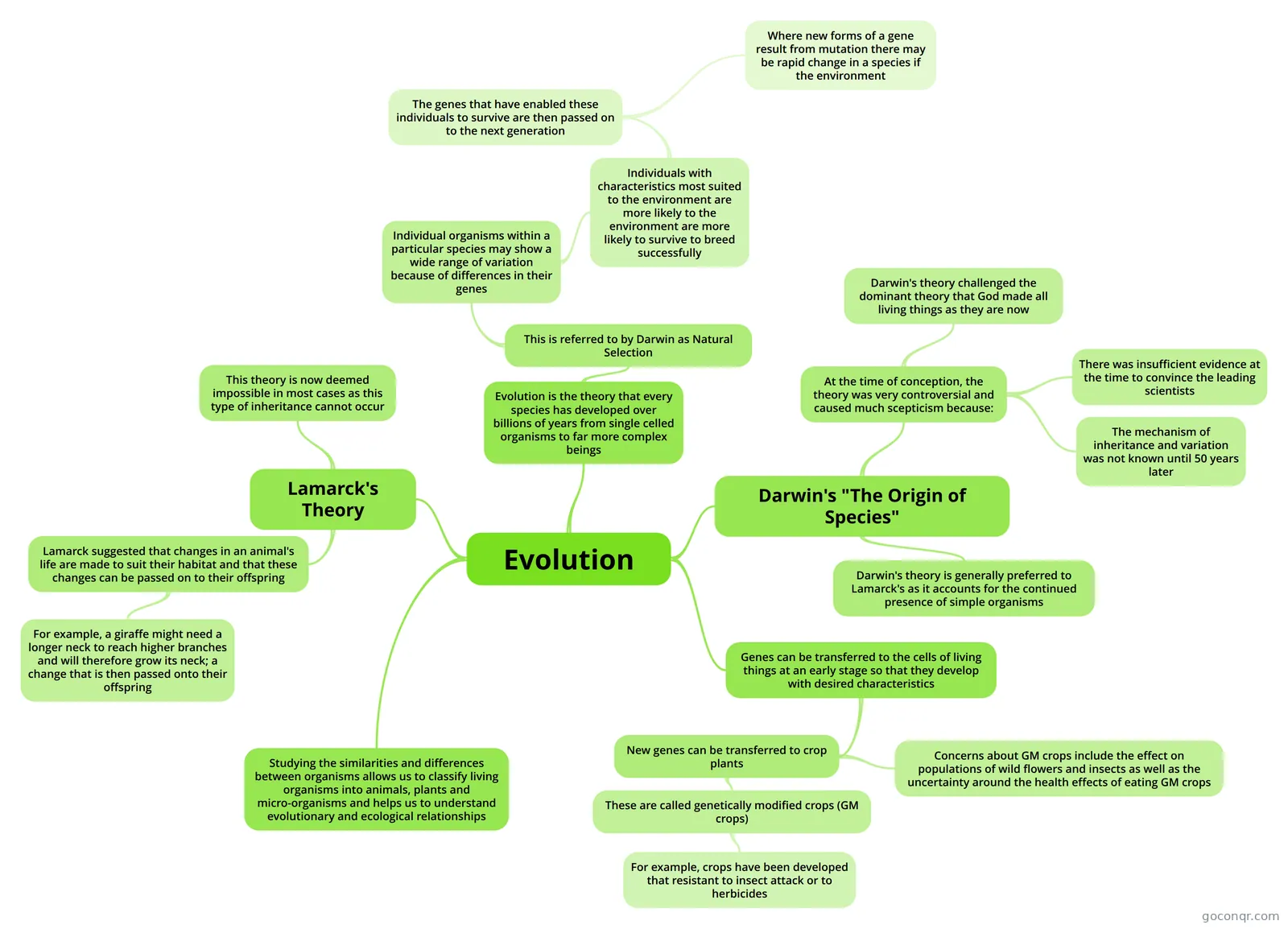
Mind map: Evolution
Conteúdo do mapa
Evolution
Evolution is the theory that every species has developed over billions of years from single celled organisms to far more complex beings
- This is referred to by Darwin as Natural Selection
- Individual organisms within a particular species may show a wide range of variation because of differences in their genes
- Individuals with characteristics most suited to the environment are more likely to the environment are more likely to survive to breed successfully
- The genes that have enabled these individuals to survive are then passed on to the next generation
- Where new forms of a gene result from mutation there may be rapid change in a species if the environment
- The genes that have enabled these individuals to survive are then passed on to the next generation
- Individuals with characteristics most suited to the environment are more likely to the environment are more likely to survive to breed successfully
- Individual organisms within a particular species may show a wide range of variation because of differences in their genes
- This is referred to by Darwin as Natural Selection
Darwin's "The Origin of Species"
- At the time of conception, the theory was very controversial and caused much scepticism because:
- Darwin's theory challenged the dominant theory that God made all living things as they are now
- There was insufficient evidence at the time to convince the leading scientists
- The mechanism of inheritance and variation was not known until 50 years later
- Darwin's theory is generally preferred to Lamarck's as it accounts for the continued presence of simple organisms
- At the time of conception, the theory was very controversial and caused much scepticism because:
Lamarck's Theory
- Lamarck suggested that changes in an animal's life are made to suit their habitat and that these changes can be passed on to their offspring
- For example, a giraffe might need a longer neck to reach higher branches and will therefore grow its neck; a change that is then passed onto their offspring
- This theory is now deemed impossible in most cases as this type of inheritance cannot occur
- Lamarck suggested that changes in an animal's life are made to suit their habitat and that these changes can be passed on to their offspring
Studying the similarities and differences between organisms allows us to classify living organisms into animals, plants and micro-organisms and helps us to understand evolutionary and ecological relationships
Genes can be transferred to the cells of living things at an early stage so that they develop with desired characteristics
- New genes can be transferred to crop plants
- These are called genetically modified crops (GM crops)
- For example, crops have been developed that resistant to insect attack or to herbicides
- Concerns about GM crops include the effect on populations of wild flowers and insects as well as the uncertainty around the health effects of eating GM crops
- These are called genetically modified crops (GM crops)
- New genes can be transferred to crop plants
Informações
- Descrição
- GCSE Biology (Core GCSE) Mapa Mental sobre Evolution, criado por seth.bragg em 13-05-2013.
- Criado por
- seth.bragg
- Visualizações
- 115
- Tags
- Avaliação