
Mapa mental
Energy Systems
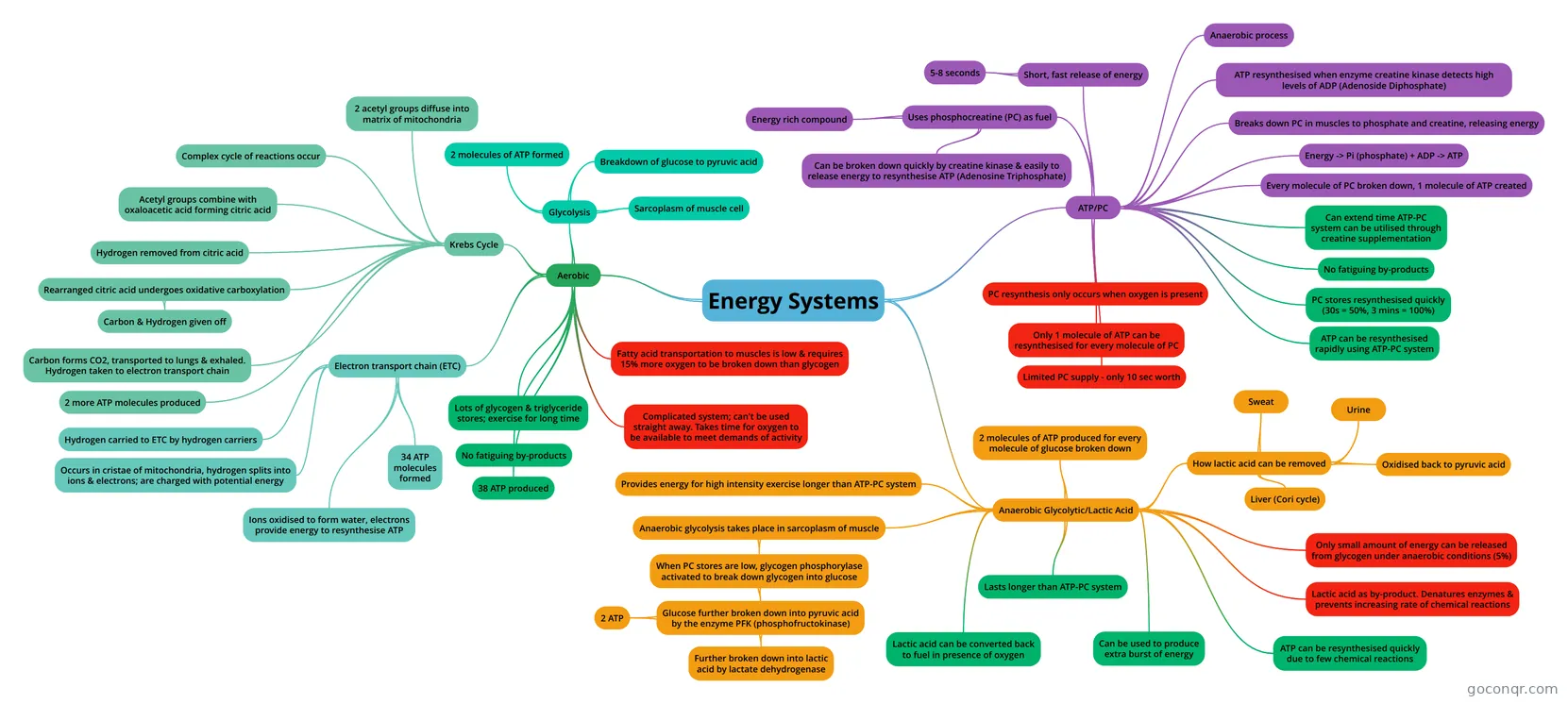
Mind map: Energy systems
Conteúdo do mapa
Energy Systems
Aerobic
- Glycolysis
- Sarcoplasm of muscle cell
- Breakdown of glucose to pyruvic acid
- 2 molecules of ATP formed
- Krebs Cycle
- 2 acetyl groups diffuse into matrix of mitochondria
- Complex cycle of reactions occur
- Acetyl groups combine with oxaloacetic acid forming citric acid
- Hydrogen removed from citric acid
- Rearranged citric acid undergoes oxidative carboxylation
- Carbon & Hydrogen given off
- Carbon forms CO2, transported to lungs & exhaled. Hydrogen taken to electron transport chain
- 2 more ATP molecules produced
- Electron transport chain (ETC)
- Hydrogen carried to ETC by hydrogen carriers
- Occurs in cristae of mitochondria, hydrogen splits into ions & electrons; are charged with potential energy
- Ions oxidised to form water, electrons provide energy to resynthesise ATP
- 34 ATP molecules formed
- 38 ATP produced
- No fatiguing by-products
- Lots of glycogen & triglyceride stores; exercise for long time
- Complicated system; can't be used straight away. Takes time for oxygen to be available to meet demands of activity
- Fatty acid transportation to muscles is low & requires 15% more oxygen to be broken down than glycogen
- Glycolysis
Anaerobic Glycolytic/Lactic Acid
- Provides energy for high intensity exercise longer than ATP-PC system
- Anaerobic glycolysis takes place in sarcoplasm of muscle
- When PC stores are low, glycogen phosphorylase activated to break down glycogen into glucose
- Glucose further broken down into pyruvic acid by the enzyme PFK (phosphofructokinase)
- Further broken down into lactic acid by lactate dehydrogenase
- 2 ATP
- Glucose further broken down into pyruvic acid by the enzyme PFK (phosphofructokinase)
- When PC stores are low, glycogen phosphorylase activated to break down glycogen into glucose
- 2 molecules of ATP produced for every molecule of glucose broken down
- ATP can be resynthesised quickly due to few chemical reactions
- Lasts longer than ATP-PC system
- Lactic acid can be converted back to fuel in presence of oxygen
- Can be used to produce extra burst of energy
- Lactic acid as by-product. Denatures enzymes & prevents increasing rate of chemical reactions
- Only small amount of energy can be released from glycogen under anaerobic conditions (5%)
- How lactic acid can be removed
- Sweat
- Urine
- Oxidised back to pyruvic acid
- Liver (Cori cycle)
ATP/PC
- Uses phosphocreatine (PC) as fuel
- Energy rich compound
- Can be broken down quickly by creatine kinase & easily to release energy to resynthesise ATP (Adenosine Triphosphate)
- Short, fast release of energy
- 5-8 seconds
- Anaerobic process
- ATP resynthesised when enzyme creatine kinase detects high levels of ADP (Adenoside Diphosphate)
- Breaks down PC in muscles to phosphate and creatine, releasing energy
- Energy -> Pi (phosphate) + ADP -> ATP
- Every molecule of PC broken down, 1 molecule of ATP created
- ATP can be resynthesised rapidly using ATP-PC system
- PC stores resynthesised quickly (30s = 50%, 3 mins = 100%)
- No fatiguing by-products
- Can extend time ATP-PC system can be utilised through creatine supplementation
- Limited PC supply - only 10 sec worth
- Only 1 molecule of ATP can be resynthesised for every molecule of PC
- PC resynthesis only occurs when oxygen is present
- Uses phosphocreatine (PC) as fuel
Informações
- Descrição
- A level Physical Education (Anatomy and Physiology) Mapa Mental sobre Energy Systems, criado por Wesley Spearman em 29-08-2017.
- Criado por
- Wesley Spearman
- Visualizações
- 829
- Tags
- Avaliação