
Mapa mental
Business Studies
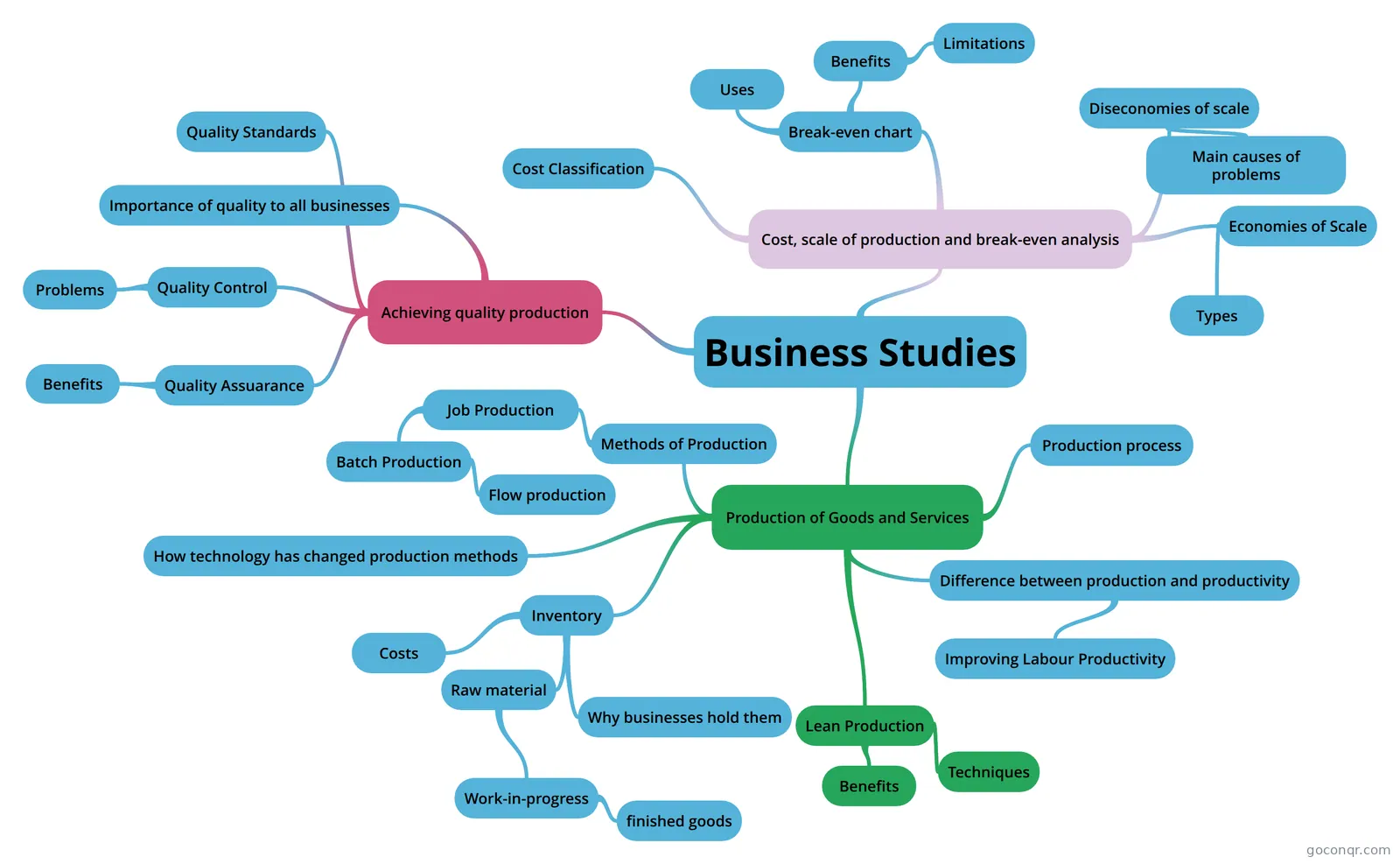
Mind map: Business Studies
Conteúdo do mapa
Business Studies
Production of Goods and Services
- Production process
- Production is the process of adding value to inputs into saleable goods.
- Operation management involves managing business resources - known as inputs, throughout the production process so as to produce finished goods - known as output.
- Operations management must: * use resources in the most cost effective way *produce the required output to meet consumer demand *meet the quality standard expected by consumers.
- Difference between production and productivity
- Productivity is a measure of the efficiency of inputs used in the production process
- It measures using labour and capita productivity. a) Labour Productivity = Total output/Total number of production workers. b) Capital Productivity = Total output/Total number of machines
- Improving Labour Productivity
- *Improving the skill level of workers *improving motivation of workers *improving the quality of management decisions *Keep the workplace tidy *Better technology
- Inventory
- Inventory is the stock of raw materials, work-in-prgress and finished goods held by a business.
- Costs
- Warehousing costs handling costs shrinakage costs Insurance cost obsolescence opportunity cost
- Raw material
- -these are needed as inputs for the production process
- Work-in-progress
- -that is part-finished goods that have not yet completed the production process
- finished goods
- -ready to be sold or sent out to customers.
- Why businesses hold them
- *If business does not have finished goods in stock, then customers' orders cannot be met and the business will lose sales.
- *Businesses often benefit from economies of scale when they buy inventories in large quantities because they receive a discount from the supplier.
- Methods of Production
- Job Production
- Job production is the production of items one at a time.
- Benefits *unique, high quality products are made *workers are often more motivated and take pride in their work
- Limitations *uses skilled labour rather than machinery so selling price will be high *production can take a long time and can be expensive. *Economies of scale are not possibles, often resulting in a more expensive product
- Batch Production
- Batch Production is the production of goods in batches. Each batch passes through one stage of production before moving onto the next stage. e.g making bread in a bakery
- Benefits *offer the customer some variety and choice *since larger numbers are made, unit costs are lower. *materials can be bought in bulk so they are cheaper
- Limitations *Workers are often less motivated because the works becomes repetitive *Goods have to be stored until they are sold, which is expensive
- Flow production
- Flow production is the production of very large quantities of identical goods using a continuosly moving process. (Also known as mass production)
- Benefits *Large number of goods are produced *materials can be purchased in large quantities, so they are often cheaper due to bulk-buying economies of scale *more CAPITAL INTENSIVE than job or batch production, which lowrs the labour cost.
- Limitations *requires very large capital investment in production line technology *workers are not motivated since their work is repetitive *if one part of the production line breaks down the whole production process stop until repairs are made.
- Job Production
- How technology has changed production methods
- Lean Production
- Lean production is the production of goods and services with the minimum waste of resources.
- Benefits
- *Quality is improved *The costs of holding inventories is eliminated *New products can be brought to the market more quickly *wastage of time and other resources is reduced or eliminated.
- Techniques
- Just-in-time inventory control -it means no inventory is held by the business. Raw material arrive from suppliers just as they are needed by the production process.
- Kaizen (continuous improvement) -gives all workers opportunity to make decisions about how to improve quality or productivity. +changes may be very small, but all these small improvements can lead to big improvements in efficiency.
- Production process
Cost, scale of production and break-even analysis
- Cost Classification
- Fixed cost- costs that do not change with output. e.g factory rent, salary of managers
- Variable cost - cost that change in direct proportion to output. e.g. raw materials
- Total cost - all the variable and fixed cost of producing the total output. -Total cost=fixed costs + total variable costs
- Economies of Scale
- Economies of scale is the reduction in average costs as a result of increasing the scale of operations.
- Types
- Managerial economies- Financial economies- Marketing economies- Purchasing economies- Technical economies-
- Diseconomies of scale
- Diseconomies of scale are factors that cause average costs to rise as the scale of operations increases.
- Main causes of problems
- >Poor communication >poor control >Demotivation of workers
- Break-even chart
- Break even is the level of output where revenue equals total costs; the business is making neither profit nor loss.
- Uses
- *calculate how many units it needs to sell before it starts to make profit *calculate the effect on profit of increasing or decreasing the price of a product *calculate the effect on profits of an increase or decrease in business costs.
- Benefits
- *Can show the effect of a decision to change costs or revenues *easy to construct and interpret *can help other important decisions such as the location or relocation of a business.
- Limitations
- *It is not easy to separate costs into fixed and variable *assumes that all costs and revenues can be represented by a straight line. *assume that all output is sold - do not allow for inventories and the cost of holding these
- Cost Classification
Achieving quality production
- Quality is ensuring a good or service that meets the needs and requirements of its consumer.
- Quality Standards
- Quality standards is the minimum acceptable standard of production or service acceptable to consumers.
- Importance of quality to all businesses
- *develop a strong brand image *reduce customer complaints and returns *Keep customers and attract new customers *charge a premium price *Reduce costs *encourage wholesalers and retailers to stock its products.
- Quality Control
- -is checking the quality of goods through inspection.
- Problems
- *The work can be repetitive and boring and this may demotivate the inspectors, resulting in them not performing their task efficiently
- *The uses of quality inspectors takes any responsibility for quality away from the workers.
- *if inspection only takes place at the end of the process, then problems with quality that occur at the beginning are not found soon enough. Resources are wasted completing a product that should have been rejected much earlier in the production process.
- Quality Assuarance
- -a system of setting agreed standards for every stage of production
- Benefits
Informações
- Descrição
- Mapa Mental sobre Business Studies, criado por Catherine Tem em 23-09-2017.
- Criado por
- Catherine Tem
- Visualizações
- 6
- Avaliação