
Mapa mental
Chapter 4: Solutions
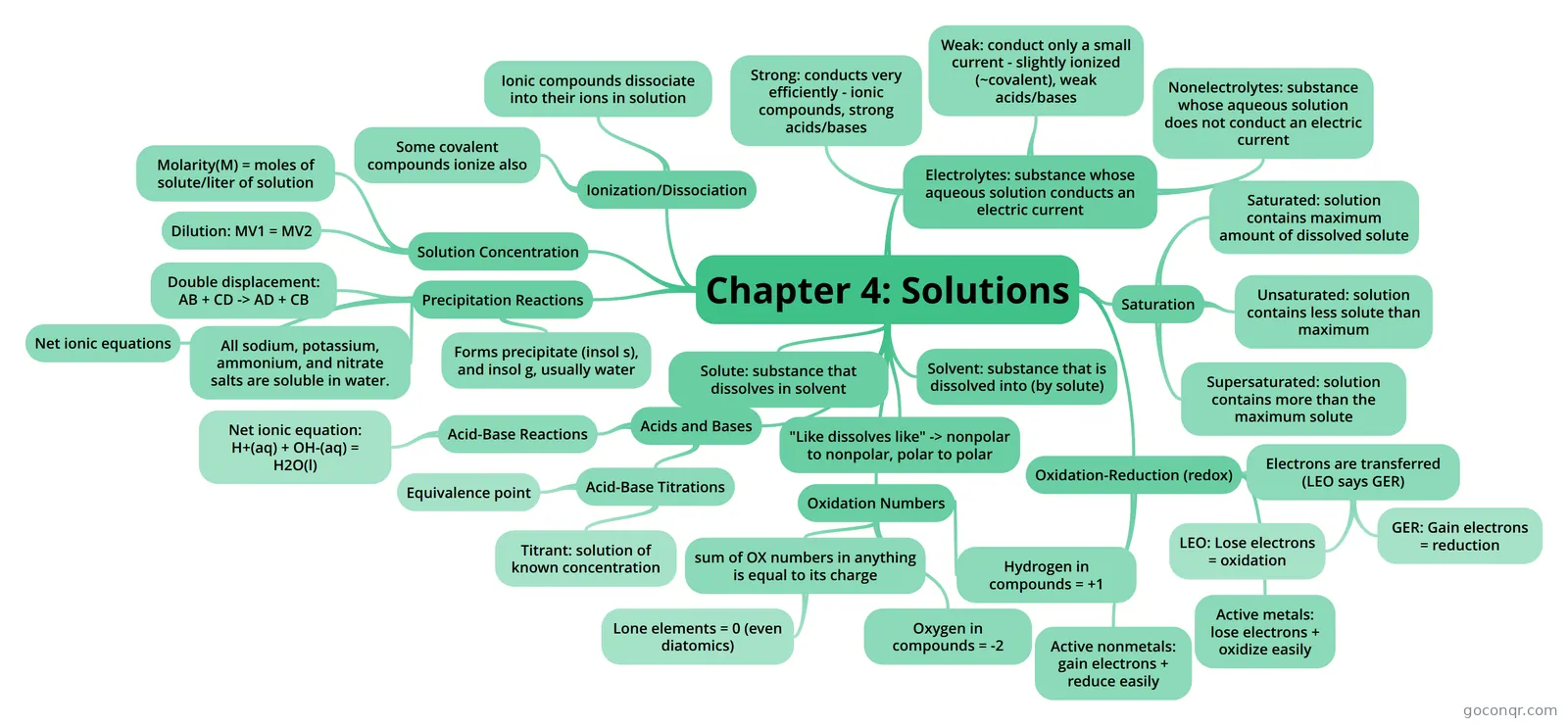
Mind map: Chapter 4: Solutions
Conteúdo do mapa
Chapter 4: Solutions
Solute: substance that dissolves in solvent
Solvent: substance that is dissolved into (by solute)
"Like dissolves like" -> nonpolar to nonpolar, polar to polar
Saturation
- Saturated: solution contains maximum amount of dissolved solute
- Unsaturated: solution contains less solute than maximum
- Supersaturated: solution contains more than the maximum solute
Electrolytes: substance whose aqueous solution conducts an electric current
- Nonelectrolytes: substance whose aqueous solution does not conduct an electric current
- Strong: conducts very efficiently - ionic compounds, strong acids/bases
- Weak: conduct only a small current - slightly ionized (~covalent), weak acids/bases
Ionization/Dissociation
- Ionic compounds dissociate into their ions in solution
- Some covalent compounds ionize also
Solution Concentration
- Molarity(M) = moles of solute/liter of solution
- Dilution: MV1 = MV2
Precipitation Reactions
- Double displacement: AB + CD -> AD + CB
- Forms precipitate (insol s), and insol g, usually water
- All sodium, potassium, ammonium, and nitrate salts are soluble in water.
- Net ionic equations
Acids and Bases
- Acid-Base Reactions
- Net ionic equation: H+(aq) + OH-(aq) = H2O(l)
- Acid-Base Titrations
- Equivalence point
- Titrant: solution of known concentration
- Acid-Base Reactions
Oxidation-Reduction (redox)
- Electrons are transferred (LEO says GER)
- LEO: Lose electrons = oxidation
- GER: Gain electrons = reduction
- Active metals: lose electrons + oxidize easily
- Active nonmetals: gain electrons + reduce easily
- Electrons are transferred (LEO says GER)
Oxidation Numbers
- sum of OX numbers in anything is equal to its charge
- Lone elements = 0 (even diatomics)
- Hydrogen in compounds = +1
- Oxygen in compounds = -2
- sum of OX numbers in anything is equal to its charge
Informações
- Descrição
- AP Chemistry Chapter 4 Study Map
- Criado por
- Rowan Skelley
- Visualizações
- 24
- Avaliação