
Mapa mental
Environmental Management and Industry
Conteúdo do mapa
Environmental Management and Industry
Pollution prevention
- Waste & Emission Prevention (WEP)
- " the avoidance or minimization of the creation of waste exports and emissions by reduction at source, by on site recycling and / or by reducing the total level of its harmfulness to the environment "
- P2
- "the minimization of waste exports and emissions to air, water and soil in a preventive way, that is, by tackling the causes of the impacts, not by displacing or mitigating the effects".
- Carrying out a P2-project
- 1. Planning and organization
- 2. Assessment
- 3. Feasibility analysis
- 4. Implementation
- Decision making
- Planning and execution
- Follow-up: what's next?
- Technical, Economical, Evironmental feasability
- Final report
- 4. Implementation
- Collecting Data
- Selecting flows
- Generating prevention options
- 3. Feasibility analysis
- Getting involvement
- Establish goals
- 2. Assessment
- 1. Planning and organization
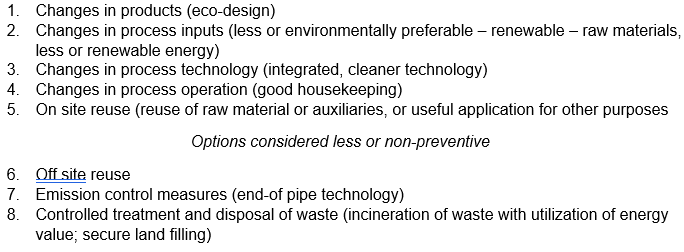
- Hierarchy
- Cooperation between companies to optimize off-site recycling
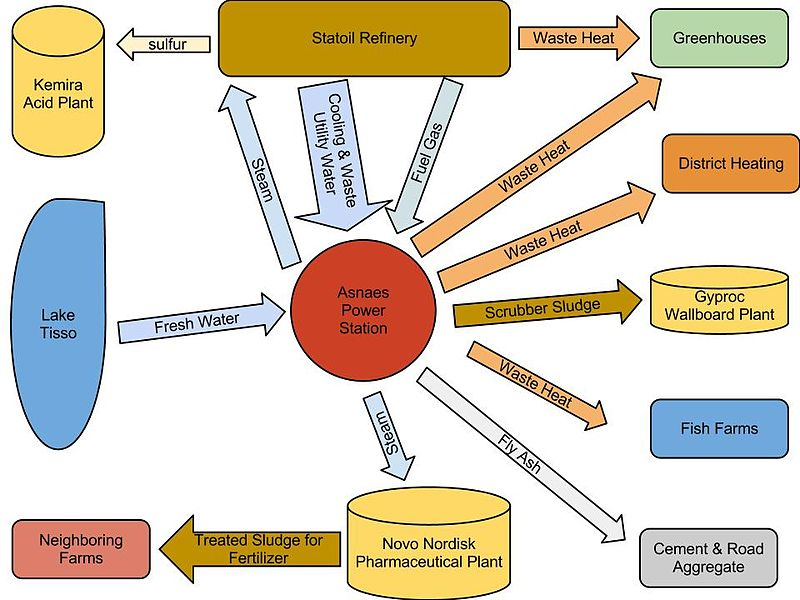
- Eco-industrial parks
- Estate of manufcaturing and service business located together. Member businesses seek enhanced economic, environmental and social performance. Working together leads to a collective benefit: 1 + 1 = 3
- Eco-industrial parks
- Waste & Emission Prevention (WEP)
Environmental Management Systems
- “That part of the overall management system which includes organisational structure, planning activities, responsibilities, practices, procedures, processes, and resources for developing, implementing, achieving, reviewing and maintaining the environmental policy”
- Direct activities in a:
- Consistent way: efficiency
- Complete way
- continuous way: policy aiming a way of continuous improvement
- Complete way
- Consistent way: efficiency
- Direct activities in a:
- Motives
- Internal:Identify, control and reduce. Compliance, cost-saving, avoid environmental harm
- External: demonstrate awareness, increase competitiveness
- For governments: stimulate companies to be responsible. Reduce permitting,
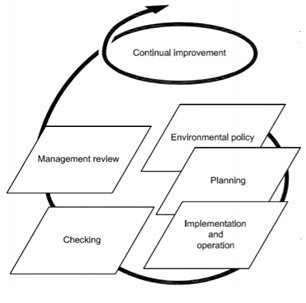
- ISO 14001
- Contains: standard requirements that may be objectively audited for purposes of certification
- Environmental Policy:
- provides initial foundation and direction for the EMS. The policy needs to clarify compliance with environental legislation
- Planning
- Process to identify significant environmental aspects
- Legislative and other requirements
- Environmental objectives and targets
- Environmental program
- time schedules, budgets, personnel, and control procedures
- Implementation & Operation
- Organzation and personnel: commitment is needed and
- Training, awareness and competence
- Training, awareness and competence
- Communication
- EMS manual: maintain information about their EMS
- Documentation
- Operational control
- Preparation and reaction to calamities
- Organzation and personnel: commitment is needed and
- Checking and corrective action
- Monitor and Measure (does the company comply with work, targets, etc)
- Corrective action in case of non-compliance
- EMS audits (=controle)
- Management review
- Top management should review the EMS, to ensure continual stability, adequacy and effectiveness
- Elements
- EU's own standard: EMAS
- EcoManagement and Audit Scheme
- More explicit on regulatory compliance: EMAS requires compliance where ISO14001 requires "commitment to compliance"
- Shorter range of environmental effects have to be addressed while ISO states all significant effects have to be addressed
- Biggest difference: EMAS requires to publish a public report with motive and efforts etc)
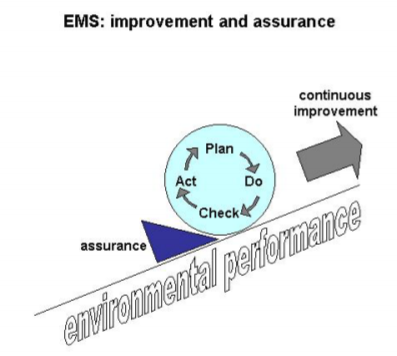
- Deming Cycle
- Do
- Plan
- establish goals and measures to achieve them
- Check
- Act
- ISO 14006
- general guidance and practical help for all organizations that are interested in implementing environmental management systems
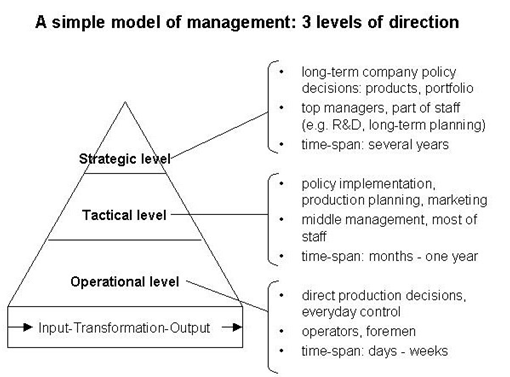
- The three levels of direction
- Strategic
- Tactical
- Operational
- Tactical
- Strategic
- Generic scheme for EMS development
- 1. Planning and Organization
- 2. Initial Review
- Systematic anaylsis of environmental issues. of impacts and their main causes
- 3. Formulating an environmental policy statement and developing an action plan
- Action plan describes action and targets for putting the policy statement in effect
- Priority, objective, action, target, timeframe, tasks
- Action plan describes action and targets for putting the policy statement in effect
- 4. Execution of the plan
- Can be: environmental analyses, developing EMS elements, WEP,P2-projects
- 5. Evaluation and reporting
- Key questions
- Develop EMS Bottom-up or Top-down
- Top-Down: top management determines EMS and directs implementation. Communication with employees will be one-way. The advantage is that development is initiated fast. Disadvantage is that usefull workfloor information is neglected and commitment/motivation from workers will drop
- Bottom-up: implies a high participation of workers and are early stage included and informed. Advantage is increased motivation and big contributions. The disadvantage is that the EMS will proceed at a slow pace
- Develop a specific EMS-system or integrate it with other management systems
- Companies ofte nalready use Deming cycle, so the EMS can be easily integrated. But it will be difficult to integrate overlapping items
- Develop EMS Bottom-up or Top-down
- Indicators
- Environmental Condition Indicators
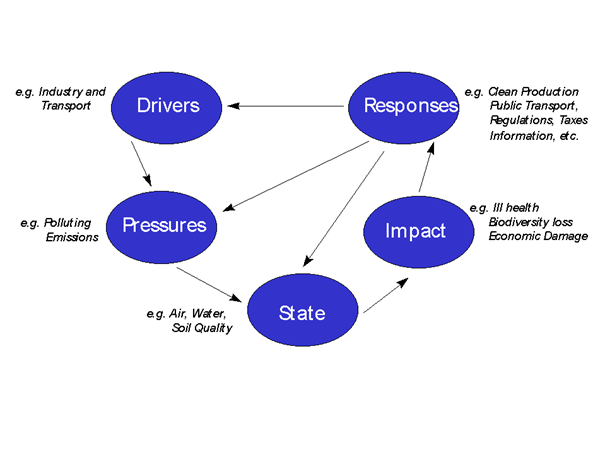
- Provide information about the condition of the environment: State in DPSIR
- Environmental performance indicators
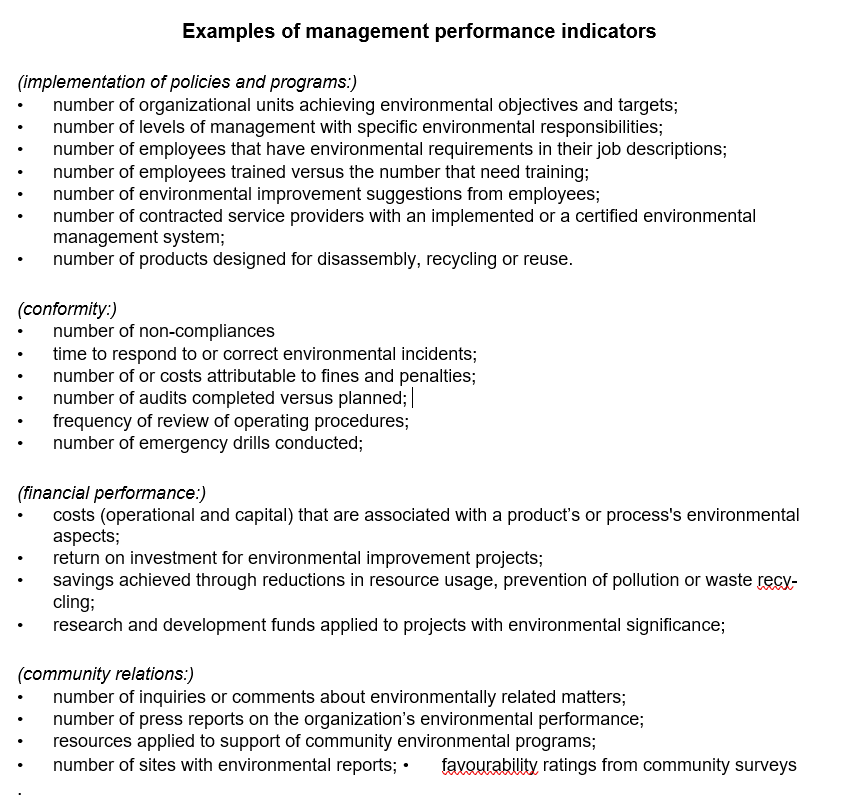
- Management performance indicaters
- Response in DPSIR
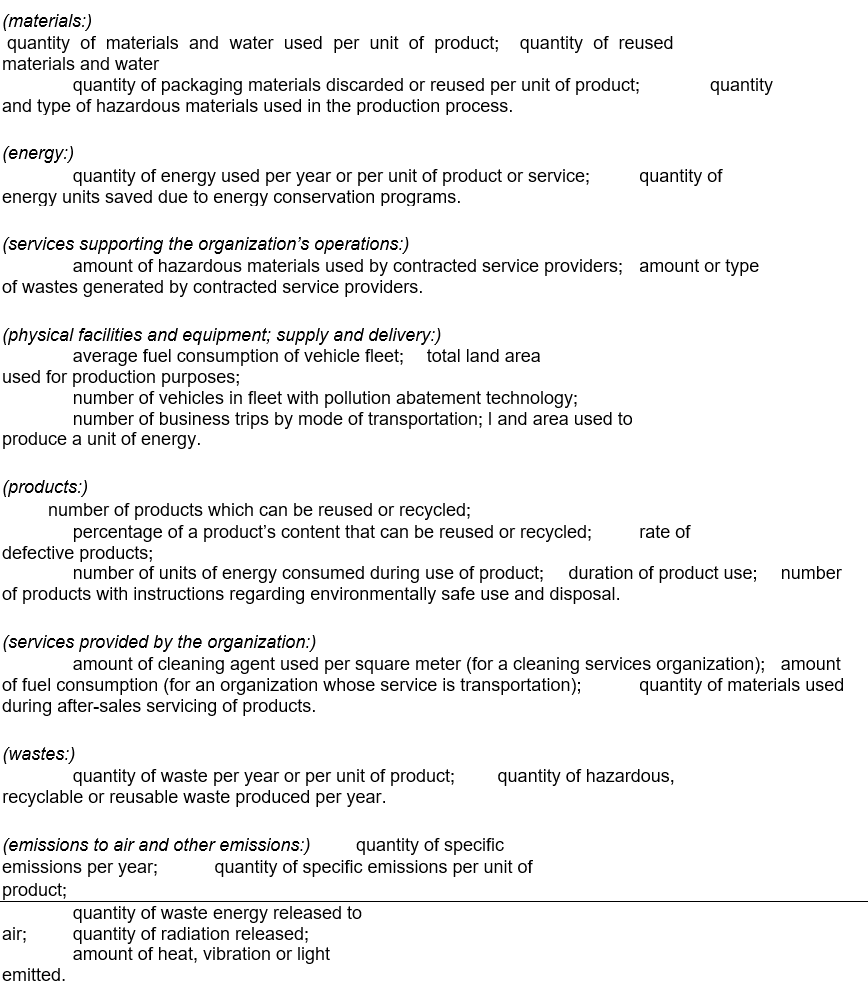
- Operational performance indicators
- • the design, operation, and maintenance of the organization’s physical facilities and equipment; • the materials, energy, products, services, wastes, and emissions related to the organization’s physical facilities and equipment; and • the supply of materials, energy and services to, and the delivery of products, services and wastes from the organization’s physical facilities and equipment. Pressure in DPSIR
- How are WE doing?
- EPI-development
- 1. Establish the objectives of the indicators: what are the aims that we want to develop indicators for?
- 2. Define the metrics of the inidcators
- 3. Formulate the assessment of the indicators: by which procedures can we establish the values of the indicators?
- Management performance indicaters
- Environmental Condition Indicators
- “That part of the overall management system which includes organisational structure, planning activities, responsibilities, practices, procedures, processes, and resources for developing, implementing, achieving, reviewing and maintaining the environmental policy”
Organizations and organizational change
- Main goals: continuity and growth
- Five company strategies by Mintzberg: the 5 P's
- Plan: intended course of action
- Ploy: a really specific manoeuvre to ouwit competitor
- Pattern: strategy shouldn't be plan. What was successful in the past can be succesful in the future
- Position: how the organiation relates to its competitive environment and what it can do to make its product unique in the marketplace
- Perspective: influence of organizational culture and collective thinking on the strategic decision making within the company
- Position: how the organiation relates to its competitive environment and what it can do to make its product unique in the marketplace
- Pattern: strategy shouldn't be plan. What was successful in the past can be succesful in the future
- Ploy: a really specific manoeuvre to ouwit competitor
- Plan: intended course of action
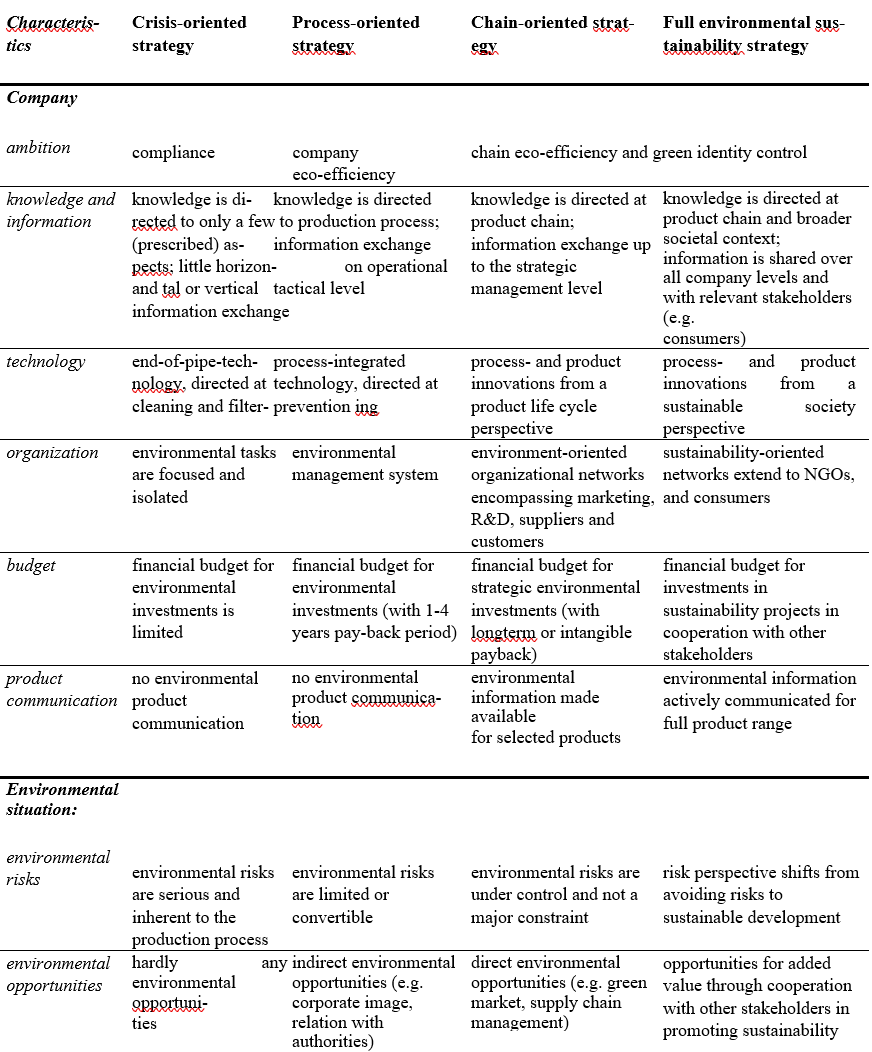
- The Four-stage model
- Usefulness
- May help as a guideline for mapping the state of environmental management in a company
- Whether the company characteristics levels are in balance. In this way the model can be helpful in choosing the right environmental strategy
- It helps the upgrade of a company to a higher strategy by identifying bottle necks (=knelpunten)
- Usefulness
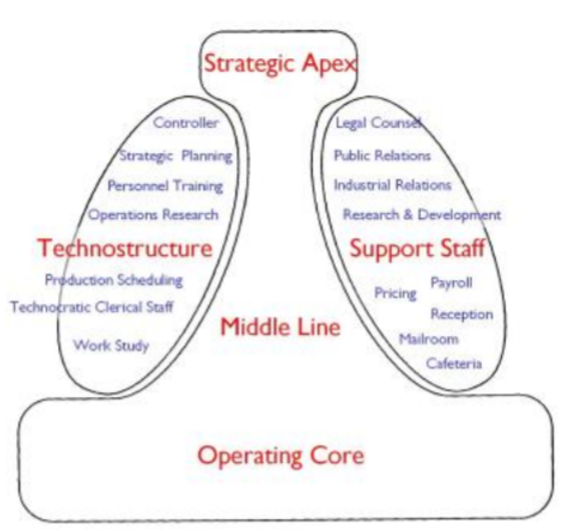
- Mintzberg's models
- Technostructure (analysts) which co-ordinate tasks in the organization by standardization of work or output
- Support staff (support outside the realm of core activities
- Middle line (middle managers)
- Operating Core (the work floor)
- Strategic Apex (top management)
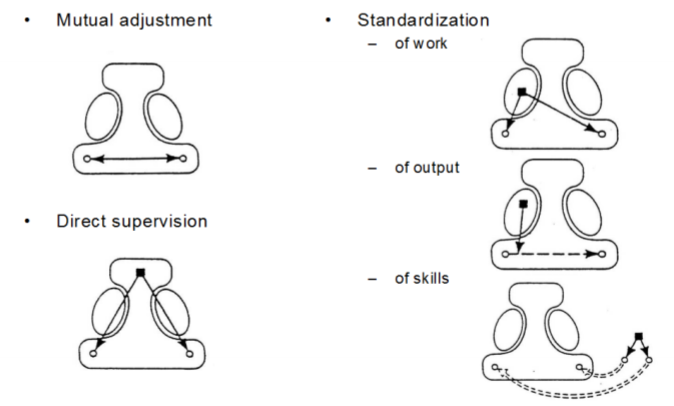
- Co-ordination mechanisms
- Organization types
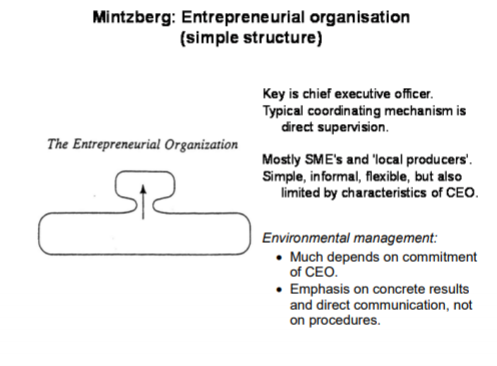
- Entrepeneurial
- Direct supervision from CEO
- Key part: strategic apex
- Usually small; small organization; personal
- Apex commitment is decisive: personal contact is important
- Usually small; small organization; personal
- Key part: strategic apex
- Direct supervision from CEO
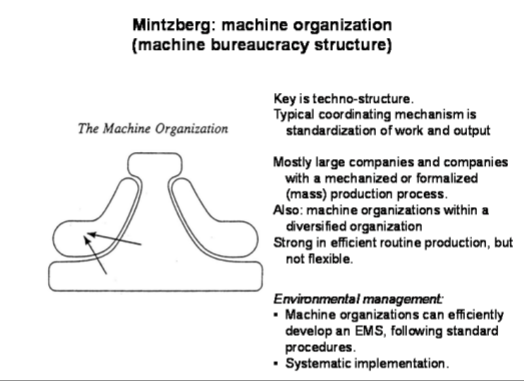
- Machine
- coordination mechanism: standardization of work process
- Key: technostructure
- Large established organizations: standard products with standard routine administrative of technological production process
- Company structure suitable for ISO-14001 EMSs
- Large established organizations: standard products with standard routine administrative of technological production process
- Key: technostructure
- coordination mechanism: standardization of work process
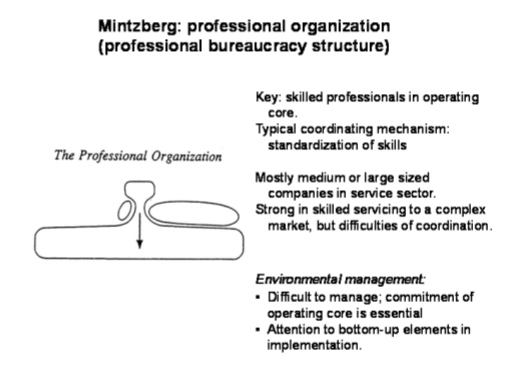
- Professional
- Prime coordiation mechanism: standardization of skills
- Operating core is the key part
- Medium to large organizations; providing complex services in a stable environment
- Difficult for implementing EMS; commitment from operating core is important
- Medium to large organizations; providing complex services in a stable environment
- Operating core is the key part
- Prime coordiation mechanism: standardization of skills
- Entrepeneurial
- Organizational Learning
- Models of (individual) learning
- Kolb Cycle
- 1. Concrete experience
- 2. Reflective observation
- 3. Abstract observation
- 4. Active Experimentation
- Giving rise to a new idea
- 3. Abstract observation
- 2. Reflective observation
- 1. Concrete experience
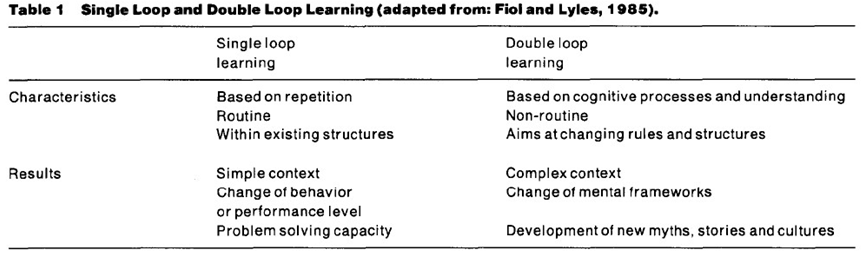
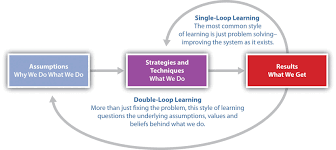
- Romme & Dillen: Single/Double loop learning
- Single loop: errors are corrected based on existing rules and norms
- Double loop: changes in rules and norms based on cognitive processes
- Kolb Cycle
- Learning processes in generating organizational learning
- Individual learning
- Process or system learning: information processing and problem solving capabilities are enhanced
- Culture
- Knowledge management: through individuals and in organization (documents, records, etc)
- Culture
- Process or system learning: information processing and problem solving capabilities are enhanced
- Individual learning
- Models of (individual) learning
Life Cycle Management
- 1. Analysising the total environmental impact of the product life cycle (LCA or ecobalance. 2. Organizing the product chain to co-operate in making environmental improvements
- Life Cycle Assessment (LCA)
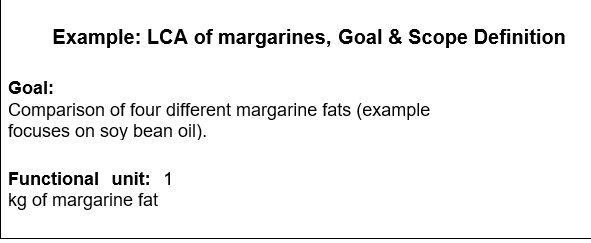
- 1. Goal and scope defenition
- Determining the goal: product design, finding env. bottle necks
- Determining the functional unit of assessment (miles of transport, one-year use of diapers)
- 2. Inventory analysis
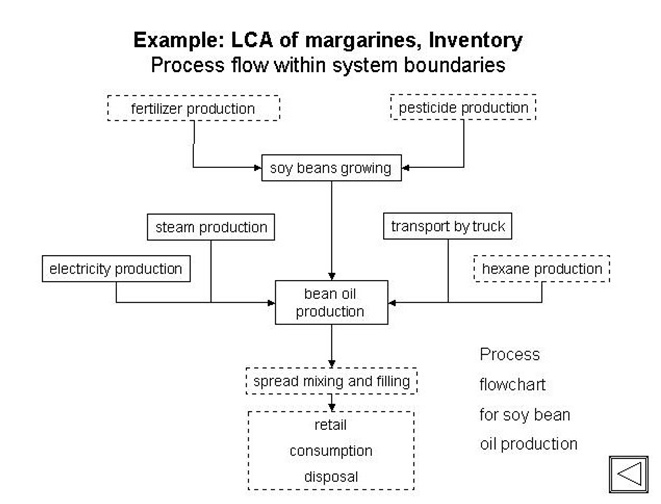
- Making a process flow chart
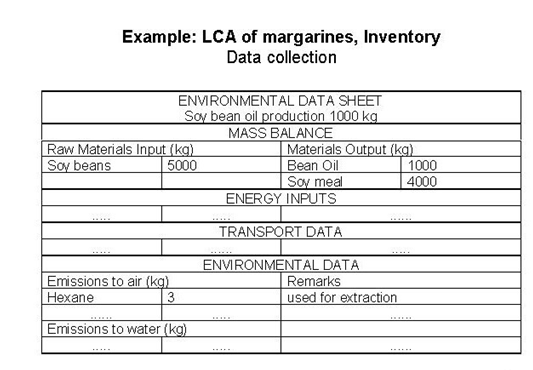
- Collecting environmental data
- Fixating system boundaries
- Processing data into the inventory table
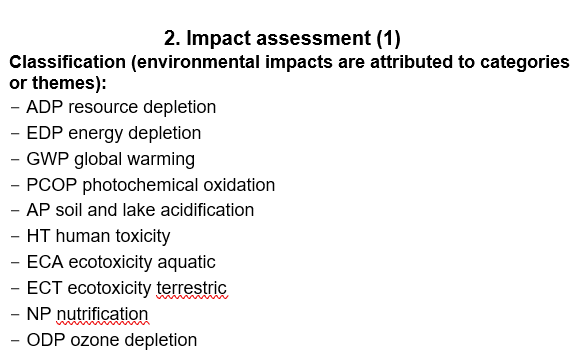
- 3. Impact assessment
- Classification of environmental impacts into categories of environmental problems
- Characterization: calculating for each category the total of impacts
- Normalization: calculating the magnitude of the category indicators relative to a common reference
- Weighting and aggregation: calculating the total scores by simple summation of the category scores
- 4. Interpretation
- Interpretation is important to all stages. It is dependent on the goal of the study. The major goals are product comparison and bottleneck identification
- Critiques
- Uncertainties due to: setting boundaries, attribution of impact, classification factors, variability in time/chains
- Normative choice concerning of categories and methods of normnalisation and weighting
- High costs
- Easily Biasable
- Legitamacy
- 1. Goal and scope defenition
- Organizing a LCM
- 1. Identifying main fields of application
- What will be the focus?
- Waste prevention
- Product design
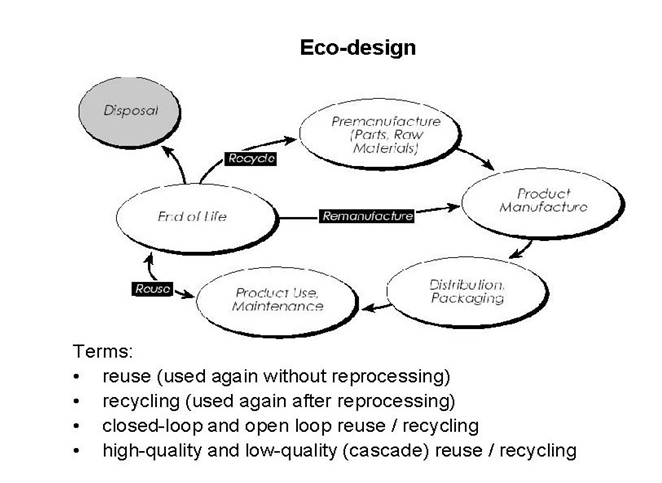
- Eco-design (DfE): directed to reducing the environmental impacts of the whole product life cycle requiring co-operation of different actors
- Can lead to government stimulated eco-labeling
- Eco-design (DfE): directed to reducing the environmental impacts of the whole product life cycle requiring co-operation of different actors
- What will be the focus?
- 2. Identifying actors that are able to direct the chain
- When predominant actors are present: interested and powerful (economy-wise) ones will be chain director
- When predominant actors are lacking: product associations take the role of chain director
- Independent societies directed by a board/governmental organ/environmental organization. Eco-label organizations are rather weak.
- Extending existing structures of chain management to environemtal issues
- Co-makership: company and supplier co-operatively design the products to be supplied - with env. aspects taken into account
- Product stewardship: company takes responsibility for the use of the product after sale. Pesticide manufacturers can provide proper product information and support resposible application
- Just-in-time production: minimize storage costs and stock depriciation
- Product quality certification: include next to for example food safety certifications for further environmental requirements
- 1. Identifying main fields of application
- Eco-design
- Directed to designing more environmentally friendly products
- Reduce or minimize the use of non-renwables
- Reduce toxic and harmful emissions to the environment
- Manage renewable resources
- Tools
- LCA:
- Material Flow Analysis and Substance flow Analysis
- Green indices & eco-point systems:
- Ranking systems attempting to summarize various env. impacts into a simple scale
- Material selection
- Label advisors such as IBM and Chrysler
- Eco-label requirements and guidelines that are provided
- Design for disassembly and recycling aids
- Directed to designing more environmentally friendly products
- State of LCM in companies and governmental policy
- No LCM
- Only internal
- Limited waste prevention activities
- Defense of products (LCA used to defend products
- Environmental product development (using the LCA)
- Environmental integrated chain management (LCA, product design, etc.)
- Environmental product development (using the LCA)
- Defense of products (LCA used to defend products
- Policy steps towards LCM
- Stimulation development of methods and projects
- Changing conditions by regulations and economic measures
- Enhancing the role of the consumer (product information)
- Product-oriented environmental management codes
- No LCM
From environmental management to industrial ecosystems
- From a single company to a complete industry
- Industrial ecology
- The envisage of industrial production as an ecosystem of organisms,
- Exchange in energy, information and resources
- Similar concept: industrial metabolism: more fixated on material and substance flows.
- Eco-industrial symbiosis (or Eco-industrial parks)
- Traditionally separate industries engage in a collective approach to competitive advantage involving pysical exchange of materials, water, energy and byproducts
- Waste exhange
- Within a company between organizational parts
- Among co-located companies in an industrial zone
- Among nearby companies within e.g. 3 km distance
- Traditionally separate industries engage in a collective approach to competitive advantage involving pysical exchange of materials, water, energy and byproducts
- Dematerialization: de-linking economic growth combined with increased environmental impact
- The envisage of industrial production as an ecosystem of organisms,
- Circular Economy
- Design out waste: material cycles closed with composting/re-upcycling so waste is mininal
- Build resilience through diversity: more connections over multiple scales are more resilient to external shocks
- Rely on energy from renewable sources
- Think in systems: helps to understand how parts influence on another and to consider the relationship with infrastructure, env. and society
- Waste is food: biological reuse of composed materials and up-cycyling to sustain items in the closed loop
Ecological modernization theory
- Core features
- Science and technology as central institutions of environmental reform (from end-of-pipe
- Stress on role of market dynamics and economic agents (rejecting the opposition of economy and ecology)
- Shifting from role of the state (from CnC to participatory)
- 1. Establishing together with science, the effective environmental policy and an framework to implement this.
- Giving room to industry, to elaborate and fill in this long-term policy in its own way.
- Modernizing the organization of production and consumption by removing the 'design fault', while taking ecological considerations into account.
- Role of the public
- Increase of awareness
- Pressure from groups/the neighborhood about environmental impact on health
- by pressure from env. organizations
- By pressure from financiers and customers, taking sustainability into account when investing
- By internal pressure from employees
- Triad-network model: considering the social-economic structure of a company
- Policy
- Q's: which authorities are responsible for setting env. standards, issuing regulations, granting permits and CnC? How can relations be improved to stimulated environmental management
- Industrial
- Q's: what are the env. interests of the main customers of a product(ion process), who are the suppliers, where is the co-operation?
- Societal
- Q's: who are pressure groups, what are their env. demands, are agreements with e.g. NGOs possible?
- Policy
- Core features
Imagens e arquivos do mapa

Informações
- Descrição
- Environmental Studies Mapa Mental sobre Environmental Management and Industry, criado por Promi Nent em 25-10-2017.
- Criado por
- Promi Nent
- Visualizações
- 81
- Tags
- Avaliação