
Mapa mental
Embedded Systems
Conteúdo do mapa
Embedded Systems
- Embedded System Design = Electrical Engineering + Computer Engineering Overall an Emb Syst project takes 10% programming and 90% debugging.Embd Syst design is to bridge digital and analog world.Embedded Syst Eng will need advance knowledge in Analog and Digital Filter Design.
IOT
- Network of embedded systems with sensors and actuators that interact within each other in wired or wireless communications.
- Components
- Areas to Study: -Wireless Connectivity (WiFi, BLE, Zigbee) -Low power design skills on hardware and firmware level -Sensor Selection and interfacing -Signal Processing -Data Analysis
- Embedded Device
- Emb Syst with sensors and actuators with network connectivity.
- Network Capability
- Network Capability across multiple nodes (things)
- Gateway
- Gateway device that connects the IOT system to the internet.
- Back End
- This includes data analytics and smart decision support.
Background
- Computer Architecture
- Programming
- Electrical Engineering Basics
- Filtering and Signal Processing
Areas
- Signal Processing
- Firmware
- When a Firmware developer is coding a firmware is expected to have a deep understanding of the hardware he is programming.
- Hardware
- Electrical Eng
- Computer Eng
Knowledge
- Must know the principles data acquisition, sampling theory, and signal bandwidth. More specialized skills include: -RTOS experience -Embedded Linux -FPGA Design and Hardware -Description Language (HDL) -Wireless protocols and IOT experience
- Basic Electronics
- If an electronic element gets toasted, it means that power was dissipated at such element.
- RLC
- How frequency response interacts in RLC circuits.
- Resistor
- Friction = Force / Speed
- Inductance
- Impede the change in current and is currently proportional to frequency. Mass = (Force * Time) / Speed Mass impedes the change in speed (Acceleration).
- Capacitors
- Impede the change of voltage and is inversely proportional to frequency. Spring = (Speed * Time) / Force Springs impede the change in force.
- Diodes
- Ideally Diodes acts as a switch that allows current in certain direction, while blocking current flow in another direction. Diode voltage-current response: -Forward Voltage: Voltage needed to get current to flow through the diode. -Reverse Breakage Voltage: The reverse voltage level at which the diode start allowing current through. This can be reached if a motor is being switched on and pulls voltage from the entire circuit. Power dissipation = forward voltage x current through the diode.
- Op-Amps
- Are heavily used in signal conditioning applications. Research Voltage follower(useful when trying to measure signal that can be affected easily by the load) and DC level shifter (is like the basic RC high pass filter but with a new DC level applied instead of the ground). Two types of Op-amps configurations: - Positive feedback: used to make output latch a state or to generate oscillations. - Negative feedback: used for amplification. In Op-Ams: - Inputs have high impedance. IOW, op-amps do not affect circuits they are attached to. - Outputs have low impedance - Also, they have very high open loop gain.
- Transistors
- To be used as a switch it needs to be driven to a saturation state. -Saturation State: enough current passes into the base, causing the maximum current through the collector. NOR-Gate
- Signal Analysis Skills
- Analyze and read schematics 1. What Step Response means and relevance of Step Response of a circuit. 2. Able to analyze basic circuits.
- Step Response
- Step response in a circuit is the output when the input is a step function.
- Truth tables
- DSP
- Is a special purpose processor that is optimized for mathematically intensive algorithms. The goal of DSPs is usually to measure, filter or compress continuous real-world analog signals. Signal Conditioning
- Filtering
- Low-pass
- The input step signal will be filtered by a low-pass filter. In the time domain low-pass filter acts as a integrator. Output signal for a periodic square wave input is a periodic sawtooth.
- High-pass
- Will preserve the high frequency component of the input. In the time domain high-pass filter acts as a differentiator. In the frequency domain perspective the sudden level changes in the square periodic wave represents high frequency. In the time domain perspective it acts as a differentiator; thus, the output to the squarewave are periodic spikes.
- RL Low-pass
- Impedes the change in current.
- Low-pass
- Amplification
- Sampling Theory
- Signals can only be represented by its samples properly, if the sampling frequency is at least double the bandwidth of the original signal.
- Aliasing
- Nyquist criteria: in order to sample a signal. The bandwidth must be at least double of the original signal.
- Debugging Skills
- Logic Analyzer
- Osiloscope
- Datasheet Reading
- Familiarize with data sheets for core devices in an embedded system i.e. processors, DAC (analog to digital converters), and sensors. Ratio-metric: means that the output is proportional to the supply voltage. Absolute: means that the output is independent of the supply.
- Hardware Skills
- Schematics Reading
- Grounds in schematics -Analog ground: means this is the ground for the analog components in a schematic. -Digital ground: this is the ground for the digital components in a schematic. -Both grounds should be kept separated and connected at a single point.
- PCB Design and Analysis
- Is a common practice to have 45 degree angle traces and avoid sharp corner traces. This is meant to prevent signal reflecting( creating interference and attenuate the signal) in a high frequency setting. Also, 45 deg are much easier than sharp corners.
- Basics Electrical Motors
- AC
- DC
- In DC motors speed is controlled by controlling voltage and torque is controlled by controlling current. Brushed motors - inherently unidirectional. Brushless motors- inherently bidirectional BLDC Stepper motors Servo motors
- Speed Control
- Linear Control
- Simple and Cheap Less EMI Less Efficient
- Switching Control
- More expensive More EMI More Efficient
- Linear Control
- Maintaining Speed
- Voltage Feedback
- Speed Feedback
- Changing Directions
- Voltage Polarity (H Bridge)
- Schematics Reading
- RTOS
- Micro-processor
- Dedicated central processing units that use external memory and peripherals to interact with the world
- Data Flow
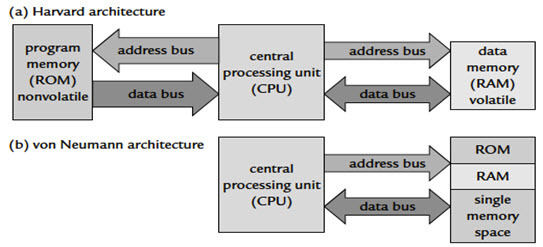
- Harvard Architecture
- -Faster in speed, simple design -Data and code can be accessed in a single clock cycle. -Physically separates data and instructions pathways.-Separates program and data memories that can be accessed simultaneously.
- Vonn Neuman Architecture
- -Slower in speed, complex design. -Instructions fetch and data operation can't be performed together. -CPU performs one operation at a time Fetch-Decode-Execute. -Instructions and data share the same bus
- Harvard Architecture
- ISA
- Instruction Set Architecture: The set of techniques used by the processor to implement task on the hardware.
- RISC
- Reduced Instruction Set Architecture: -Main focus is on software side. -Fixed length instruction -Reduced instructions -Larger code size
- CISC
- Complex Instruction Set Architecture: -Main focus is on the hardware side. -Variable length instructions -Complex instructions. -Small code size.
- Microcontroller
- An integrated SoC (System-on-Chip) that contains: processor, memory, and programmable peripherals.
- N-bit
- N-bit refers to the width of the data unit it handles. - Width of the data bus the processor can handle. The bigger the bus the more efficient processing capability, -The size of data that the processor can access in a single instruction -Input and output peripherals is more advanced in a 16bit MCU compared to an 8-bit MCU.
- Memory Alignment
- Little vs Big endianness
- PLL
- Phase-locked Loop is a control system that generates an output signal whose phase is like the input signal. At the core the PLL consists of a variable frequency oscillator and a phase detector.
- MCU Data Sheet
- Initial State
- State of the registers after reset.
- Interrupts
- How interrupts are handled and where interrupt vector table is stored. How interrupts are enabled and disabled.
- Memory
- How memory is organized in the processor.
- Sleep Modes
- What are the sleep modes in the processor.
- Assembly
- You will need to familiarize with processor architecture and instruction set.
- Initial State
- FPGA
- Field Programmable Gate Arrays: Integrated circuits that can be configured after manufacturing.
Project
- How to select the micro-controller? Decision is mainly based on: Power requirements, performance expected, and price range.1. Understand application requirements i.e Power consumption, computations, RAM size, peripherals needed.2.Data bus: Decide width (8-bit -slower but lower current consumption, 16-bit, 32-bit -faster but higher current consumption) 3. Peripherals needed by the app?4. Current consumption and sleep modes available.
- PLL
- Phase-Locked Loop: Used to run a processor at frequencies higher than the external crystal frequency available.
- Watchdog / COP timer
- Watchdog is a timer that is used in embedded systems to prevent the system from hanging out in a certain task. It is used to detect and recover from a malfunction. These are used when a timely reaction to faults is required. i.e. Remote embedded systems in space.
- Reset
- Processor reset.
- Maskable Interrupt
- Non-Maskable Interrupt
- I/O Ports
- How much current can a port sink or source? What is the input or output impedance for a certain port? Does the port has internal pull-up or pull-down resistors? How long it takes the Micro to read the input signal? Pull-up and pull-down are used to ensure that the port always has a known state. Used to avoid jumping into unknown state upon reset. Output puts don't normally used these.
- Input
- Two possible ways to read a signal connected to an input port: 1. Interrupt Driven method: MCU stops its main task to service the interrupt when activated. This is preferred if the event of interest is asynchronous, urgent, and infrequent. 2.Polling input: MCU decides when to read the input. This is preferred if is synchronous, not urgent, and frequent.
- Programming Language
Imagens e arquivos do mapa
Informações
- Descrição
- Computer Engineering Mapa Mental sobre Embedded Systems, criado por Ruben A em 15-01-2018.
- Criado por
- Ruben A
- Visualizações
- 3
- Avaliação