
Microprocessors, Microcontrollers and Embedded Systems
108 resources created by 85 users
This Microprocessors, Microcontrollers and Embedded Systems page on GoConqr gathers community-made mind maps, flashcards, notes, flowcharts and quizzes, from the 8051 and MSP430 interrupts to PIC chips, Arduino and ARM Cortex-M. It's built for university students working through the material and teachers after ready-made resources. There are over 100 resources here, including more than 50 mind maps and two quizzes, mostly at university level. Pick a topic, test yourself with a quiz, then make your own revision aids.
Select topic
- Microprocessor and Microcontroller Architecture16
- Intel 8085 and 8086 Microprocessors6
- 8051 Microcontroller8
- PIC Microcontrollers8
- Embedded Programming and Control Flow5
- Digital I/O and Interfacing5
- Interrupts and Timers6
- Sensors and Data Acquisition10
- Communication Interfaces and Protocols8
- Arduino Hardware and Projects5
Top Microprocessors, Microcontrollers and Embedded Systems resources
-
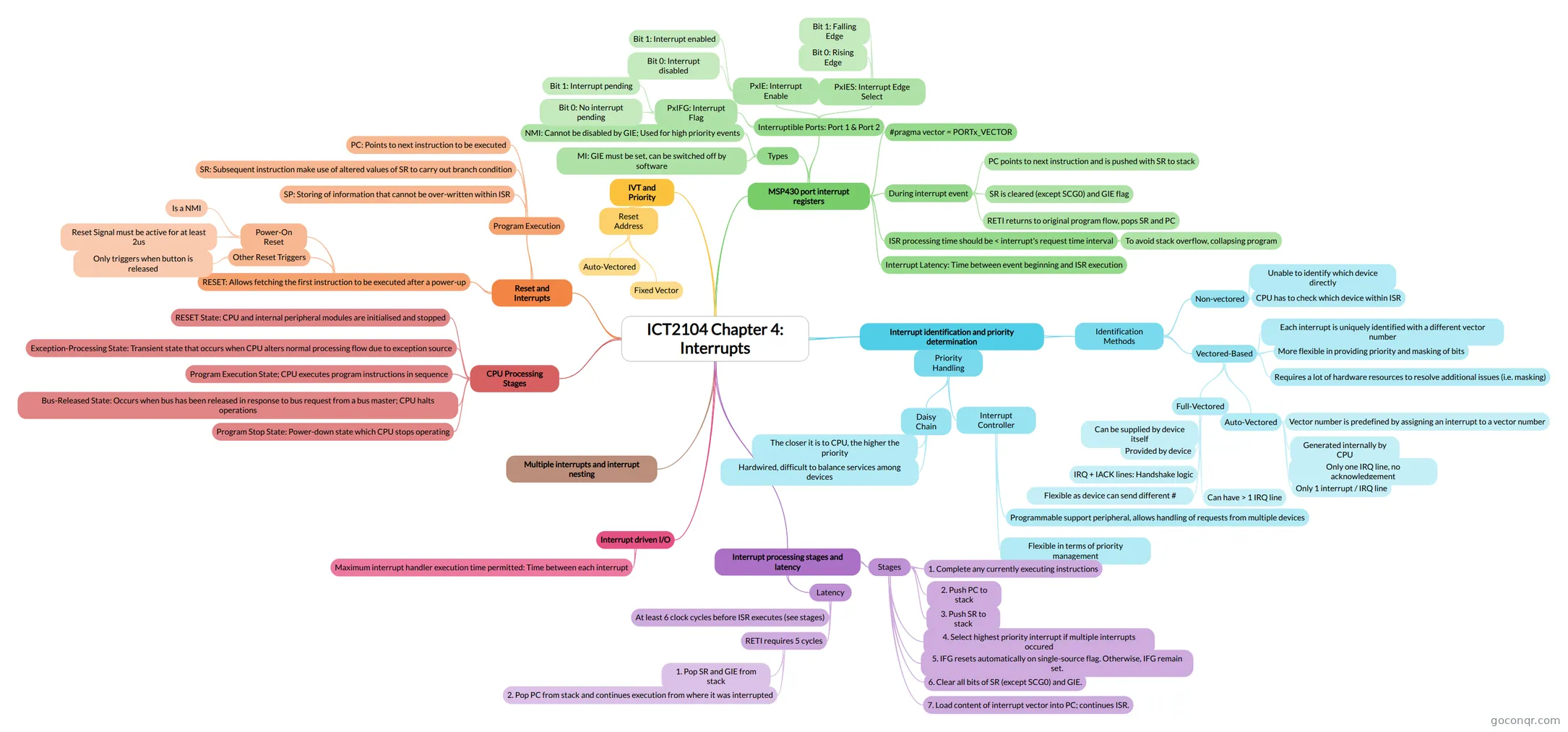 Mind map ICT2104 Chapter 4: Interrupts mind map for ict2104 chapter 4
-
 Mind map Architecture of 8051
-
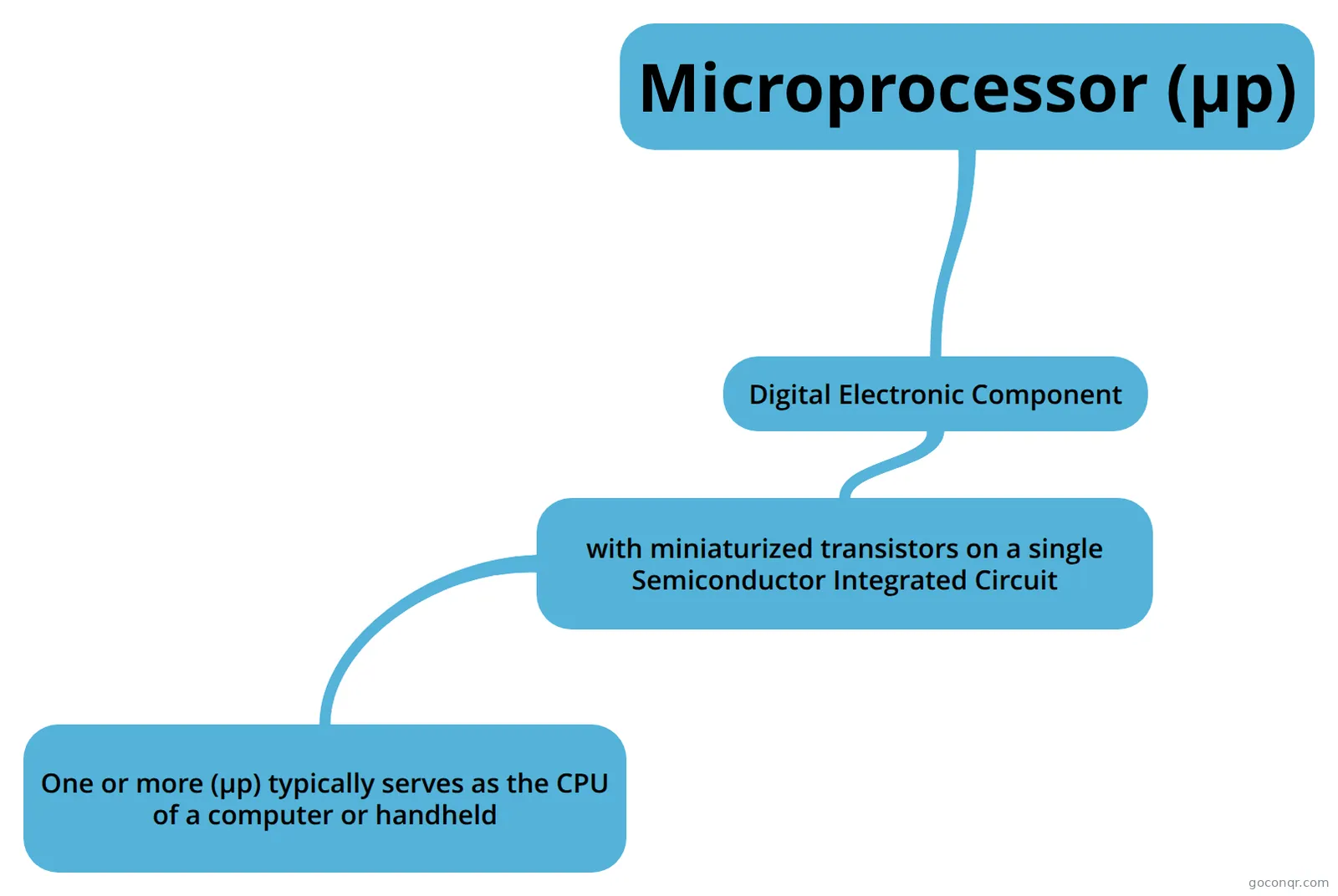 Mind map Microprocessor (µp) Microprocessor and Microcomputer Theory
-
37 cardsEmbarqué Chap2 What is ARM Architecture?
-
Mind map Embedded Systems
-
52 cards01Handout01 It has the capability of executing instructions at an extremely high speed.
-
55 cardsembedded midterm accepts the data signals from the external world into the system which may be directed to any number of des...
-
Mind map PIC Microcontroller Actividad 2.4 En las actividades anteriores del módulo se facilitó información y se incitó a la investigaci...
Quizzes
Mind maps
See all 53 mind maps-
ICT2104 Chapter 4: Interrupts mind map for ict2104 chapter 4
-
Architecture of 8051
-
Microprocessor (µp) Microprocessor and Microcomputer Theory
-
Embedded Systems
-
PIC Microcontroller Actividad 2.4 En las actividades anteriores del módulo se facilitó información y se incitó a la investigaci...
-
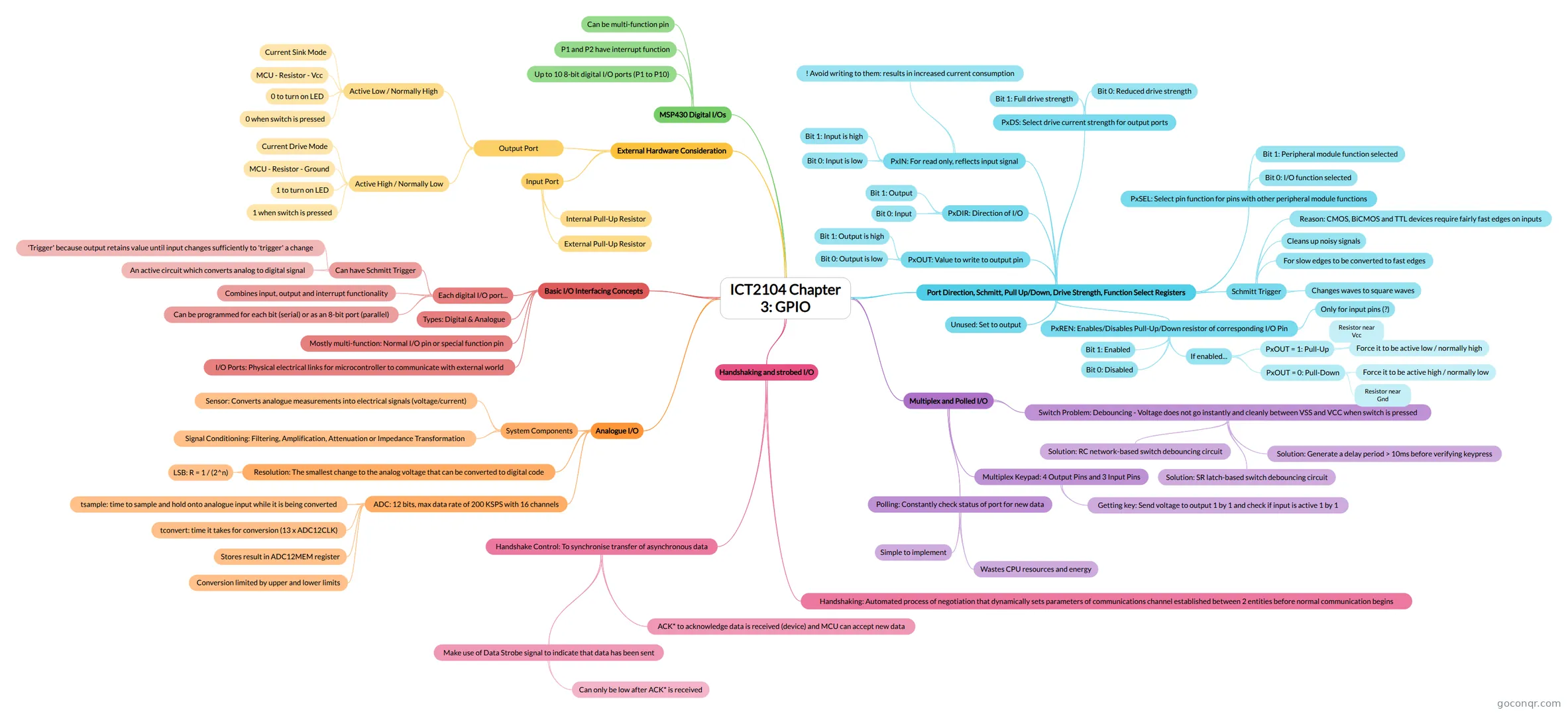 ICT2104 Chapter 3: GPIO mind map for ict2104
-
Programming UART ports
-
PIC18F4550
Flashcards
See all 18 flashcards-
37 cardsEmbarqué Chap2 What is ARM Architecture?
-
52 cards01Handout01 It has the capability of executing instructions at an extremely high speed.
-
55 cardsembedded midterm accepts the data signals from the external world into the system which may be directed to any number of des...
-
12 cardsmbed_exam_p2 List three benefits that the usage of functions can have on the code and/or program development.
-
43 cardsMidterm Study Microprocessor vs Microcontroller
-
10 cardsFPGA vs. Processor, ARM Cortex M - Lecture 3 State the differences between a FPGA and Processor
-
14 cardsEmbedded Systems terms
-
18 cardsArduino interface Basic arduino structure and interaction
Flowcharts
See all 25 flowchartsNotes
-
Program status word(PSW) Flags: 1 bit registers provided to store the status of results of some instruction : It is a flip flop8051 has :-4 math flags: Carry(CY), Auxiliary carry(AC), Overflow(OV), Parity(P)-3 general purpose user flag:1) Car...
-
architecture and features CPU- CPU acts as a mind of any processing machine. It synchronizes and manages all processes that are carried out in a microcontroller INTERRUPTS- Interrupts is a subroutine call that given by the microcontroller...
-
Microcontrollers - creado desde un Mapa Mental Small computer on a single IC Memory CPU I/O Peripherals Flash RAM EEPROM Programs Data SRAM Control Unit Datapath Digital I/O GPIO USB Timer ADC DAC PWM UART DMA Applications Home appliances Office machines Remote co...
-
Program status word(PSW)_1 Flags: 1 bit registers provided to store the status of results of some instruction : It is a flip flop8051 has :-4 math flags: Carry(CY), Auxiliary carry(AC), Overflow(OV), Parity(P)-3 general purpose user flag:1) Car...
-
pin configuraton contn. pin 29- this is PSEN pin which stands for program store enable pin. it is used to read a signal from the external program memory. pin 31- this is a EA pin which stands for external access input. it is used to ena...
-
pin configuraton the 8051 is available in 40 pin dual in line package pin 1-8- these pins are known as port 1. this port doesnt serve any other functions. it is internally pulled up, bi directional input output port. pin 9 is a reset ...
-
CHAPTER 4 - 8086 MICROPROCESSOR - created from Mind Map PIN DIAGRAM DESCRIPTION The microprocessor 8086 is a 16-bit CPU available in different clock rates and packaged in a 40 pin CERDIP or plastic package.DESCRIPTION The microprocessor 8086 is a 16-bit CPU available in di...
Slides
Topics in Microprocessors, Microcontrollers and Embedded Systems
More Electrical and electronic engineering topics
About Microprocessors, Microcontrollers and Embedded Systems
GoConqr OriginalWhat this unit covers
The page brings together material on processors, microcontrollers and the wider idea of embedded systems. The mind map Microprocessor (µp) describes a processor as a digital component built on a single integrated circuit. The map Embedded Systems links firmware, hardware, IoT, network capability and gateways.
Where to start
Begin with the basics. The map Introduction sets out the microcomputer idea: processor, memory, I/O, and the roles of ROM, RAM and EEPROM. Then move to Microcontrollers, which lists the CPU, GPIO, timers, ADC, DAC, PWM, UART and DMA. A note with the same title was created from that map, so you can read it as text.
Going deeper
- 8051: the maps Architecture of 8051 and Features of 8051, plus the note Program status word(PSW), cover the accumulator, program counter, data pointer, stack pointer and flags.
- Interrupts: the MSP430 map on interrupts covers the vector table, priority and port interrupt registers. The flashcards Steps of an Interrupt help you rehearse the sequence.
- Other chips: you will find maps for the PIC16F877X, PIC18F4550 and ATmega128, and flashcards on Arduino and ARM Cortex-M.
- Interfacing: lecture maps cover keyboard scanning, analogue I/O, RS232, SPI and I2C.
Using quizzes and maps together
Read a map first, then take a quiz such as MICRO CONTROLLERS to see what stuck. If a question catches you out, go back to the matching map or flashcard deck. The flowcharts, such as DATA LOGGER, show how ideas become small projects.
Where it fits
This unit sits in the Digital Electronics and Computer Systems strand of Electrical and electronic engineering. Teachers can pull maps and flashcards straight into lessons. Choose one chip or topic, work through its resources, then try writing your own flashcards.
Frequently asked questions
Which resource should I open first?
Start with the mind map Introduction, which covers the microcomputer, memory types and I/O. Then open Microcontrollers for peripherals such as GPIO, timers, ADC and UART. Once those feel familiar, choose a specific chip, such as the 8051, and work through its maps.
What do the mind maps cover?
They cover processor and microcontroller basics, the 8051 architecture and features, MSP430 interrupts, GPIO, PIC and ATmega chips, PWM motor control, UART, SPI and I2C. Some are lecture-based and others are short project maps, such as the automatic water controller.
Are there quizzes on this page?
Yes, there are two quizzes: MICROPROCESSORS Lecture 1 and 2, and MICRO CONTROLLERS. Use them after reading the matching maps to check your understanding. Flashcard decks such as Embedded Systems terms offer extra practice on vocabulary.
Are the resources free to use?
Yes. Every resource listed here is free to open, study and take, with no account needed. A free account also saves your quiz scores and lets you make your own quizzes, mind maps, flashcards and notes.
Who made these resources and what level are they?
They were made by GoConqr users, not by GoConqr, with over 80 contributors. Most are at university level, with a smaller share at secondary level. They suit university students and teachers looking for ready-made material.
What if I can't find the chip or topic I need?
Try related maps first. Many chips share ideas such as interrupts, GPIO and serial communication, so a map on another chip may still help. You can also build your own map or flashcards on the missing topic.