
Mapa mental
Kinetics, Equilibria and Redox
Conteúdo do mapa
Kinetics, Equilibria and Redox
Rates of Reaction
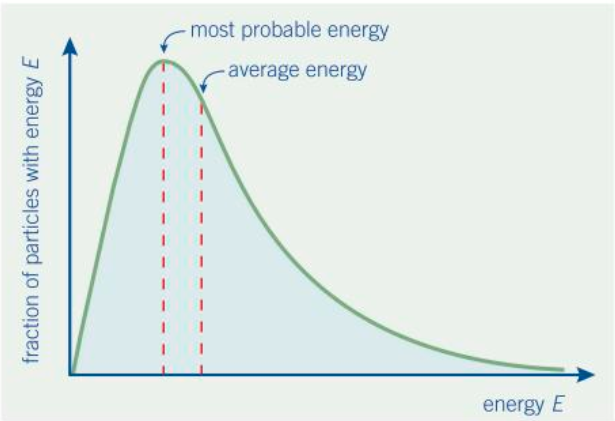
- Maxwell-Boltzmann
- Speed of particles in a gas vary
- Shown on distrubution graph
- Area under curve is equal to total number of molecules / particles
- The peak of curve is the most likely energy of a particle
- Average energy is right of the peak
- No particles have zero energy
- Average energy is right of the peak
- The peak of curve is the most likely energy of a particle
- Speed of particles in a gas vary
- Collision Theory
- To react, particles collide
- Particles only react when they collide if:
- (1) Collide in the correct direction
- (2) Collide with a certain amount of kinetic energy
- (1) Collide in the correct direction
- Particles only react when they collide if:
- Activation Energy (Ea)
- Minumum kinetic energy needed for reaction to occur
- Energy needed to break bonds
- Minumum kinetic energy needed for reaction to occur
- To react, particles collide
- Factors Effecting Rate
- Temperature
- Increases number of molecules with have activation energy
- Shifts curve to the right with a larger area having activation energy
- Also increases the frequency of successful collisions in the reaction
- Increases number of molecules with have activation energy
- Concentration
- Increases frequency of more successful collision, increases rate
- Pressure
- Does the same as concentration only in gases
- Catalysts
- Increases rate by providing an alternative route for the reaction that has a lower activation energy
- Catalysts are chemically unchanged
- Increases the area of curve with correct activation energy without moving the curve itself
- Increases rate by providing an alternative route for the reaction that has a lower activation energy
- Temperature
- Measuring Rate
- Rate is the change in conc. of product or reactant over time
- Timing how long it takes for precipitate to form
- Subjective - relies on a persons judgement
- Measuring the decrease in mass
- Easy and accurate
- Measuring the volume of gas given off
- Very accurate
- Maxwell-Boltzmann
Equilibrium Constant
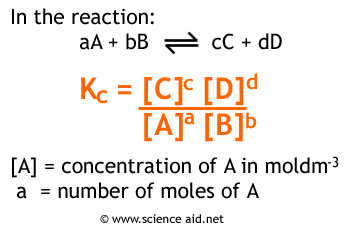
- Kc is the Equilibrium Constant
- Concs of A,B,C,D given in mol/dm^3
- Whatever value for a,b,c,d units to the power of these values
- Concs of A,B,C,D given in mol/dm^3
- Calculations
- Calculating Equili concs
- conc = mole / vol
- Use kc to work conc
- Use Kc to work out conc in mixture
- Enter values into the Kc
- Check molar ratio, 1:1 concs equal
- Rearrange Kc equation
- Check molar ratio, 1:1 concs equal
- Enter values into the Kc
- Use Kc to work out conc in mixture
- Use kc to work conc
- conc = mole / vol
- Calculating Equili concs
- Temperature changes Kc
- Kc only valid for one temperature
- If a temperature rise increases product
- Kc will rise
- Catalysts don't affect Kc
- Kc will rise
- If a temperature rise increases product
- Kc only valid for one temperature
- Kc is the Equilibrium Constant
Redox
- Oxidation States (OS)
- Total number of electrons donated or accepted by a element
- Uncombined elements and diatomic have OS of 0
- OS of ion or compound ion is the same as its charge
- Sum of OS in a neutral compounds is 0
- Oxygen is nearly always -2
- Hydrogen is nearly always +1
- Oxygen is nearly always -2
- Sum of OS in a neutral compounds is 0
- OS of ion or compound ion is the same as its charge
- Uncombined elements and diatomic have OS of 0
- Total number of electrons donated or accepted by a element
- Electrons transfered is a redox reaction
- OILRIG (of electrons)
- Oxidising agent accepts electrons itself is reduced
- Reducing agent donates electrons itself is oxidised
- Oxidising agent accepts electrons itself is reduced
- OILRIG (of electrons)
- Half Equations
- Combine half equations to form redox equations
- Balance equations by CHO and equal electrons
- Combine half equations to form redox equations
- Oxidation States (OS)
Reversible Reactions
- Resersible reactions can reach dynamic equilibrium
- This is when the reaction is at equilibrium
- Where forward and backwards reactions are at the same rate
- And the concentrations are equal and constant
- Where forward and backwards reactions are at the same rate
- Only in closed systems
- (nothing added, nothing lost)
- This is when the reaction is at equilibrium
- Le Chatelier's Principle
- A reaction at equilibrium will shift to oppose any change
- Concentration
- E.g. Increase conc. of reactant, shifts to make more product
- Pressure
- Only involving gases
- Increase pressure, shifts to the side with the least moles
- to reduce pressure
- Increase pressure, shifts to the side with the least moles
- Only involving gases
- Temperature
- Increase temp, shift to endothermic side (+ delta H)
- Catalysts
- No effect on position of equilibrium, doesnt increase yield either
- Faster to reach equilibrium
- No effect on position of equilibrium, doesnt increase yield either
- Reactions in industry
- Balancing high rates with high reaction costs
- High pressure increases rate
- Increasing the pressure too much is expensive to run / maintain
- High temperatures increase rate
- Low temperatures may be needed to oppose exothermic reactions for high yield
- But need a good rate to make product in a good time
- Compromise is required
- But need a good rate to make product in a good time
- Low temperatures may be needed to oppose exothermic reactions for high yield
- High pressure increases rate
- Balancing high rates with high reaction costs
- Concentration
- A reaction at equilibrium will shift to oppose any change
- Resersible reactions can reach dynamic equilibrium
Imagens e arquivos do mapa
Informações
- Descrição
- A2 Chemistry (Physical 1) Mapa Mental sobre Kinetics, Equilibria and Redox, criado por Dominic Weston em 07-02-2018.
- Criado por
- Dominic Weston
- Visualizações
- 190
- Avaliação