
Mapa mental
Transcription
Mind map: transcription
Conteúdo do mapa
Transcription
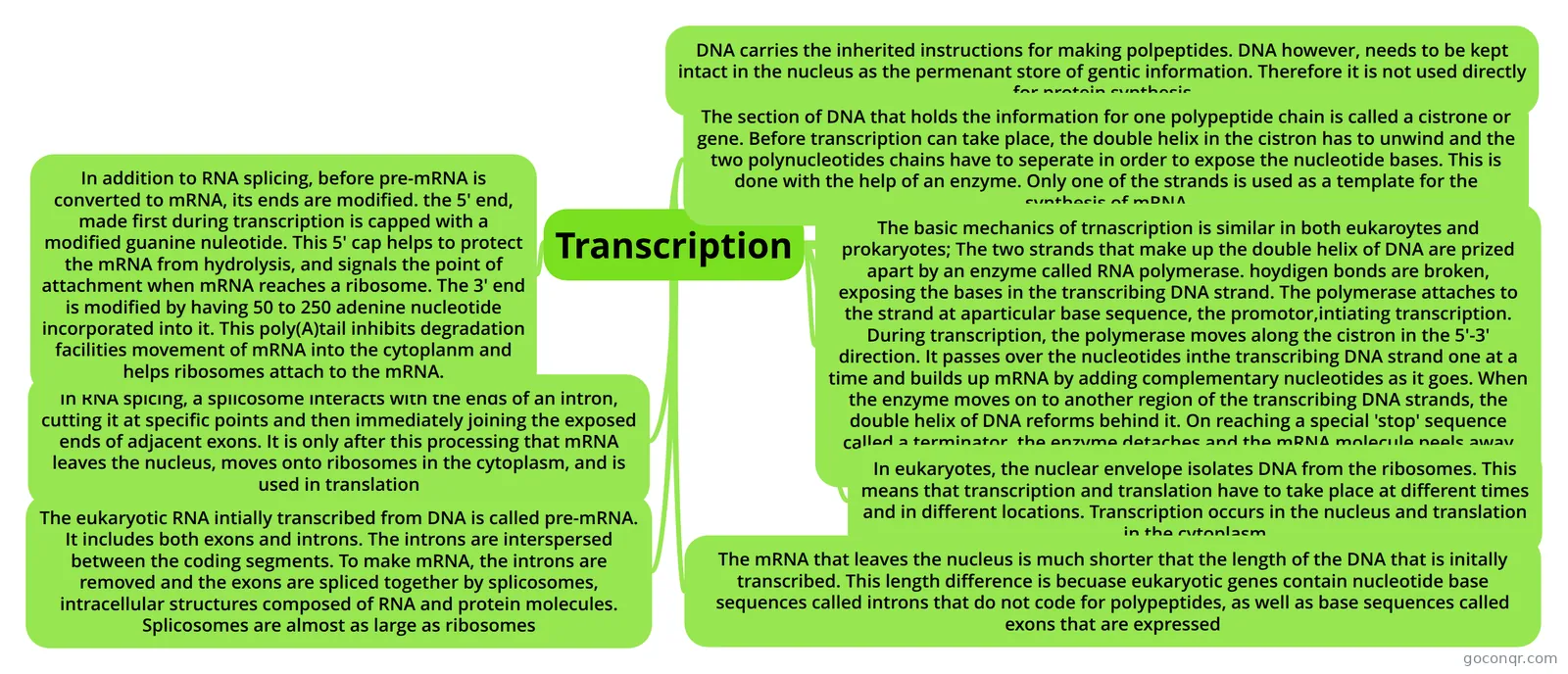
DNA carries the inherited instructions for making polpeptides. DNA however, needs to be kept intact in the nucleus as the permenant store of gentic information. Therefore it is not used directly for protein synthesis
The section of DNA that holds the information for one polypeptide chain is called a cistrone or gene. Before transcription can take place, the double helix in the cistron has to unwind and the two polynucleotides chains have to seperate in order to expose the nucleotide bases. This is done with the help of an enzyme. Only one of the strands is used as a template for the synthesis of mRNA
The basic mechanics of trnascription is similar in both eukaroytes and prokaryotes; The two strands that make up the double helix of DNA are prized apart by an enzyme called RNA polymerase. hoydigen bonds are broken, exposing the bases in the transcribing DNA strand. The polymerase attaches to the strand at aparticular base sequence, the promotor,intiating transcription. During transcription, the polymerase moves along the cistron in the 5'-3' direction. It passes over the nucleotides inthe transcribing DNA strand one at a time and builds up mRNA by adding complementary nucleotides as it goes. When the enzyme moves on to another region of the transcribing DNA strands, the double helix of DNA reforms behind it. On reaching a special 'stop' sequence called a terminator, the enzyme detaches and the mRNA molecule peels away from the DNA
In eukaryotes, the nuclear envelope isolates DNA from the ribosomes. This means that transcription and translation have to take place at different times and in different locations. Transcription occurs in the nucleus and translation in the cytoplasm
The mRNA that leaves the nucleus is much shorter that the length of the DNA that is initally transcribed. This length difference is becuase eukaryotic genes contain nucleotide base sequences called introns that do not code for polypeptides, as well as base sequences called exons that are expressed
The eukaryotic RNA intially transcribed from DNA is called pre-mRNA. It includes both exons and introns. The introns are interspersed between the coding segments. To make mRNA, the introns are removed and the exons are spliced together by splicosomes, intracellular structures composed of RNA and protein molecules. Splicosomes are almost as large as ribosomes
In RNA spicing, a splicosome interacts with the ends of an intron, cutting it at specific points and then immediately joining the exposed ends of adjacent exons. It is only after this processing that mRNA leaves the nucleus, moves onto ribosomes in the cytoplasm, and is used in translation
In addition to RNA splicing, before pre-mRNA is converted to mRNA, its ends are modified. the 5' end, made first during transcription is capped with a modified guanine nuleotide. This 5' cap helps to protect the mRNA from hydrolysis, and signals the point of attachment when mRNA reaches a ribosome. The 3' end is modified by having 50 to 250 adenine nucleotide incorporated into it. This poly(A)tail inhibits degradation facilities movement of mRNA into the cytoplanm and helps ribosomes attach to the mRNA.
Informações
- Descrição
- A-Levels Biology 5 (Nucleic acids, Genetic code and Mutations) Mapa Mental sobre Transcription, criado por harry_bygraves em 15-06-2013.
- Criado por
- harry_bygraves
- Visualizações
- 137
- Tags
- Avaliação