
Mapa mental
Aetiologies of Depression
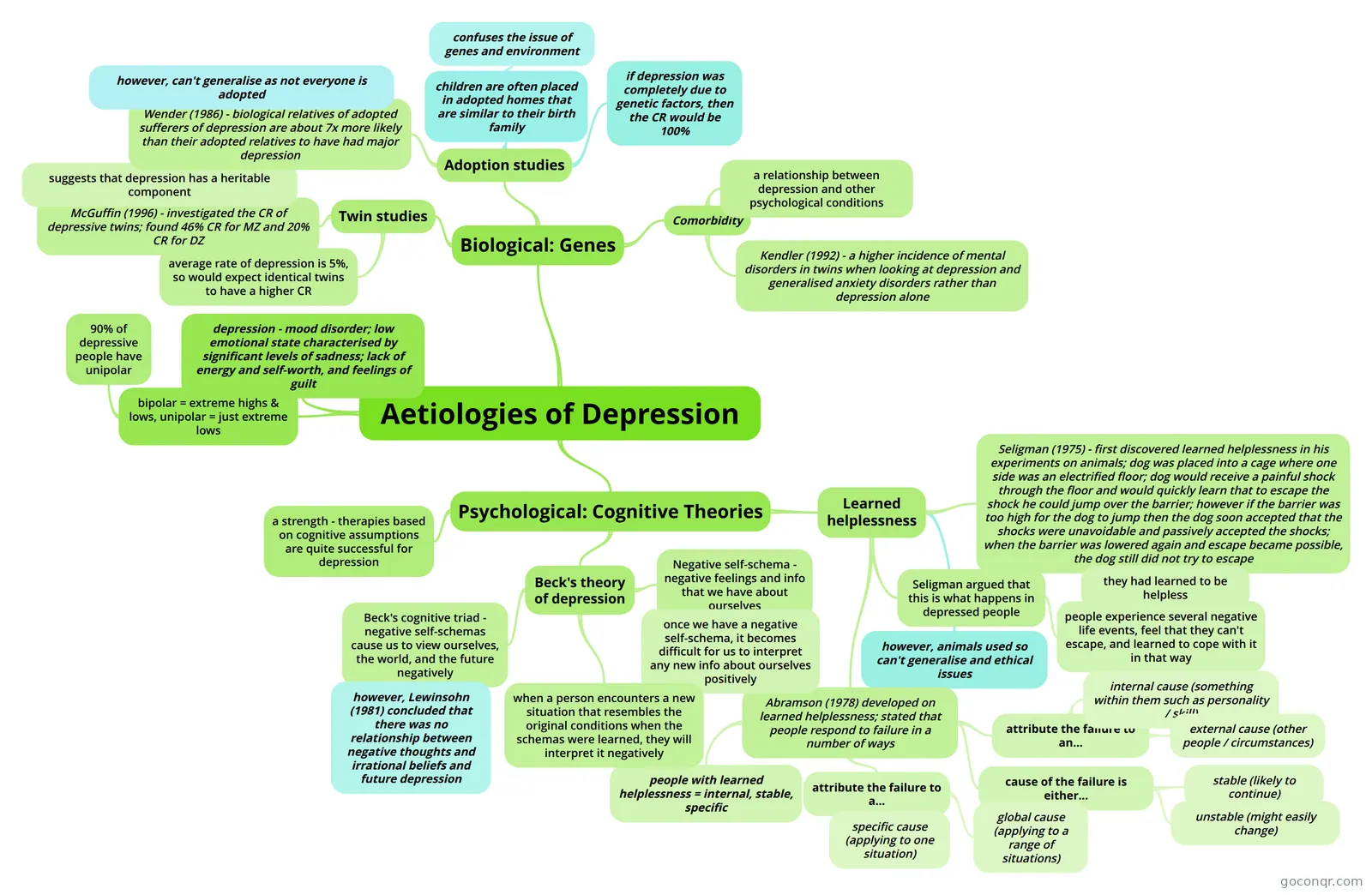
Mind map: aetiologies of depression
Conteúdo do mapa
Aetiologies of Depression
depression - mood disorder; low emotional state characterised by significant levels of sadness; lack of energy and self-worth, and feelings of guilt
bipolar = extreme highs & lows, unipolar = just extreme lows
- 90% of depressive people have unipolar
Biological: Genes
- Twin studies
- average rate of depression is 5%, so would expect identical twins to have a higher CR
- McGuffin (1996) - investigated the CR of depressive twins; found 46% CR for MZ and 20% CR for DZ
- suggests that depression has a heritable component
- Adoption studies
- Wender (1986) - biological relatives of adopted sufferers of depression are about 7x more likely than their adopted relatives to have had major depression
- however, can't generalise as not everyone is adopted
- children are often placed in adopted homes that are similar to their birth family
- confuses the issue of genes and environment
- if depression was completely due to genetic factors, then the CR would be 100%
- Wender (1986) - biological relatives of adopted sufferers of depression are about 7x more likely than their adopted relatives to have had major depression
- Comorbidity
- a relationship between depression and other psychological conditions
- Kendler (1992) - a higher incidence of mental disorders in twins when looking at depression and generalised anxiety disorders rather than depression alone
- Twin studies
Psychological: Cognitive Theories
- Learned helplessness
- Seligman (1975) - first discovered learned helplessness in his experiments on animals; dog was placed into a cage where one side was an electrified floor; dog would receive a painful shock through the floor and would quickly learn that to escape the shock he could jump over the barrier; however if the barrier was too high for the dog to jump then the dog soon accepted that the shocks were unavoidable and passively accepted the shocks; when the barrier was lowered again and escape became possible, the dog still did not try to escape
- they had learned to be helpless
- Seligman argued that this is what happens in depressed people
- people experience several negative life events, feel that they can't escape, and learned to cope with it in that way
- however, animals used so can't generalise and ethical issues
- Abramson (1978) developed on learned helplessness; stated that people respond to failure in a number of ways
- attribute the failure to an...
- internal cause (something within them such as personality / skill)
- external cause (other people / circumstances)
- cause of the failure is either...
- stable (likely to continue)
- unstable (might easily change)
- attribute the failure to a...
- global cause (applying to a range of situations)
- specific cause (applying to one situation)
- people with learned helplessness = internal, stable, specific
- attribute the failure to an...
- Seligman (1975) - first discovered learned helplessness in his experiments on animals; dog was placed into a cage where one side was an electrified floor; dog would receive a painful shock through the floor and would quickly learn that to escape the shock he could jump over the barrier; however if the barrier was too high for the dog to jump then the dog soon accepted that the shocks were unavoidable and passively accepted the shocks; when the barrier was lowered again and escape became possible, the dog still did not try to escape
- Beck's theory of depression
- Negative self-schema - negative feelings and info that we have about ourselves
- once we have a negative self-schema, it becomes difficult for us to interpret any new info about ourselves positively
- when a person encounters a new situation that resembles the original conditions when the schemas were learned, they will interpret it negatively
- Beck's cognitive triad - negative self-schemas cause us to view ourselves, the world, and the future negatively
- however, Lewinsohn (1981) concluded that there was no relationship between negative thoughts and irrational beliefs and future depression
- Negative self-schema - negative feelings and info that we have about ourselves
- a strength - therapies based on cognitive assumptions are quite successful for depression
- Learned helplessness
Informações
- Descrição
- A-Levels PY4 (Abnormal Psychology) Mapa Mental sobre Aetiologies of Depression, criado por Hayd23 em 15-06-2013.
- Criado por
- Hayd23
- Visualizações
- 616
- Tags
- Avaliação